


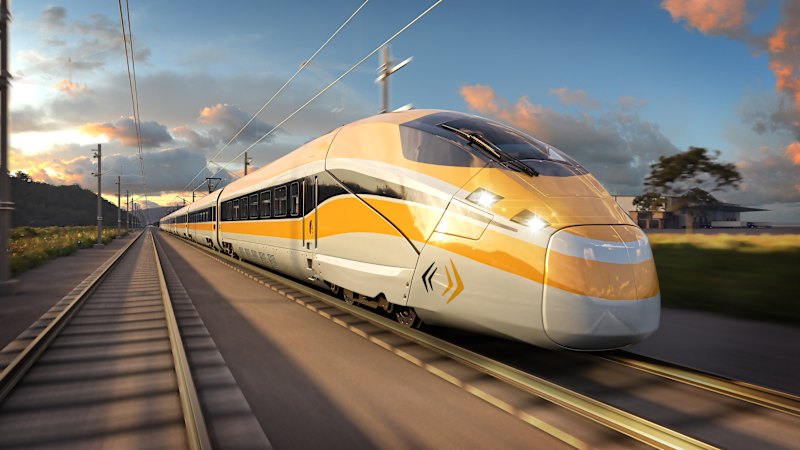
A high-speed rail link between Sydney and Newcastle would cost up to $90 billion, significantly higher than initial estimates for the mega=project, with federal taxpayers likely to carry most of the financial burden.
This masthead can reveal that the project, which would be Australia’s first stretch of high-speed rail, is on track to be the most expensive individual piece of infrastructure ever funded by the federal government.
The business case for the 191-kilometre project, which both sides of politics have supported since it emerged during the 2022 election campaign, is due to be released within days.
Prime Minister Anthony Albanese on Tuesday revealed an announcement on the project would be made “in a couple of weeks” while making clear his support for the concept.
Albanese said he supported high-speed rail, not just between Sydney and Newcastle but across the east coast.
“I think that it absolutely makes sense. We’re the only inhabited continent on Earth that doesn’t have high-speed rail,” he told ABC.
“And certainly Newcastle to Sydney to Canberra to Melbourne, makes absolute sense. It’s where most of our population is along that corridor. And what makes it financially viable is the economic development along the route.”
The NSW government has previously estimated it could cost as much as $32 billion to build a fast train line from Sydney to the Central Coast.
But fresh analysis by the High Speed Rail Authority now puts the total bill of a line that extends all the way to Newcastle at somewhere between $70 billion and $90 billion.
The authority argues the Sydney-Newcastle rail corridor is the busiest in the country with more than 15 million passenger movements a year. It is expected to reach capacity by the early 2040s.
Geotechnical work has recently been completed to identify the best route between Sydney and Newcastle. Of the new rail link, an estimated 115 kilometres would be in tunnels, 41 kilometres on surface tracks and 38 kilometres over bridges and viaducts.
Trains would run at up to 320 kilometres an hour, reducing the current 2½-hour travel time to about an hour. Each train, the authority has argued, could be up to 200 metres long and carry 520 passengers.
The federal government is likely to pick up almost the entire bill for the project. Proponents argue that the huge cost will be offset by development opportunities, particularly in Newcastle, which offers much cheaper housing and land than Sydney.
NSW Premier Chris Minns said his government was not willing to commit funding to high-speed rail “at the moment” because it had its hands full completing the biggest infrastructure projects in the country.
“We’re spending $30 billion this year on public infrastructure, and I’ve said it a lot, but we’re well out over our speeds when it comes to that kind of spending,” he said on Tuesday.
Last November, Minns said he would not hand over a blank cheque for the project but would be willing to fast-track planning and ensure access to existing railway and easements.
NSW is in the midst of an expensive metro rail line construction program, which is on track to top $71 billion. All but a 23-kilometre metro rail line to Sydney’s new international airport is funded by the state government.
The rail authority’s preferred option is also to build a Newcastle-Sydney line in three stages, with 12 years of construction starting next year on the line between Newcastle and the Central Coast.
It would be followed by the next stage to the Sydney CBD by 2039, and Parramatta and Western Sydney Airport by 2042.
Releasing a business case and early planning will be the most advanced a project has been for a high-speed train in Australia’s long history of rail infrastructure, which includes proposals examined by the Hawke and Howard governments in the 1980s and 1990s. The former NSW government of Gladys Berejiklian commissioned a study into high-speed rail links to Newcastle, Wollongong and regional centres, but it was never released.
Such a large project would put pressure on NSW’s already strained supply of engineers and construction workers.
The International Monetary Fund this week warned that while the federal government’s finances were sound, growing debt levels held by the states were an emerging risk. NSW’s gross debt is on track to reach $177 billion this year.
According to the fund, one of the biggest risks is cost blowouts associated with major construction projects.
“Should state spending continue to accelerate, risks include inefficiency due to rising construction costs and additional credit rating downgrades leading to higher interest expenses,” it warned.
Cut through the noise of federal politics with news, views and expert analysis. Subscribers can sign up to our weekly Inside Politics newsletter.
 Shane Wright is a senior economics correspondent for The Age and The Sydney Morning Herald.Connect via X or email.
 Matt O’Sullivan is transport and infrastructure editor at The Sydney Morning Herald.Connect via X or email.