







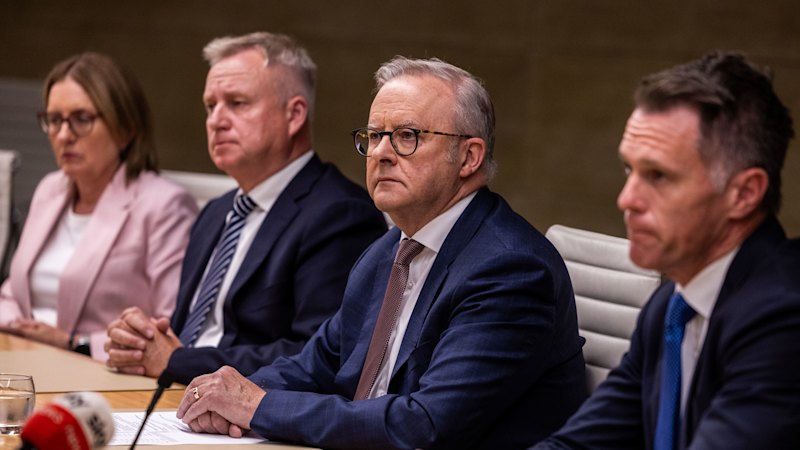


Motorists could see petrol prices fall an extra 6¢ a litre almost immediately after the premiers and chief ministers finally agreed to a change to the GST on unleaded and diesel, but there are warnings it could ultimately leave state taxpayers worse off.
Western Australian Premier Roger Cook on Thursday confirmed that premiers and chief ministers had signed off on the change that combined with the federal government’s own cut to fuel excise will save motorists 32¢ a litre until June 30.
The surge in petrol and diesel prices is delivering the states and territories a GST windfall estimated at $400 million a month. The 10 per cent tax is imposed on the retail price of liquid fuel, which has meant a big increase in GST collections since the war in Iran began.
At this week’s national cabinet meeting, premiers and chief ministers agreed to forgo the windfall. Prime Minister Anthony Albanese, who announced federal fuel excise would be cut for three months, said it was up to the states to come up with their own way to implement the idea.
Most states, bar Queensland and Victoria, immediately backed a further cut in excise equal to the extra GST collected since prices spiked.
Victoria dropped its position on Wednesday, but Queensland held out until Thursday morning.
Cook said after a meeting of the Council for the Australian Federation, which is made up of state and territory leaders, a unanimous agreement had been reached.
The decision means that on top of the halving of excise, worth 26¢ a litre, another 6¢ a litre will be sliced from liquid fuel prices.
“State and territory leaders were united today in our desire to assist the prime minister to deliver real relief at the bowser,” Cook said.
“We know the price of petrol drives up inflation through higher transportation costs for almost everything else in our economy.
“Putting downward pressure on the price of petrol puts downward pressure on the price of food and costs for business.”
Fuel prices started falling at most service stations on Wednesday when the 26¢-a-litre cut in excise officially began. The extra 6¢ is expected to flow through to pump prices just as fast.
Albanese, speaking at the National Press Club, said the move would alleviate some of the price pressures faced by families caused by the war in Iran.
“This will mean a combined saving of 32¢ on every litre. Treasurer, Jim Chalmers, has already signed that change in the law, because we want this added relief to start showing up at petrol stations straight away for our truckies,” he said.
Queensland Treasurer David Janetzki defended his state’s role in the delay to the arrangement being signed off.
“From the beginning it has been Queensland’s position to forgo windfalls from higher fuel prices, and how this can be calculated, collected and distributed has been facilitated following today’s meeting,” he said.
The deal is a political win for NSW Premier Chris Minns who led the push for a simple adjustment in excise rather than alternatives, including different excise rates among the states, which were likely to be unconstitutional.
“We welcome the agreement to return the extra GST collected on higher fuel prices back to motorists. It’s some relief to drivers and helps take the edge off higher fuel costs,” Minns said.
But researchers for independent think tank e61, Lachlan Vass and Josh Clyne, said the estimated $400 million windfall was likely illusory.
They said that while motorists were paying more GST because of the increase in petrol prices, they were likely reducing their expenditure on other goods and services that would attract the GST.
“Households will respond to the price signal of higher fuel prices partially by reducing the amount of fuel they buy, and partially by adjusting how much they spend on other products,” they said.
“Applying standard elasticities of demand across products, we estimate that the windfall GST gain may fully disappear once accounting for consumer behavioural responses.”
Vass and Clyne said if the states offered their own cost-of-living relief, such as the decision by Victoria and Tasmania to make public transport free, their budget positions would likely deteriorate given the absence of a GST windfall.
Cut through the noise of federal politics with news, views and expert analysis. Subscribers can sign up to our weekly Inside Politics newsletter.


