


Students have called on citizens to march towards the campus to break the siege on Tuesday evening.
The involvement of students is a significant development in the protests. Universities in Iran have historically served as launching points for major political upheavals, including the 1979 Islamic Revolution, the 2009 Green Movement, which challenged disputed election results, and the 2022 Woman, Life, Freedom protests sparked by the death of Amini.
Female students of at least one university removed their mandatory headscarves, waved them in the air, and called for Khamenei’s death, while others compared the Islamic Revolutionary Guard Corps to Islamic State.
At least five students were arrested while others chanted “freedom” in Persian and “neither Gaza nor Lebanon, I sacrifice myself for Iran”. Video footage showed students tearing down a sign for Khamenei’s representative office on campus and throwing it to the ground.
Residents in several Tehran neighbourhoods and nearby cities told The Telegraph that armed forces had blocked roads as night fell and had clashed with students calling for the overthrow of Khamenei.
Ahmadreza, a resident of Malard, said: “Their motorcycle patrols have been all over the city all day. They also set up checkpoints and raid any gathering of people, even if it’s not a protest – there have been heavy movements of forces now.”

Iranian Supreme Leader Ayatollah Ali Khamenei meets students in Tehran in November.Credit: AP
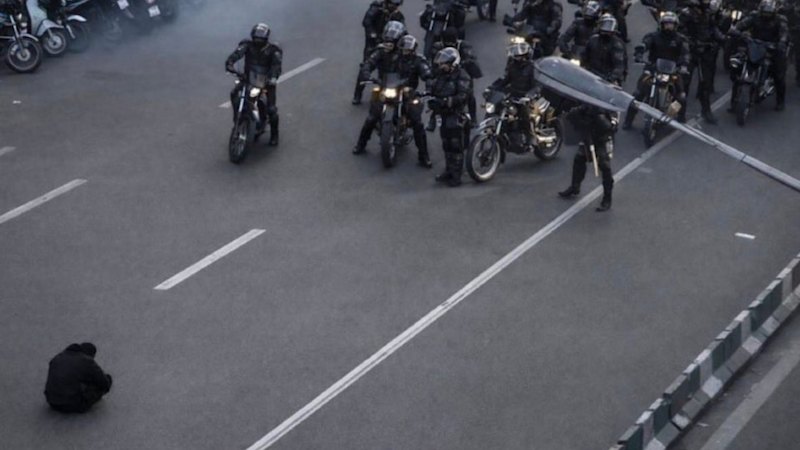
Widely circulated video from central Tehran on Monday showed one protester sitting down in the middle of Jomhouri Street, refusing to move as security forces on motorcycles advanced before beating him.
The protests began on Sunday afternoon after mobile phone and electronics shopkeepers in Tehran shut their stores as the rial fell to a record low of 1.45 million to the US dollar – a 40 per cent drop since June.
The crisis prompted the resignation of a member of President Masoud Pezeshkian’s information council on Tuesday. He said he could no longer defend the government.
Mehdi Beyk, the political editor of the reformist Etemad newspaper, went missing after travelling to protest sites to report on the demonstrations, according to his wife, Zahra Soleimani.

People hold signs and chant slogans during a 2022 protest against the death of Iranian Mahsa Amini.Credit: Getty Images
Iranian authorities have routinely arrested journalists during protest movements while characterising the unrest as foreign-instigated sedition.
Authorities announced that a lockdown would be enforced across the country on Wednesday, citing expected cold weather and a need to conserve energy. All government offices, markets, schools, universities and banks will be closed.
The intelligence organisation of the Islamic Revolutionary Guard Corps had sent text messages to Tehran residents, warning that their presence near “illegal gatherings” had been “monitored by intelligence” and urging them to avoid such events. Several pro-regime rallies were also held in Tehran.
Loading
Iran’s currency collapse is compounding severe inflation. The state statistics centre reported inflation reached 42.2 per cent in December, up 1.8 percentage points from November. Food prices surged 72 per cent, and health and medical items rose 50 per cent compared to the same period last year.
Unemployment plagues young people, who have spent years studying for futures that no longer exist. Many university graduates end up driving taxis or working in coffee shops if they can find jobs at all.
Families across the country rely on government ration cards just to buy basic foods such as rice and bread. Once a cornerstone of the Islamic Republic’s social contract, the subsidy system has become unreliable after millions of people were removed from the list.
Economic hardship is made worse by environmental problems. In Tehran and other major cities, children often stay at home from school when air pollution reaches dangerous levels.
Loading
Farmers in central and eastern provinces watch their lands turn to dust as drought, worsened by climate change and poor water management, dries up rivers and aquifers.
Mahmoud, a taxi driver in Karaj, near Tehran, told The Telegraph: “I’m sure we haven’t eaten red meat since [the Persian New Year] in March, and it’s the same for many people I know.
“When things started getting expensive, we switched to chicken, then to eggs. Now we can’t even afford that. People are angry – very angry. They say it’s better to die on the path to freedom than to die at home from anger.”
Merchants in Tehran’s Grand Bazaar, a traditional barometer of public sentiment whose closures have historically signalled serious political trouble for Iranian governments, shut their shops.
Mohesen, a shopkeeper at the bazaar, said: “The common pain is that if we close our shops, our profit is more than when we sell goods, because tomorrow we cannot buy anything at today’s price.
“Even if we wanted to, we cannot carry on under the current situation. People are angry and hungry, and our sales have dropped sharply this year.”
Videos from western Kermanshah showed merchants shouting “close it” as they urged shop owners to join the strike.
The government’s response has mixed repression with attempted conciliation. Security forces issued threats while Pezeshkian, a relative moderate, promised dialogue. The Islamic Revolutionary Guard Corps warned against “sedition” and said it would “stand powerfully against any unrest or miscalculation by enemies”.
State media acknowledged the protests, but said shopkeepers were concerned only about economic conditions.
Loading
Fatemeh Mohajerani, a government spokesperson, said the authorities were taking the demonstrations seriously, acknowledging the public’s concerns over inflation and the cost of living.
“The demands of the Iranian people are clear and legitimate, and we are listening to them, and we recognise them,” she said.
Vice President Jafar Ghaem Panah apologised to citizens on Tuesday for soaring inflation and economic hardship.
