


A decade ago, when I was living in Moscow, my Russian teacher explained to me her standard procedure if ever she was pulled over by traffic police. She would swiftly take off any visible jewellery and hide it. Then she’d take out whatever cash was in her wallet, leaving only a 100 rouble note. That way, when the police requested a bribe in return for letting her off a fine (as they invariably did), she could show the meagre contents of her wallet. They’d grudgingly accept the 100 roubles (the equivalent of around $30 back then) and she’d be on her way.

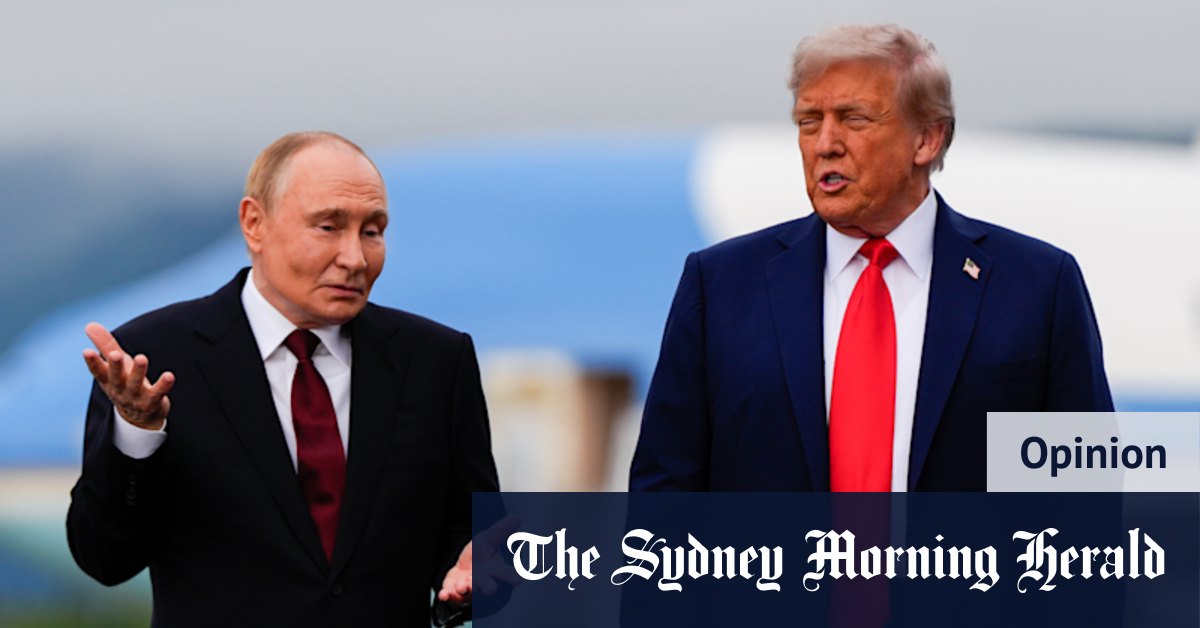
US President Donald Trump and Russia’s President Vladimir Putin met in Alaska in August.Credit: AP
Far from being outraged about this, my teacher was perfectly content with this system and said most Russians she knew were too. It saved the hassle of dealing with the bureaucracy involved in paying or contesting a fine. It probably worked out cheaper too. Widespread bribery and corruption, from the pettiest level up, was a mundane fact of life in Vladimir Putin’s Russia and was accepted with little more than a shrug.
While the narrative in the US focuses on America’s collapse into authoritarianism under Donald Trump, less is written about its descent into a Putin-style kleptocracy. Meaning “rule of thieves”, kleptocracy is a style of governance that Putin has perfected over his five presidential terms. British financier Bill Browder, formerly the largest foreign investor in Russia, believes Putin and his cronies have stolen as much as a trillion dollars from the Russian people.
Evidence that Trump is taking cues from the Kremlin’s crooked-regime-building playbook is in plain sight. American academic Karen Dawisha’s 2014 book Putin’s Kleptocracy – Who owns Russia? analysed the methods Putin used to systematically build a corrupt state, including bribe taking, kickbacks, election-fixing, the persecution of political enemies and total dominance over ultra-wealthy citizens. Recent actions undertaken by the White House reveal disturbing similarities between the Russian mafia state and the Trump administration.
In May, Trump hosted a private dinner for the top 25 investors in his $TRUMP meme coin. The final guest list spent an estimated $US148 million ($227 million) for their meal and presidential access. The top holder of Trump’s meme coin on the night (to the tune of $US18.5 million) was crypto entrepreneur and billionaire Justin Sun, who had been under investigation for fraud by the Securities and Exchange Commission. Sun also invested $US75 million in World Liberty Financial, the Trump’s family’s cryptocurrency company. The SEC halted its fraud case against him earlier this year.
In April, Trump’s family company, the Trump Organization, announced that it had signed a deal to build a luxury golf resort in Qatar. In May, Qatar gifted a $400 million jet to Trump viewed by many as a kickback. In early October, the Pentagon announced that a Qatari air force facility will be built in Idaho.
Loading
Then there’s election-fixing. A Department of Justice report released in January found Trump would have been convicted of illegally trying to overturn the 2020 election had he not been re-elected in 2024. The criminal case was dropped due to a longstanding policy against prosecuting a sitting president.
The persecution of political enemies has also begun in the Kremlin-on-the-Potomac. Investigations are under way into Democrat Senator Adam Schiff (who led the first impeachment trial against Trump) and former special counsel Jack Smith (who led the January 6 investigations into Trump). Former FBI director James Comey (head of the 2016 Russia investigation) and New York Attorney General Letitia James (who successfully prosecuted Trump for business fraud) have both been indicted by the Department of Justice, under direct pressure from Trump.
