








“The investment that both Australia and the UK have made into the program has allowed us to set a capability for generations to come.
“We will have cutting-edge, brand new, state-of-the-art facilities to realise the AUKUS ambition. The extra capacity that goes into the industry, within the company and in the supply chain, allows us to become more resilient and more capable.

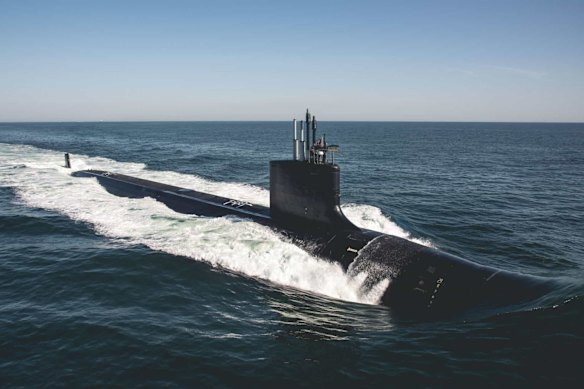
A US Virginia-class submarine.Credit: US Defence
“That’s why I’m really confident we’ll get there.”
The main US contribution to AUKUS is its agreement, currently under review, to sell three Virginia-class submarines to Australia and to continue sharing nuclear propulsion work with the UK under co-operation that began in the 1950s.
The UK will make a far greater contribution over time because it is due to build 12 of the next-generation submarines using a shared design with Australia, which is to produce five of these SSN-AUKUS vessels.
Australia will pay Rolls-Royce about $5 billion over the coming decade to develop the power systems, in a proportional contribution with the British government.
Palmer, who has been at the company for 38 years, said the first components of the power plants would be sent to Australia by 2029 to prepare for the construction of the vessels in the 2030s.
The reactors at the heart of these systems represent a new generation of the technology, he said, and were an “evolution” on work over the past 25 years to create power plants that do not need to be restocked with nuclear fuel.
“A teaspoon of uranium will allow a submarine to circumnavigate the globe, so we have enough fuel in there to last the lifetime of the submarine,” he told this masthead in an interview.
Rolls-Royce began developing nuclear power plants for submarines in the 1950s and has delivered 30 naval nuclear power plants over time.
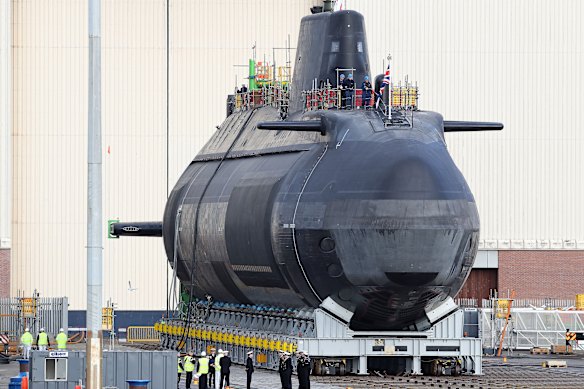
An Astute-class nuclear-powered submarine, HMS Audacious, is built at the BAE Systems complex in Burrow-in-Furness, England.Credit: Getty
While the Australian debate about AUKUS focuses on the capability gap against China if the submarines are not built on time, the British concerns centre on the threat from Russia in the North Atlantic.
The UK is currently building two types of submarines, both using Rolls-Royce nuclear power plants. The Astute class has conventional weapons and the Dreadnought class has nuclear ballistic missiles. The UK needs to build one submarine every 18 months to remain on track to deliver the AUKUS-class on time.
Dr Sidharth Kaushal, a senior research fellow at the Royal United Services Institute, has warned that a delay to the next-generation fleet would leave the UK exposed to Russian submarines that could slip past defences in the gap between Scotland, Iceland and Greenland.
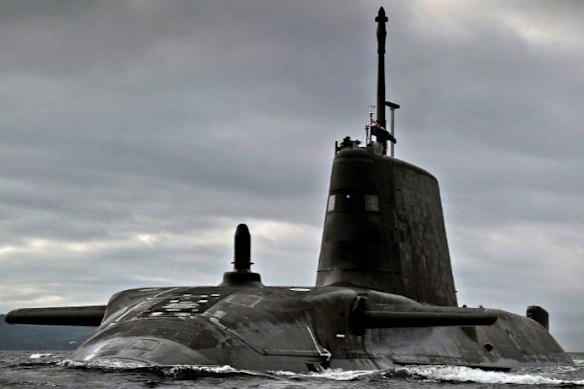
The new AUKUS submarines will be much improved from the British Astute class submarines, in a major boost of Australia’s defences.
Loading
While Rolls-Royce is developing the power plants, BAE Systems is building the AUKUS-class vessels in the UK and is working with Australian company ASC to build them in South Australia. Australia aims to have five vessels from the early 2040s using the same design as the UK.
Rolls-Royce is doubling the size of the submarine site in Raynesway, near Derby in the English midlands. It is also expanding a Nuclear Skills Academy in Derby to address a mammoth need for skilled workers to build and maintain the power systems.
The academy is likely to take more Australian apprentices and workers over time under an agreement with the Australian Submarine Agency to build up the construction workforce in South Australia over time.
Get a note directly from our foreign correspondents on what’s making headlines around the world. Sign up for our weekly What in the World newsletter.


