


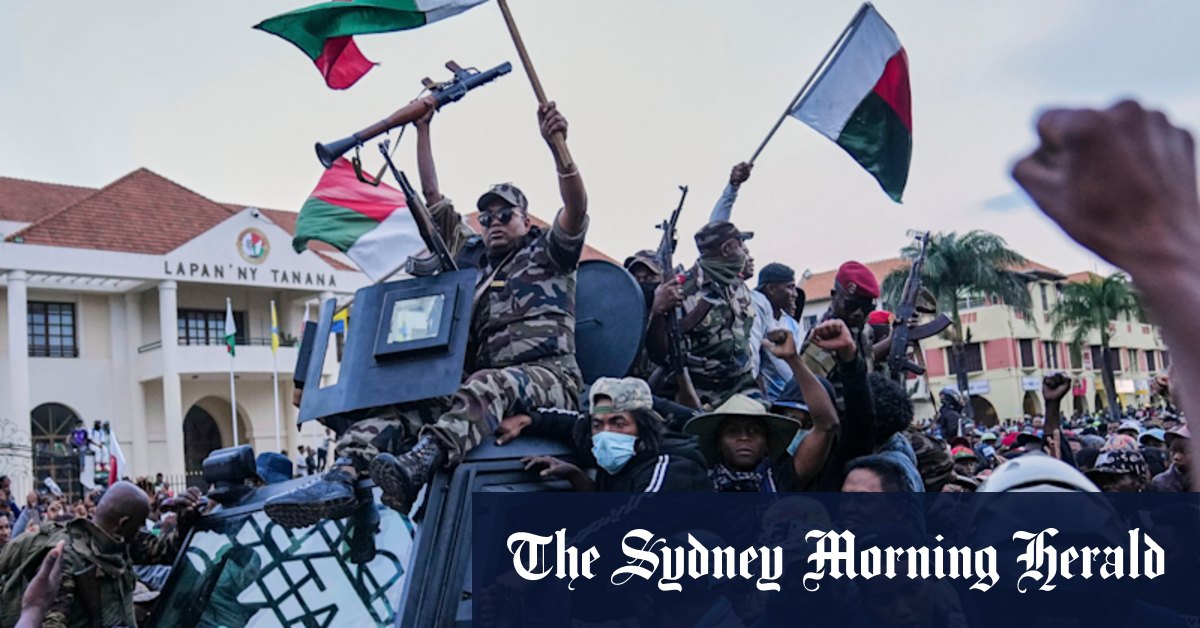
The anti-government protests began on September 25 over chronic water and electricity outages but have snowballed into wider discontent with Rajoelina and his government.
It is the most significant unrest in the island nation of 31 million people off the east coast of Africa since Rajoelina himself first came to power as the leader of a transitional government following a 2009 military-backed coup.

People greet soldiers in Antananarivo, Madagascar on Sunday.Credit: AP
The same elite CAPSAT military unit that rebelled against Rajoelina was prominent in him first coming to power in 2009.
Rajoelina hasn’t identified who was behind this attempted coup, but the CAPSAT unit has said it now controls all the armed forces in Madagascar and has appointed a new officer in charge of the military, which was accepted by the defence minister in Rajoelina’s absence.
CAPSAT appears to be in a position of authority and also has the backing of other military units, including the gendarmerie security forces.
A commander of CAPSAT, Colonel Michael Randrianirina, said the army had “responded to the people’s calls” but denied there was a coup. Speaking at the country’s military headquarters on Sunday, he told reporters that it was up to the Madagascan people to decide what happens next, and if Rajoelina leaves power and a new election is held.

Predominantly Gen-Z people took to the streets as protests over longstanding water and power cuts continued on September 30 in Antananarivo.Credit: Getty Images
Randrianirina said his soldiers had decided to stand with protesters and had exchanged gunfire with security forces who were attempting to quell weekend protests, and one of his soldiers was killed. But there was no major fighting on the streets, and soldiers riding on armoured vehicles and waving Madagascan flags were cheered by people in Antananarivo.
The US embassy in Madagascar still advised American citizens to shelter in place because of a “highly volatile and unpredictable” situation. The African Union urged all parties, “both civilian and military, to exercise calm and restraint”.
Madagascar has been shaken by three weeks of deadly anti-government protests that were initially led by a group calling itself “Gen Z Madagascar”.
The United Nations says the demonstrations left at least 22 people dead and dozens injured and criticised Madagascan authorities for a “violent response” to what were largely peaceful protests in the early days of the movement. The government has disputed the number of deaths.

People shop in an open market ahead of a nightly curfew in Antananarivo, Madagascar on Monday.Credit: AP
The demonstrators have brought up a range of issues, including poverty and the cost of living, access to tertiary education, and alleged corruption and embezzlement of public funds by government officials, as well as their families and associates.
Civic groups and trade unions also joined the protests, which resulted in night-time curfews being enforced in Antananarivo and other major cities. Curfews were still in effect in Antananarivo and the northern port city of Antsiranana.
The Gen Z protesters who started the uprising have mobilised over the internet and say they were inspired by the protests that toppled governments in Nepal and Sri Lanka.
Loading
Madagascar has had several leaders removed in coups and has a history of political crises since it gained independence from France in 1960.
The 51-year-old Rajoelina first came to prominence as the leader of a transitional government following the 2009 coup that forced then-president Marc Ravalomanana to flee the country and lose power. Rajoelina was elected president in 2018 and re-elected in 2023 in a vote boycotted by opposition parties.
Madagascar’s former prime minister under Rajoelina and one of the president’s closest advisers have also fled the country and arrived on the nearby island of Mauritius in the predawn hours of Sunday, the Mauritian government said. Mauritius said it was “not satisfied” that the private plane had landed on its territory.
