


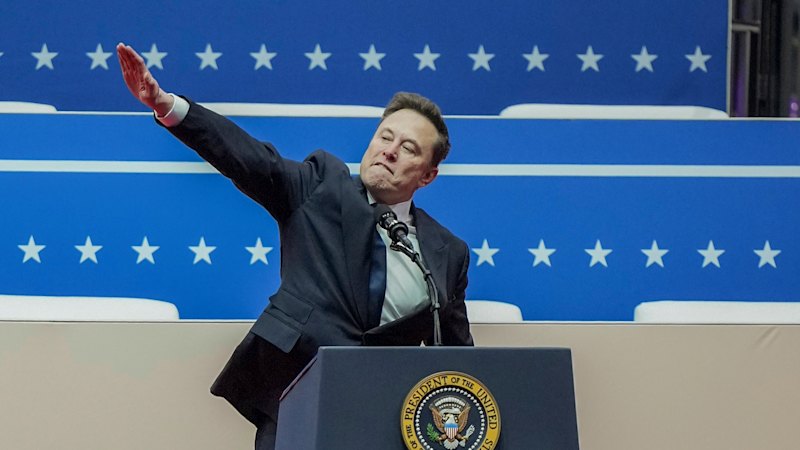

Tesla registrations in Queensland have been in steady decline since the electric car manufacturer’s CEO, Elon Musk, fully embraced the far-right in the US and around the globe.
Data from the Department of Transport and Main Roads show annual Tesla registrations decreased by 34.97 per cent between 2023 and 2025.
That came on the back of a 245.31 per cent increase between 2021 and 2023 – and 1144.89 per cent between 2020 and 2023.
While correlation did not necessarily equate to causation, Queensland University of Technology Associate Professor Frank Mathmann said Musk’s political activities could not have come at a worse time for the company.
Chinese EV manufacturers were increasingly competitive, Mathmann said, so it was no time to alienate environmentally conscious consumers – many of whom tended to lean left politically.
“These are people who care about the environment, who are happy to pay a little extra to purchase an environmentally friendly EV,” he said.
“People on the right haven’t necessarily changed their position about electric vehicles.
“What Musk did with his political activities is disgruntle those left-leaning consumers, without really impressing or convincing the right-leaning consumers about electric vehicles. It’s like trying to jump from one foot to the other without really being on solid ground on either.”
Mathmann said most consumers would not necessarily seek out a politically active brand, but they would certainly avoid one if it came at no cost.
“This was a clear political miscalculation on his side, at least as it relates to his association with Tesla,” he said.
“He has multiple businesses and whether there are benefits for SpaceX or some of the other companies, that’s a different question.
“But when it comes to his human-facing brand with Tesla, I don’t think he really did himself a favour through these political activities.”
Those extracurricular activities have rankled some Tesla owners.
Former Tesla owner Datta Prasad, of Brisbane, sold his Model 3 in November 2024 and has since moved on from the brand.
Prasad said, along with maintenance costs, Musk’s political activities were a factor in his decision – not so much the substance of those politics, but rather the amount of time he spent on them.
“He’s been so distracted with his involvement in politics and other companies that he hasn’t focused on Tesla,” he said.
“For example, his buying of Twitter was not a purely business decision.”
Tesla did not respond to requests for comment.
Griffith University Associate Professor Gavin Northey, as expert in marketing and consumer motivation, said “at first glance” it could be thought there was a correlation between Musk’s political activities and the drop in demand for Tesla products.
But global EV production had increased by about 25 per cent in 2024, with almost 800 models available, so a saturated market could well be a more likely contributor.
“Competition in the EV market is about to explode, so I’m not sure Elon Musk’s political stance will be the primary factor driving consumer decisions moving forward,” he said.
“Instead, I think we will see more entrants in the EV market, which will mean increasing downward pressure on EV prices that are going to shape the EV market for the next decade.”
Northey said research showed views of a corporate leader did influence consumer brand attitudes, but it was not always negative.
“Political ideology exists on a spectrum, so it is only natural to think that for every consumer who sees the political stance as a reason to abandon the brand, there is often a corresponding segment of the market that see it as a reason to become more engaged with the brand,” he said.
A spokesman for the Electric Vehicle Council of Australia said figures showed there was still sustained consumer demand to EVs, including the best-selling Tesla Model Y.
“Individual brand performance can fluctuate year to year due to model updates, shipping schedules, increased competition and government incentive programs,” he said.
“The broader story is that total EV sales nationally grew by 38 per cent in 2025, and almost 17 per cent of all new cars sold in December were electric. Queensland has been part of that transition as more drivers choose EVs.”
Start the day with a summary of the day’s most important and interesting stories, analysis and insights. Sign up for our Morning Edition newsletter.
