


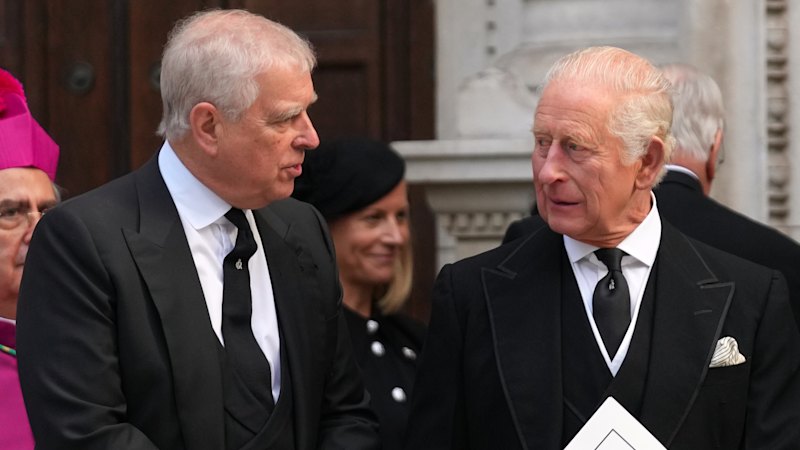

London: The British government has signalled plans to remove Andrew Mountbatten-Windsor from the royal line of succession following his arrest on suspicion of misconduct in public office, as police launched further inquiries into his former security team.
The proposal will depend on the outcome of the police investigation but it represents a significant shift from the UK government stance last year, and it sets up a decision for Australia on whether to match the moves with similar votes in federal and state parliaments.
Mountbatten-Windsor was for many years the second in line to the throne, but is now eighth after Prince William and his three children, as well as Prince Harry and his two children.
The plan, briefed by the UK government to the British media, follows new polling that shows 82 per cent of British adults favour a vote in parliament to ensure the former prince could never become king.
Mountbatten-Windsor was released from police custody late on Thursday (London time) after his arrest on suspicion of misconduct in public office. He has previously denied any wrongdoing.
Thames Valley Police said he was “released under investigation” but they did not charge him. Police conducted a second day of searches through his former residence at Windsor, known as Royal Lodge, and are preparing to return if needed after the weekend to seek more evidence.
In a separate move, the Metropolitan Police announced further work on months of concern about the actions of Mountbatten-Windsor’s security team, asking them to “consider carefully” whether they knew anything that should be pursued by police.
The Metropolitan Police also said it was assessing claims that convicted sex offender Jeffrey Epstein – a friend of Mountbatten-Windsor for many years – used London airports for human trafficking and sexual exploitation.
Amid several lines of inquiry into Mountbatten-Windsor and his friendship with Epstein, the most dramatic was his arrest on suspicion of misconduct in public office during his time as an official UK trade envoy with access to confidential government information.
The Epstein files released by the US Department of Justice include emails suggesting the former prince sent government documents to Epstein, such as a briefing on a trade mission to Asia and investments in Afghanistan.
In a further development, London’s Daily Telegraph reported on Friday (London time) that Epstein sought to help Mountbatten-Windsor set up a £1 million ($1.9m) company to share commissions for funds management work.
The US documents include a draft agreement that would have given Mountbatten-Windsor a 40 per cent cut of future profits from the joint venture with investment company Cantor Fitzgerald. The deal was discussed with David Stern, a businessman who was close to Epstein and Mountbatten-Windsor.
While opinion polls have shown for years that Mountbatten-Windsor had lost public support, a new survey released on Friday asked about the line of succession and found that 82 per cent of British voters wanted him removed.
The YouGov survey was based on answers from 7242 adults. It found that 6 per cent did not want the former prince removed from the succession and 12 per cent were unsure.
The UK government briefed multiple media outlets about the issue to make it clear that UK Prime Minister Keir Starmer and the cabinet were willing to consider the move.
There was no official announcement of the new stance, which departs from Starmer’s stated position in November, when his spokesperson said there were “no plans” to make legislative changes.
While King Charles III has used his powers as sovereign to demote his brother without needing any action by parliament – such as removing his peerage – the line of succession can only be changed by parliament.
The change would require matching laws by more than a dozen realms including Australia to ensure the former prince could not be considered an heir to the throne, similar to changes made more than a decade ago to introduce gender equality into the succession.
The changes on gender equality took several years to accomplish across the parliaments in every realm after then-UK prime minister David Cameron outlined the changes in 2011.
The Australian parliament passed the Succession to the Crown Bill in March 2015. State parliaments approved the same changes to ensure every realm was aligned.
Robert Hazell, professor of government and the Constitution at University College London, noted that the YouGov poll did not tell respondents about the time and cost involved in changing the line of succession by a vote of parliament.
“Parliamentary time for legislation is a very scarce commodity,” he said.
“Legislating on this would mean that parliament would have less time to legislate on other things.”
Hazell said the change would address an unlikely scenario, given the low probability that the former prince would ever become king, and would require matching changes by 14 realms including Australia with the king as their head of state.
Read more on Andrew Mountbatten-Windsor’s arrest:
 David Crowe is Europe correspondent for The Sydney Morning Herald and The Age.Connect via X or email.