


Even if there were a world in which such a war justified the extrajudicial killing of purported drug-runners in international waters, they would not justify the double-tap strike the administration has now confirmed. The Navy’s own manual says attacking shipwrecked survivors of an initial strike is “a grave breach of the law of armed conflict”.
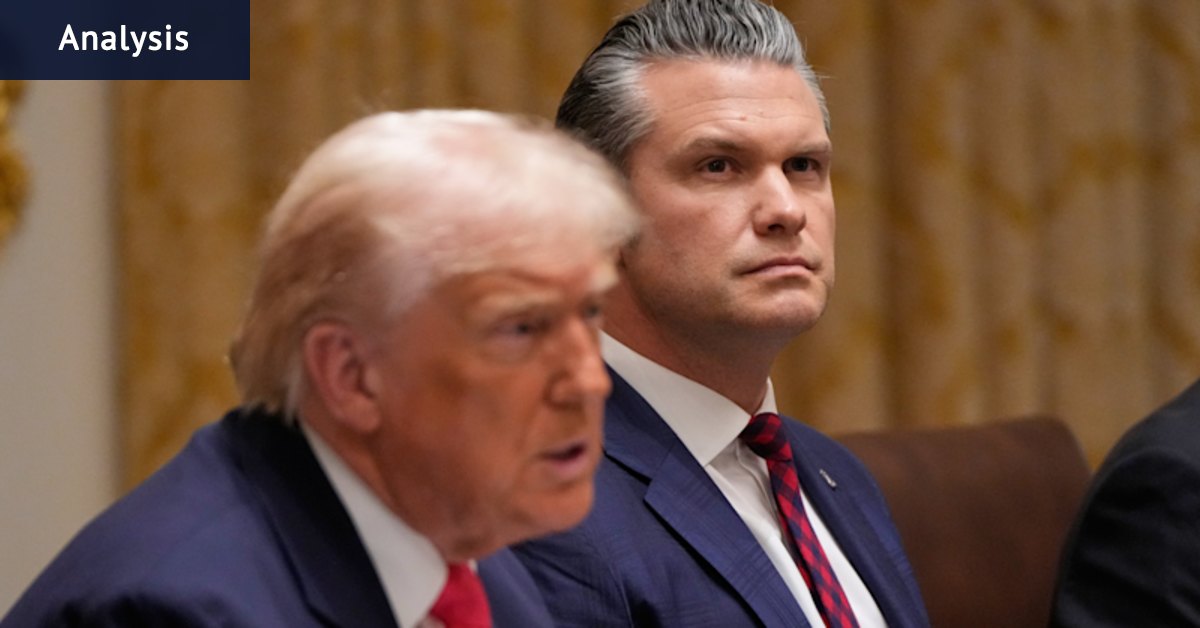
At a cabinet meeting on Wednesday (AEDT) – at which his name card was comically misspelt “Ssecretary of War” – Pete Hegseth argued Admiral Mitch Bradley correctly ordered a follow-up strike to “eliminate the threat” still posed by the survivors.

Hegseth’s name card for the cabinet meeting was misspelt.Credit: AP
He also invoked the “fog of war” excuse, something mere civilians – namely, journalists – wouldn’t understand.
Many things are murky in war, but this isn’t one of them. It’s not a battlefield: the boat wasn’t firing back. And the rules on killing survivors are clear.
As Justin Logan, director of defence and foreign policy studies at the Cato Institute, tells me: “You cannot kill people that do not pose a threat, that are defenceless. A drowning man is not going to kill an American via a drone that’s loitering overhead.”
Nor do they pose an ongoing threat to Americans on the mainland. If they were ferrying drugs before the first strike, they certainly weren’t after.

“Ssecretary of War” Pete Hegseth at Tuesday’s cabinet meeting in the White House.Credit: Bloomberg
Hegseth is trying to have it both ways. He is defending his admiral and praising him as an American hero, while not-too-subtly distancing himself from the decision. And he is creating a straw man to attack the media. It was never claimed that Hegseth explicitly ordered the follow-up strike.
That hardly lessens his culpability. He ordered a strike on a boat in international waters – already illegal, many experts say – and was responsible for a situation where an admiral apparently felt compelled and empowered to shoot again on the survivors.
It’s notable that in at least one later attack on alleged smugglers, two men who survived were captured and repatriated to their home countries. White House press secretary Karoline Leavitt said there had been no change of policy following the first such attack.
Trump maintains he has full confidence in Hegseth, but there are concerns throughout the administration that the former Fox News host’s cowboy approach to the deeply serious role is a problem.
After all, it’s not the first time somebody else has had to take the blame while Hegseth accepts none. When the war secretary shared sensitive operational information in a Signal group chat this year, it was national security adviser Michael Waltz who took the fall for creating the group in the first place.
That’s not to absolve either Bradley or Waltz from their responsibilities. But Hegseth shows no willingness to absorb his share.
John Yoo, who as deputy assistant attorney-general in the second Bush administration authored memos providing a legal rationale for waterboarding and other forms of torture, told CNN that the military should have disobeyed any order to leave no survivors.
Loading
“There are grey areas, but one area that’s not grey … is you can’t fire on the wounded, you can’t kill survivors who can no longer fight,” Yoo said. “So, the admiral should not have obeyed the order that Secretary Hegseth gave, and even the soldiers who carried out the admiral’s orders should not have obeyed.”
Despite the misgivings in Congress, plenty of Trump supporters are happy to excuse this act. They argue the American people have no sympathy for drug traffickers, and few will give a damn about international law.
But they should care: these are the same rules that protect US soldiers when they are sent into battle. Parents would want their sons to be shown mercy if it were them clinging to the side of a stricken boat.
It also concerns Washington’s credibility among allies. Last month, Britain reportedly ceased sharing intelligence with the US about suspected drug boats in the Caribbean, not wanting to be complicit in potentially criminal acts.
The more we learn, the clearer it becomes they had good reason to worry.
Get a note directly from our foreign correspondents on what’s making headlines around the world. Sign up for our weekly What in the World newsletter.
