



Updated ,first published
One of the two remaining Iranian soccer players in Australia has uploaded a smiling social media photo in Brisbane declaring that “everything will be fine”, as the number of team members seeking asylum rapidly diminishes.
Team captain Zahra Ghanbari became the latest player to abandon an asylum claim in Australia on Sunday, sparking fears the players’ relatives are being threatened with retaliation by the Tehran regime.
Five members of the Iranian delegation have now abandoned their asylum claims, and members of the diaspora in Australia have expressed concerns the remaining two players will follow.
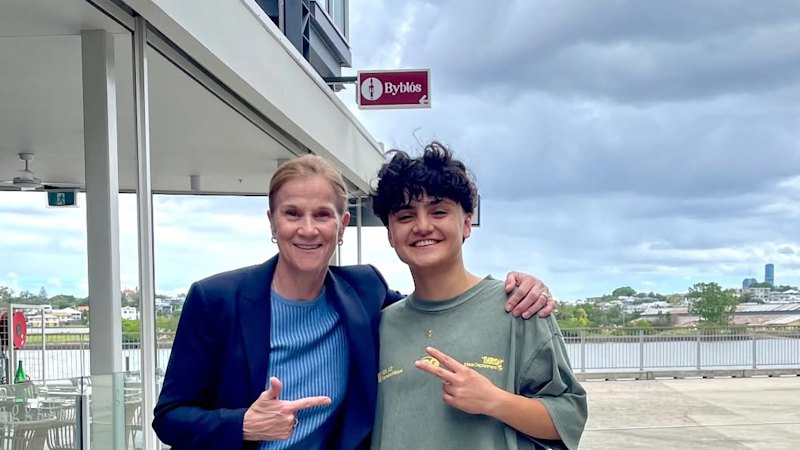
One of those players, Fatemeh Pasandideh, posted a photo from the Brisbane waterfront on Instagram on Monday afternoon with a peace sign emoji and the caption “everything will be fine”.
Pasandideh, 21, posed for the photo alongside Jill Ellis, FIFA’s head of football.
Five members of the delegation sought asylum late last Monday, followed by two others on Tuesday evening.
Iranian player Mohaddeseh Zolfi, 21, contacted Iranian officials on Wednesday morning and asked to be collected from a safe house soon after Burke announced she had sought asylum in Australia.
Three more members of the delegation changed their minds and decided to return to Iran on Saturday night, followed on Sunday by captain Ghanbari, who is joining her fellow players in Malaysia.
Ghanbari, 34, is Iran’s top female goalscorer at a national level. She is Kurdish and grew up in Kangavar, the largest Kurdish-populated city in Iran.
The Iranian regime has leapt upon the reversals as a propaganda victory as it fights against Israel and the United States in a war that has entered its third week.
Shiva Amini, a former Iranian soccer player, said in a post on X that “the Iranian Football Federation, working with the Islamic Revolutionary Guard IRGC, has placed intense and systematic pressure on the players’ families in Iran”.
“They have even targeted the family of Zahra Ghanbari,” Amini said.
“Despite the fact that she has just lost her father, authorities are putting pressure on her mother. This shows the level of cruelty and desperation they are willing to use to force these athletes to comply.”
Home Affairs Minister Tony Burke said on Sunday that the players who had decided to return to Iran were given repeated chances to talk about their options.
“While the Australian government can ensure that opportunities are provided and communicated, we cannot remove the context in which the players are making these incredibly difficult decisions,” he said.
The Tasnim News Agency, an outlet with close links to Iran’s Islamic Revolutionary Guard Corps, said the players had “rejected Australia’s seductive and political offer of asylum”, branding it a “patriotic decision”.
It earlier called the players’ decision to leave Australia a “disgraceful failure of the American-Australian project and another failure for Trump”.
“The national spirit and patriotism of the Iranian women’s national football team girls defeated the enemy’s plans against this team,” the news agency said.
Tina Kordrostami, an Iranian-Australian community leader, said she feared the regime would use threats to convince the remaining players in Australia to return to Iran.
“I am not too hopeful. I have real concerns,” she said on Sunday.
Kordrostami said she and other diaspora activists believed technical staffer Zahra Soltan Meshkehkar – one of the three women who left the country on Saturday night – played an important role in convincing the players to change their minds.
Kordrostami said she believed Meshkehkar was a regime infiltrator, although this claim has not been verified.
“She is a mother figure – they look up to her,” she said.
Sara Rafiee, a human rights activist who campaigned for the players to be given the right to stay in Australia, said she held similar fears.
“While the full circumstances remain unclear, many within the community are concerned that significant pressure may have been exerted on the players, potentially including pressure conveyed through an individual described as ‘support staff’ who reportedly sought asylum in Australia,” she said.
“Some community members fear that this person may have been used by the regime to influence the players from within the group and pressure them to return.”
The Iranian-Australian community has acknowledged the players faced an impossible situation as they weighed up whether to return to possible persecution or risk exposing their families to retaliation and financial harm.
A government source, speaking on condition of anonymity, said all members of the delegation who received asylum were “thoroughly vetted” and it had not been established that Meshkehkar was an infiltrator.
A member of the Iranian soccer team told protesters in Malaysia they weren’t scared about going home and that officials had promised them rewards when they return.
In the video, translated by members of the diaspora, the player said they were promised “rewards” by officials and told that they would be treated well upon their return, like princesses or queens.
Start the day with the day’s most important and interesting stories, analysis and insights. Sign up for our Morning Edition newsletter.
 Matthew Knott is the foreign affairs and national security correspondent for The Sydney Morning Herald and The Age.Connect via X, Facebook or email.