







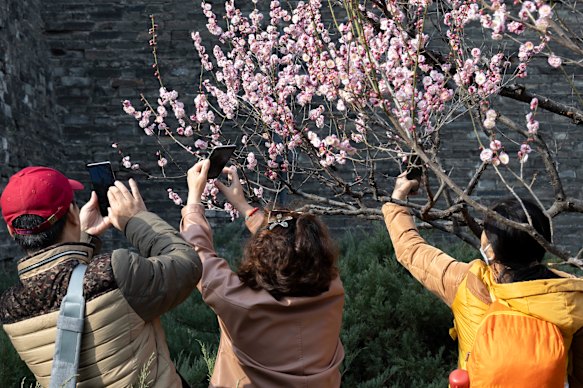
Beijing: It’s a frosty afternoon in early spring and hundreds of Beijingers have shaken off a late seasonal blast of snow to take a stroll through the Ming City Wall Ruins Park.
They have come in droves with their cameras for the park’s plum trees, which are popping with pink and white blossoms. It’s an overly pretty backdrop for chatter about the perilous state of world affairs.


Yet, this is what Mr Miao and his friend are bantering about – the United States’ attacks on Venezuela and Iran, and climbing oil prices – as they wander through the grounds on a Saturday afternoon.
“Trump is erratic. I think he is an entrepreneur, not a politician and strategist,” says Mr Miao, a 66-year-old retired financier, who agrees to share his thoughts on the condition that only his surname is used.

He sees opportunities for Trump’s chaotic decision-making to play in China’s favour, pointing to the Iran war.
“It was a mistake to attack Iran, as it will consume the national strength of the United States. Once the war starts, it is impossible to end it as soon as he imagined,” he says.
“The US’s ultimate goal is to counter China, but this may become more remote now.”
It’s a view shared by some experts, both within and outside China, as America again risks becoming bogged down in a war in the Middle East and redeploys its military resources from the Indo-Pacific to the region.
In its joint strikes on Iran with Israel, the US has heavily tapped into its stockpiles of missiles and interceptor systems, which cannot be quickly replenished. Some Western defence analysts say the longer the war drags on, the more Washington’s ability to project force in the Indo-Pacific, which is key to deterring China from making a move to control Taiwan, will be diminished.
It can be challenging to gauge the views of regular people in China on global politics and, in particular, US-China relations under the countries’ leaders, Donald Trump and Xi Jinping. People are often cautious about speaking to Western media, concerned their views will form part of what the Chinese system broadly deems an “anti-China” story.
Adding to this, China’s domestic news ecosystem is tightly controlled by the government, and organic online discussions on social media platforms are heavily censored to remove commentary not sanctioned by Beijing.
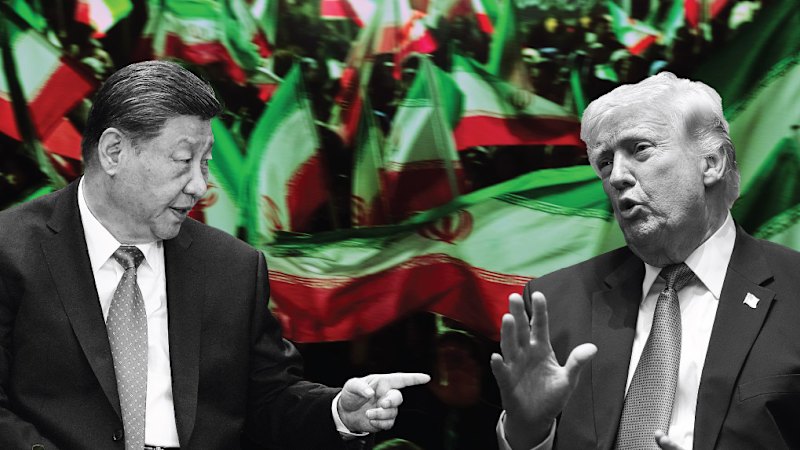
By the time Trump called last week for a “month or so” delay to his state visit to Beijing to meet with Xi, citing the war in Iran, Chinese state media had given it sparse coverage.
Beijing had not confirmed the dates (which Washington had briefed out as March 31 to April 2), giving news outlets little to work with.
On Wednesday, Trump posted to Truth Social that the summit had been rescheduled for May 14 to 15, suggesting he intends to wind down the war by then. In keeping with past practice, Beijing won’t confirm Xi’s schedule until a few days before the event.
“I haven’t heard the news [of Trump’s visit],” says Mr Jiang, a 35-year-old energy researcher, who is strolling with his wife through the Beijing park, taking photos of their young son playing in the blossoms.
But it’s good for the China-US relationship, he says.
“Recently, many things have happened in the international arena, like Iran and Venezuela, that are not good for peace,” he says.
“So the US and China, as the G2, have a responsibility to co-operate,” Jiang says, referencing the “group of two” concept revived by Trump to refer to the superpowers.
A fragile truce endures
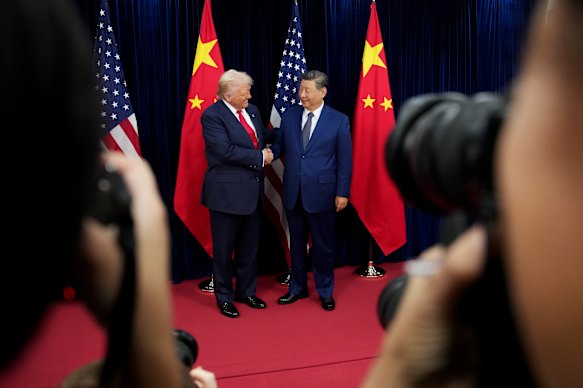
While Beijing has been tight-lipped about the summit plans, there have been plenty of signals that it is keen to keep the fragile truce minted between Trump and Xi in South Korea last year on track.
“It really depends on the situation in Iran [whether the summit can proceed],” says Professor Wu Xinbo, dean of American studies at Shanghai’s Fudan University.
But he says Beijing remains committed to making it happen and that preparations are well advanced.
“China is very much looking forward to his visit and the expected return visit by President Xi to the US later this year. There is high expectation on both visits,” he says.
Many analysts also point to the mild response from Beijing to the US attacks on its friends and key oil suppliers, even as the leadership of Venezuela and Iran were dismantled and, in Tehran’s case, assassinated – acts that strike at the heart of China’s instinctive paranoia about regime change.
Speaking on the sidelines of China’s big annual political meetings earlier this month, Foreign Minister Wang Yi avoided directly criticising the US by name while broadly condemning the war on Iran as a breach of sovereignty that “shouldn’t have happened”.
This language is a remarkable shift from Beijing’s often strident criticism of the US, says Associate Professor Dylan Loh, an expert on Chinese foreign policy at Nanyang Technological University in Singapore.
“This was very different from last year’s press conference, where Wang Yi directly called out the US and said that things like they had no moral legitimacy,” Loh says.
“It is quite clear that China is prioritising the Xi-Trump summit over the damage to its national and economic interests in Venezuela and Iran.”
Other observers have made similar assessments of Chinese Premier Li Qiang’s address to the China Development Forum this week, where he swiped at the US indirectly by condemning protectionism, power politics and “arbitrary and reckless conduct”.
This implicit criticism “stands in stark contrast to their optimism about the fact that they believe President Xi and President Trump can maintain a stable US-China relationship going forward,” says Daniel Kritenbrink, a former US ambassador to Vietnam now with The Asia Group consultancy.
Kritenbrink says Iran will be the key issue on the table when Trump’s visit to Beijing proceeds.
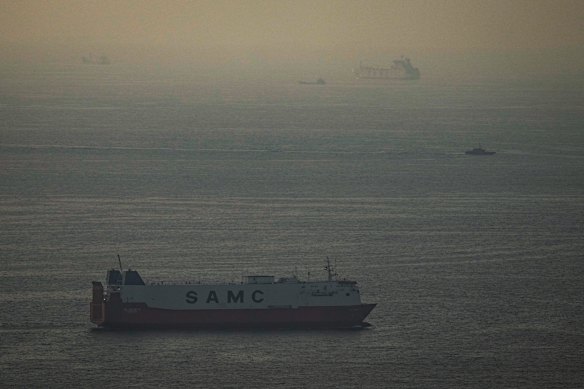
China would “have to be uneasy about the regime change aspects of US and Israeli military action, but I think their primary interests are on maintaining stable oil flows from the Middle East, which currently are disrupted,” he says.
“That in and of itself will put some pressure on this detente.”
Wu says Beijing is likely to advocate for a role in stabilising the Middle East and in any peace deal that limits Iran’s nuclear capacity and that this topic will push aside other foreign policy agenda items at the summit table, such as Russia’s war in Ukraine.
‘It is quite clear that China is prioritising the Xi-Trump summit over the damage to its national and economic interests in Venezuela and Iran.’
Associate professor Dylan Loh
China was one of the six major powers that signed on to the Iranian nuclear deal negotiated by the Obama administration and ditched by Trump during his first term.
“If there’s going to be an international mechanism, I think China would certainly like to be part of the process because we are also a stakeholder in the Middle East,” he says.
Low expectations of a grand bargain in Beijing
The Beijing summit is set to be the first of several potential face-to-face meetings between Trump and Xi this year. It would open the door for Xi to be hosted at the White House later in the year and the pair could also meet at the APEC summit to be held in China’s tech capital, Shenzhen, in November.
This string of opportunities, general uncertainty over Trump’s core tariff structure after it was struck down by the Supreme Court last month, and the US preoccupation with the Middle East, have diluted expectations of a wide-ranging deal being sealed in Beijing.
“A successful meeting is a meeting that proceeds and happens at all,” Loh says.
Experts are generally anticipating the Trump-Xi summit will extend the trade truce and that it will potentially secure some further agreement in areas regarded as low-hanging fruit, such as co-operation on fentanyl, China lifting its orders for US soyabeans and Boeing aircraft, and continued access to rare earth materials.
The Chinese side is expected to push Washington to relax its strict controls on advanced tech and chip exports to China; to remove Chinese companies from US trade blacklists; and to allow its companies to invest more in America.
Government officials and defence experts in Taipei, Washington and elsewhere will be closely watching Trump for any signs of shifting resolve towards Taiwan’s security.
Xi, who regards it as China’s core goal to unify the self-governing island with the mainland, by force if necessary, is expected to stress Beijing’s long-held complaints about US arms sales to Taipei.
Some analysts have speculated he could push Trump to scale back these sales or to shift Washington’s rhetorical position of “does not support” to “opposes” Taiwan’s independence.
In the meantime, China is capitalising on the global chaos caused by Trump’s war, the ensuing energy crisis, and his tariff campaign to talk up Beijing’s status as a more reliable, stable global partner.
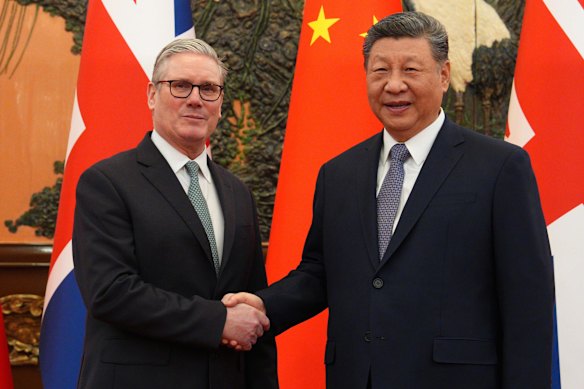
In what is a victory of optics, if not substance, a cavalcade of US allies has made its way to Beijing in recent months, including Canada’s Mark Carney and Britain’s Keir Starmer – the first visit by their countries’ leaders to China in almost a decade.
“They all realise that as the US becomes a less reliable partner under Trump, they need to diversify their diplomatic outreach and improve relations. China is a very necessary option for them,” Wu says.
Confidence in China’s role on the world stage
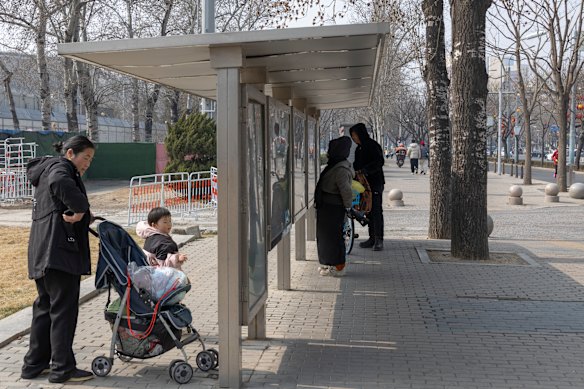
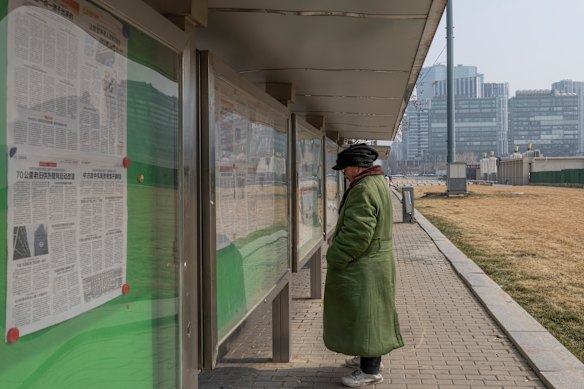
On a Saturday morning at a public newsstand outside Beijing’s Workers Stadium sports complex, people are mingling and reading copies of Chinese state newspapers, The People’s Daily and The Global Times, which are posted on a notice board.
The papers carry reports about Ukraine’s concerns that the US could reduce its weapons supply to Kyiv due to the Middle East conflict, and speculation that Washington is preparing to deploy military resources from bases in South Korea to the region.
“[Trump] has been very unstable and hard to predict,” says Mr An, 71, a retired radio factory worker, who has pulled up to the newsstand on his bicycle.
He has heard the US president is expected to visit the city in May and he wants it to happen.
“Let me put it simply – a visit is always better than a non-visit. The US and China are not enemies. We aspire for a harmonious world,” he says.
Since Trump unveiled his tariff agenda in April last year, Beijing has hammered home its resolve to fight back even if it means “eating bitterness” in the short term, as Xi puts it, and enduring economic pain.
Mr An echoes this view, which sceptics might dismiss as parroting propaganda. While it’s inevitable that the relentless drumbeat of Beijing’s narrative will shape public opinion in China, it can also be easy to write off what is a genuine confidence among the public about their country’s place in the world.
“China now has a certain level of strength to face off against the United States. We have a lot of ways to strike back. After all, China has rich resources, a huge population and a complete industrial chain,” he says.
“China is not afraid of sanctions. China can get through it.”
Get a note directly from our foreign correspondents on what’s making headlines around the world. Sign up for our weekly What in the World newsletter.


