


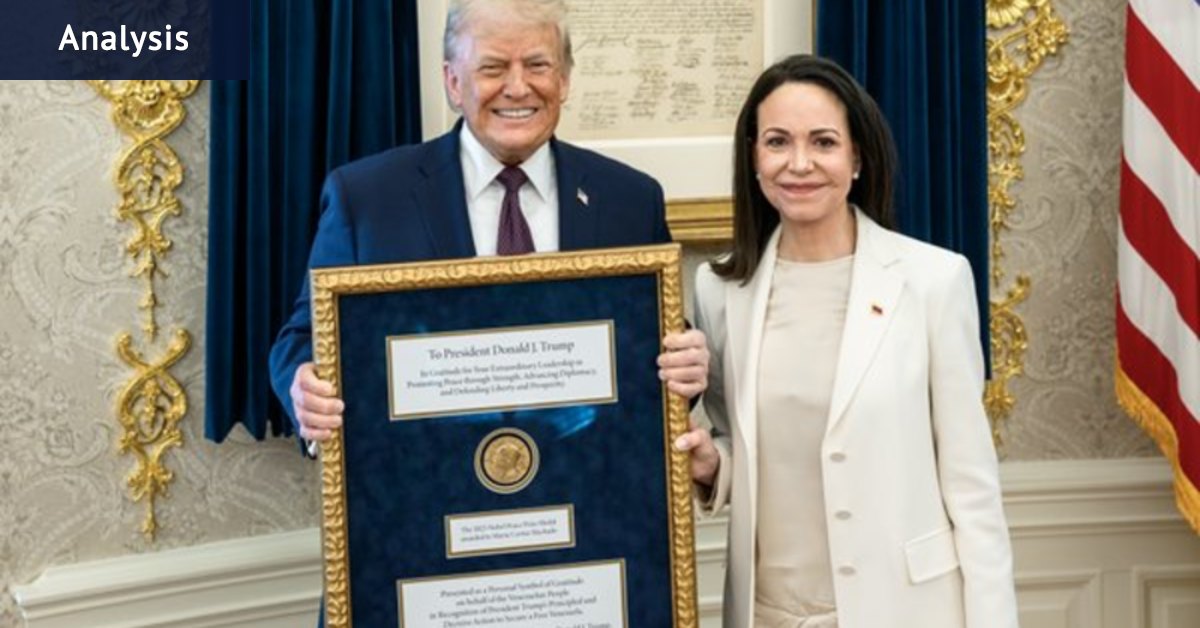
The gifting plan also did not seem to work for Machado, at least immediately. As she and Trump were meeting, CIA director John Ratcliffe was in Caracas meeting with Delcy Rodríguez, the interim president of Venezuela. She had been Maduro’s vice president, and was part of the forces that barred Machado from running in the election – one of many steps the Maduro government took to fix the outcome.
In short, Trump has chosen to operate Venezuela through the very people Machado fought. The prize – the one Trump claimed as his own – was essentially given to mark the bravery of those who stood up to the forces Trump has now embraced, betting that Rodríguez will do his bidding and grant US companies access to the world’s largest oil reserve. And Trump believes the old regime – not Machado – is most likely to enable the United States to run Venezuela’s affairs by remote control.

Delcy Rodríguez (centre) in Caracas on Thursday.Credit: Getty Images
It is, in short, realpolitik in its rawest form, something Henry Kissinger would have admired. If that means embracing the political power structure set up by Hugo Chávez and Maduro – and rejected by a strong majority of Venezuelans – that is the price that Trump appears willing to pay.
It seemed like Machado had been cornered into making her gift. At first, she had “dedicated” the Nobel to Trump. But in an interview on January 5, Sean Hannity, the Fox News commentator and one of Trump’s supporters and informal advisers, asked the opposition leader, “Did you at any point offer to give him the Nobel Peace Prize?”
Machado said that “it hasn’t happened yet, but I certainly would love to be able to personally tell him” that he, and the Venezuelan people, shared in it.
That changed, and now Machado appears to be playing the long game. She is betting that sooner or later, the survivors of the Maduro regime will be ousted, and so giving Trump what he wants – that golden Nobel medallion – is a worthwhile investment.

Maria Corina Machado greets crowds in Oslo after emerging from hiding to accept the Nobel Prize in December.Credit: AP
“I have no doubt that President Trump, his administration and the people of the United States support democracy, justice, freedom and the mandate of the people of Venezuela,” she said on Friday in a speech to the Heritage Foundation, ticking off four values that Trump has spoken about very little as he has described his plans to bring American enterprises, especially oil companies, back to the country.
She insisted that “once the regime is out and the transition is accomplished, the United States will not only be a safer nation, but one that will have more prosperity and strength in our hemisphere”.
The bigger mystery is how Trump regards the handover of the prize. He clearly was interested in possessing it, perhaps because possession, as he has said of Greenland, is “psychologically important”. Of course, he already has one Nobel Peace Prize medallion just steps from the Oval Office: the 1906 award given to Theodore Roosevelt, which is kept in the Roosevelt Room.
Roosevelt won the prize for bringing an end to the Russo-Japanese War, and even some of Trump’s critics have said that, if Trump could do the same for the war between Russia and Ukraine, he would be the natural candidate for the next award. But that has been frustratingly elusive, as Trump himself often admits, even while ticking off other conflicts – India vs. Pakistan, Thailand vs. Cambodia, Israel vs. Hamas and Egypt vs. Ethiopia, among others – that he claims credit for ending.

US President Donald Trump has made it clear he would like to receive the Nobel Peace Prize.Credit: AP
Karoline Leavitt, the White House press secretary, said Friday that Trump intended to keep the prize, but noted that “its final home in the White House is still yet to be decided.”
But she suggested that the issue was not over for Trump, that the wrong he believes was committed against him by the Nobel committee has not been resolved.
