


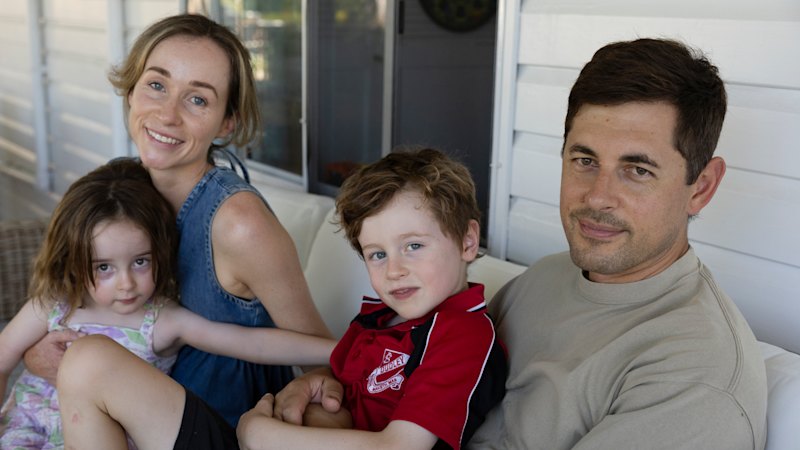
Sarah Peddie-McGuirk, a public school graduate, never gave much thought to private schools. After all, she hadn’t had to.
“I went to a public primary, I went to a public high school. I never really considered the Catholic school system or a private school for my own children,” she says.
But after her eldest son, Henry, started kindergarten at Dudley Public – a small school with a big reputation for excellence in a coastal enclave just south of Newcastle – talk among other parents quickly turned to secondary options.
“Initially, I just thought, well, you’ve got seven years to think about that.”
But then she noticed something interesting: students in years 3 and 4 began to leave the school. Why, and where were they going, she wondered? It turned out that strategic parents were pulling their kids out to enrol them in the Catholic system to guarantee them a year 7 spot at a local Catholic high school.
Sarah does not use the words parental panic. “But there’s definitely a feeling of, ‘OK, I perhaps need to be a bit more proactive in looking at what the options are going to be’.
“You feel a lot of pressure. You want to make sure that your child is in an environment where they’re going to thrive and that they’re surrounded by people who will bring out the best in them and be good role models.”
Across the state, more students attended a private school last year than at any other time in the state’s history after public education enrolments dropped by almost 7000 pupils, the seventh year of declining enrolment share. Girls in the secondary years are leading the charge to private schools.
The NSW Education Department said in its most recent annual report that public education is the cornerstone of a fair society, but that cornerstone is now showing signs of decay. If current trends continue, there will be more high school students in Catholic and independent schools than public ones in just over a decade’s time.
Education analysts point to policies dating back to the 1960s and ’70s designed to provide parents with “school choice” that have increased taxpayer funding for private schools. In turn, this has inflamed a situation that some researchers call residualisation – the process by which poor students become the residual remainder left over as other, more advantaged students leave public education.
Research last year by former Education Department head Michele Bruniges showed 97 per cent of schools with a high concentration of disadvantage in NSW are public schools.
As those schools become concentrations of disadvantage, they become less attractive to parents who can afford to choose a fee-paying option.
“Residualisation is perhaps the central systemic risk,” says University of Melbourne education researcher Professor Glenn Savage.
“When parents who can afford fees leave public schools, there is a risk of compound and concentrated disadvantage in our public systems.”
The effects are manifold. Researchers point to the “socio-economic composition effect”, whereby students attending schools with a high concentration of students from poor families tend to have lower results than students from similar backgrounds attending schools with more students from well-off backgrounds.
Then there is the “double jeopardy” effect for poor students: disadvantaged once because of their circumstances at home, and again because of the concentration of disadvantage at school.
“There are also serious consequences for the teaching profession,” Savage says. “Schools serving high-needs populations become harder to staff and retain quality teachers in. The systemic effect is that the schools most in need of experienced and supported educators are often the ones least able to attract and keep them.”
He says residualisation doesn’t just harm the students left behind; it undermines the social function that public education has historically served by creating shared civic institutions. “Once that function is lost, it’s not easily recovered,” he says.
For some parts of Sydney, the horse has already bolted. “I think there are points of no return in quite a few communities,” says independent education researcher Barbara Preston. Last year, Preston wrote a paper in academic journal The Australian Education Researcher that characterised the situation as “a vicious cycle of residualisation”.
She points to the closure of public high schools in Sydney’s eastern suburbs decades ago.
“There’s a lot of communities where public schools have lost so many enrolments to the private sector that they have closed down. Once you’ve closed the school down and closed the campus, kids have to travel a much longer distance or go to a private school.”
There are similar factors at play on Sydney’s north-western and south-western fringes, where the previous state government failed to build adequate schools for the number of families moving into new housing estates.
In addition to financial resources and segregation along socio-economic lines across the board, Preston says there are other factors at play.

“COVID just damaged public schools so much compared to private schools,” Preston says. “The government gave money to private schools; they received JobKeeper, even though they didn’t reduce the number of teachers. Public schools didn’t get that financial support, and you had a much higher proportion of public school students who didn’t have the internet at home.”
Public schools did receive some additional funding for small-group tuition programs, but the trend has continued. “Parents were just feeling the public schools just weren’t providing the support for their kids,” she says.
Inside a conference room at the Sofitel Hotel in Sydney’s CBD this week, Education Minister Prue Car addressed a group of educators at The Sydney Morning Herald Schools Summit. She said that in her own electorate in western Sydney, public education lost an entire decade’s worth of students because the previous government failed to provide sufficient public options.
“In some parts of Sydney, there simply were no public schools. So when we talk about choice, parents actually have no choice to choose a public school,” Car said.
Other polices could make a difference. The Inspire program – to give every high-potential student access to gifted education in comprehensives, could help win parents back, she said.

She also pointed to the decision to relax strict catchments for some public schools to further entice parents who might have gone private.
“In reality, people are just not going to attend a school they’ve been forced to if they don’t want to go there,” she said.
“But if they see schools in the system that are offering something that suits their family and their child, I believe we’ll see more students actually coming into our public education system.”
Other measures designed to bolster enrolment share include refreshing the websites of 2200 public schools across the state, and providing more options by converting numerous single-sex boys and girls campuses into co-educational high schools.
Are these new policies working? An Education Department spokesman cautioned this week that it takes time for results to appear after changes in policy.
Central Coast Council of Parents and Citizens president Sharryn Brownlee is optimistic about moves to expand gifted education and relax enrolment catchments – but she would like to see more of a focus on expanded vocational options for a wider variety of students.
“It is wonderful to see the investment, it’s wonderful the department is listening to parents and expanding the gifted opportunities,” Brownlee says.
She has noticed other changes that have potential to boost enrolments, such as schools proactively seeking to engage parents via their own social media channels. Meanwhile, high school principals are now regularly attending primary schools to speak to prospective parents.
“For primary parents, they worry about what is going to happen in the high school,” Brownlee says. “You don’t know what you don’t know. Public education needs to tell its story better; it is incredibly powerful, and it is a story not often told and not told well.”
The state and federal governments last year made a historic funding agreement that will send an extra $4.8 billion over the next decade to NSW public schools.
Former public school principal and education researcher Chris Bonnor says longstanding funding discrepancies, despite additional money, cannot overcome the two-tiered system.
“Parents instinctively know this. I am not in the business of blaming parents. If they are searching for a school where their child can get a reasonable score at the end of their schooling, they believe there’s an advantage in enrolling their child in a school with a substantial number of other advantaged students.
“In those schools, they will likely find greater curriculum diversity, adequate and quite good resources and possibly higher teacher expectations.”
In NSW, socio-economic segregation has been worsened by the expansion of the state’s highly competitive selective school system, which Bonnor says further drains comprehensive schools of advantaged students.

Selective schools fell out of favour in the 1980s. But by the 1990s, the government began establishing them again in a bid to broaden high potential options. NSW now has 48 fully or partially selective schools.
Bonnor conducted research looking at the effects of the government’s decision to add more partially selective schools in south-west Sydney in 2012. He found selective schools took the most advantaged students while nearby comprehensive schools recorded sharp declines in the number of HSC high achievers.
Natasha Watt, deputy president of the NSW Teachers Federation, says that unfortunately a myth has spread that private or selective schools are necessary for kids to get ahead.
“This can make 11-year-old kids believe their future rests on one test,” Watt said. “NSW needs to begin to wean itself off both selective and private schools, which place families under completely unnecessary emotional and financial pressure.”
Last year, the pressure on the state’s selective schools was brought into sharp relief by chaotic scenes as riot police were called in to testing centres across the city as parents accompanying their children tried to file into the venues.

So, should the government just shut selective schools down? Bonnor thought that might be the best solution 25 years ago, but now says it is unfeasible.
“It would be very difficult, and in the short term it would create mayhem,” he says. “It would obviously increase the pressure to open more private schools. I don’t support that. I support modifying the operations of the schools to make them more representative.”
NSW Secondary Principals’ Council president Denise Lofts says that using social media to promote individual schools could help, but she believes broader system-wide changes are needed – including levelling the playing field between private and public schools on staffing and expulsions.
She says that with two funding sources – government and parent fees – private schools can amass higher staffing levels. They can also expel students for poor conduct more easily. “They receive public money for the public good, so private schools should follow the same rules when their students behave badly,” she said.
Lofts warns that the consequences of declining enrolment share go beyond the classroom. “It would be a damn shame if the enrolment decline continues,” she says.
“Then you have concentrated disadvantage. It is not very Australian. It means we are not serving everyone in Australia, and education appears to be increasingly dependent on parents. If your parents’ financial resources are limited, you’re not getting the same opportunities as someone down the road.”
Education researcher Lyndsay Connors, who co-authored Imperatives in Schools Funding, says that as enrolment share declines, it is becoming increasingly difficult to win back parents such as Sarah at Dudley Public.
“There’s a rapid, dangerous decline now in public school,” Connors says. “Parents who really support public schooling because it is so underfunded, relative to private schools, they don’t feel like they’re able to get the breadth of curriculum and the staffing.”
Start the day with a summary of the day’s most important and interesting stories, analysis and insights. Sign up for our Morning Edition newsletter.
