


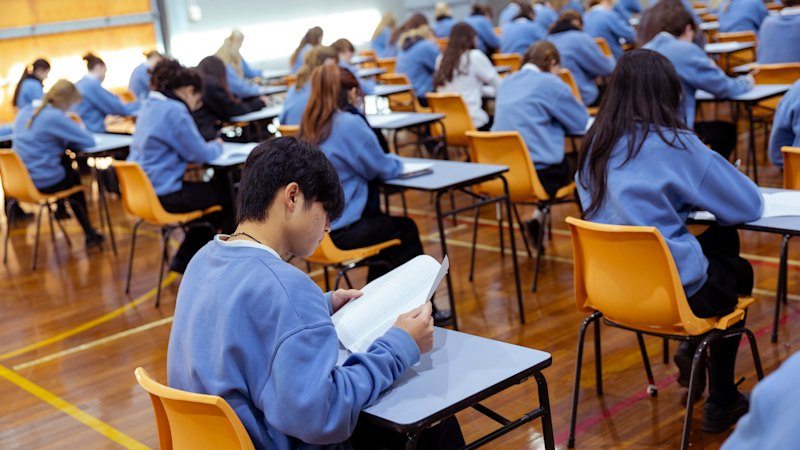

The education system is facing real and urgent risks from students’ use of artificial intelligence to cheat and avoid thinking for themselves, warns a new report that sounds the alarm on the emerging technology.
The report calls for an urgent review of the use of take-home assignments in year 12 in a bid to identify cheating and ensure the integrity of qualifications such as the HSC, as teachers say they are at a loss about how to stem the tide of AI.
The report, by education research consultancy Learning First, draws on NSW Education Standards Authority survey data from 3400 teachers and 750 school leaders in public, private and Catholic schools. NESA will use the report to develop advice for schools as the system grapples with the technology’s increasing prevalence.
“The system is not about to completely break but the dangers posed by AI are real and urgent,” the report says.
About 75 per cent of teachers surveyed said students used AI to complete assessments, even though more than 80 per cent were restricted from using AI for this purpose. About half were worried they did not know how to stop students from cheating.
It says concerns about AI use were most pronounced among secondary school teachers but it also says primary school teachers “should be prepared to respond as risks emerge”.
Students have for generations enlisted tutors, parents and siblings to help complete homework and assignments but now, AI tools such as ChatGPT had turbocharged that practice.
“Time and again, educators say that students are using AI not as a cognitive partner for learning but as a surrogate to which they can delegate their thinking, a phenomenon known as cognitive outsourcing,” it said.
Artificial intelligence’s predisposition to be helpful and immediately provide answers means it bypasses any need for students to produce the cognitive effort required to learn.
Other large, randomised control trials tracking students’ learning have found unrestricted access to AI improved short-term performance but ultimately damaged learning.
What teachers said about artificial intelligence
“Kids are trying to get to the answer the shortest, fastest, quickest, most convenient way possible, and they’re missing the point that, yes, getting the right answer matters – but it matters because of the process you’ve gone through to get there and what you’ve learnt by doing it.”
“One of the things I’m concerned about is the process of thinking. They [students] don’t develop that and they just arrive at a conclusion and an outcome. [AI] is not helping them to be thinkers … they just want to get to the destination. So they’re losing the value of learning itself as a journey … I think it [students’ thinking] is being dwarfed and snuffed.”
“One of the major difficulties that I’ve encountered is that for some students, their expectation of what generative AI tools should do is to offload close to 100 per cent of their own cognitive effort.”
“The problem of students relying on AI to think for them extends to even low-stakes and common activities like class discussions,” the report said.
In focus group interviews, one teacher said that when they asked students questions in class, students immediately defaulted to plugging the question into AI to generate a response.
The most pressing issue facing schools was assignments in year 12, which could create an uneven playing field.
“If students complete internal assessment in unsupervised settings where they can potentially access AI tools, it brings into doubt the accuracy of assessment information,” the report said.
It urged system leaders to immediately review their senior secondary assessment system, evaluate how susceptible assessment methods and resulting qualifications are to AI, and take appropriate action.
“System leaders should above all pay attention to the challenge AI poses to the senior secondary years because when assessment is compromised at this stage of schooling, the entire education system loses credibility.”
Meanwhile, teachers using artificial intelligence to make their jobs easier has become widespread practice but the report said the content it produced was not necessarily best practice. “As a result, AI can harm effective teaching,” it said.
The report puts forward eight considerations for reform, including resisting the educational technology industry and not allowing AI to spread unchecked in schools.
“Edtech has too often been allowed to spread unchecked in schools in the name of finding what works. But students shouldn’t be guinea pigs for technology companies.”
The report also said the benefits of artificial intelligence in the future should be continually monitored.
Independent Schools NSW chief executive Margery Evans said many Australian schools had since moved beyond simply trying to identify whether students are cheating or whether teachers are sidelining their professionalism.
“Increasingly, the focus has shifted towards establishing clear guidelines, building staff capability and supporting ethical, transparent and purposeful use of AI across schools,” Evans said.
She said schools were demonstrating to students how AI can “enhance their learning and reflection” rather than replace their thinking.
“Australian schools must engage with AI because their staff and students are already using AI tools. The question for schools is no longer whether AI is present but how it is being used, guided and understood within their community.”
NESA chief executive Paul Martin said the organisation had been monitoring the impact of AI and had recently adjusted a program called All My Own Work, where students learn the rules about cheating.
“NESA’s board continues to discuss ways to address AI and its impact on schools, including with academic education experts,” Martin said.
“We use contemporary data, evidence and research to inform new policy settings and develop system-wide guardrails as the education landscape continues to evolve.”
Start the day with a summary of the day’s most important and interesting stories, analysis and insights. Sign up for our Morning Edition newsletter.
