


It is widely agreed that the prime minister’s national address on Wednesday stole three minutes and 17 seconds of irreplaceable life from Australians who bothered to tune in. The format, conventionally used to make an announcement of national import, consisted of messages we’d already heard. But from the government’s perspective, the address wasn’t a waste of the prime minister’s platform at all. It was part of a sequence of signals paving the way for a budget framed by Albonomics.
It is the cruel habit of history to distribute crises arbitrarily. Consequently, many are frittered, while leaders who yearn for a nice juicy inflection point are condemned to govern in the grinding mediocrity of good times. Scott Morrison squibbed his opportunity to blast out rent-seeking in the name of COVID, while former treasurer Joe Hockey had a radical plan to overhaul the economy at a time when absolutely no one wanted change.
So who can blame Albanese and his strategist Paul Erickson if they saw the embers of a crisis and decided this was their opportunity to coax it into a moment of account?
The prime minister’s national prime-time address began that process. A national address signals that life as we know it is about to change significantly. The brief speech itself deployed the language of national sacrifice. Albanese’s ostensible message was “don’t panic”. But the subtext was that we should panic enough to be open to change.
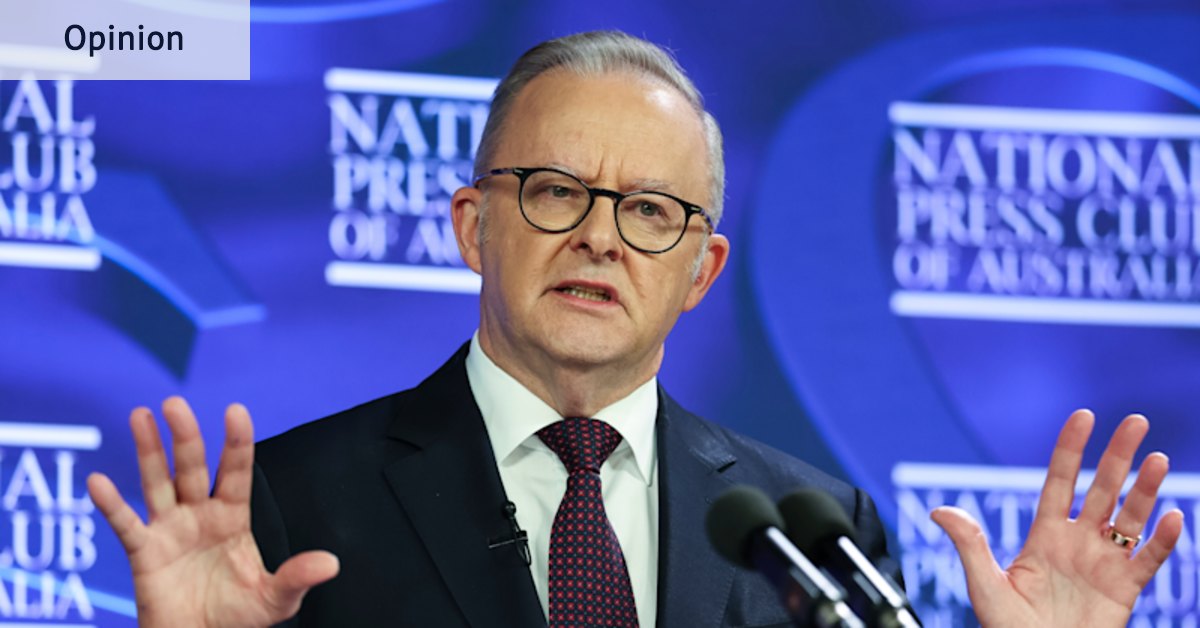
The day after, Albanese gave a speech at the National Press Club. Being prime minister ensures that a speech in this venue gets widespread coverage. Readers of The Australian Financial Review woke to the headline that the “free market has left us exposed”. Albanese underscored the “urgency” of his presentation by noting that his appearance was taking place on Holy Thursday.
The National Press Club speech meandered from what we know about the war in Iran, including the well-canvassed fuel supply issues, to what the government has done about endometriosis. The real point was the overarching theme of “the changes we need to make to prepare our economy for the future”.
Albanese calls it progressive patriotism. It’s now clear that equates to left-wing populism.
That means attacking “the mindset that left Australia exposed to this global shock”. Which is, as the AFR translated, the belief that free trade can make a nation richer.
Never waste a good crisis, comrade. Anthony Albanese is “taking a different path”. One that is government-directed. The plan entails “investing in a Future Made in Australia” – a scheme which, to date, has put taxpayer money into a relocation program for overseas quantum computing executives and, through the Australian Renewable Energy Agency, better known as ARENA, taken over a green hydrogen white elephant after energy giant BP decided it was a poor bet.
It also promises a National Reconstruction Fund to back manufacturing. This fund’s greatest hits include bailing out an aluminium smelter Rio Tinto couldn’t make work.
And, of course, Albanese wants to bring new energy online – “cleaner, cheaper power that we generate, store and control, for ourselves”.
Albanese is not the first person to realise that Australia took its eye off the geostrategic ball when it allowed itself to become heavily dependent on importing refined fuel from overseas. Experts are having an “I told you so” moment.
But the government’s solution is perplexing. In pivoting to renewable energy, we will encounter a very similar problem. That sector is dependent on technology (in particular solar panels) produced cheaply in China. We may “own” the wind and sun, but we don’t own the means of harnessing it.
Albanese wants that to change. But the reason we don’t have these key assets is not because the government forgot to tell businesses that oil and power would be useful. It’s because those industries couldn’t compete in a high-wage and increasingly high-energy-cost country.
Energy costs will keep rising while Australia attempts an energy transition which has the bigger and more technologically savvy Germany licked. So the only lever left is for government to insert itself into the business decision-making process, by massively subsidising the types of industries it believes are crucial. That’s a command economy, not a competitive one.
When government hands out subsidies, the money comes from taxpayers. Which inevitably means young Australians and children who aren’t yet old enough to vote. Australia would need to take on debt to fund those new “investments”, which will be left to the young to deal with.
But that’s not all folks. Albanese also used the speech to tell us about the many, many government programs he’s sprinkling over the economy like salad crunch. Free this, subsidised that – it’s raining money to make up for the fact that young Australians face an uphill battle to get ahead in a system which penalises enterprise.
He calls it progressive patriotism. It’s now clear that equates to left-wing populism. Capitalism with Venezuelan characteristics.
Over the coming month, there will be more preparation for the shift to Albonomics, packaged as “intergenerational fairness”. Changes to the capital gains tax will be a satisfying slug against an older generation which many young people believe had it easier because of tax concessions, rather than because a strong economy offered more opportunities. It’s a clever political deflection to punish people who did well out of economic liberalisation to convince young voters they shouldn’t punish the government of the day for acquiescing to cronyism.
With the Liberal Party a lame duck, the timing is perfect. Labor’s strategists have laid the groundwork for this to be a most useful crisis. US free-marketeer Grover Norquist likes to say that his goal is to “get government down to the size where it can drown in a bathtub”. Now the Liberal Party is small enough to drown in a bathtub, the PM seems determined to use the opportunity to drown liberalism with it.
Parnell Palme McGuinness is an insights and advocacy strategist. She has done work for the Liberal Party and the German Greens and is a senior fellow at the Centre for Independent Studies. She is also an advisory board member of Australians For Prosperity, which is part-funded by the coal industry.
 Parnell Palme McGuinness is an insights and advocacy strategist. She has done work for the Liberal Party and the German Greens and is a senior fellow at the Centre for Independent Studies. She is also an advisory board member of Australians For Prosperity, which is part-funded by the coal industry.