








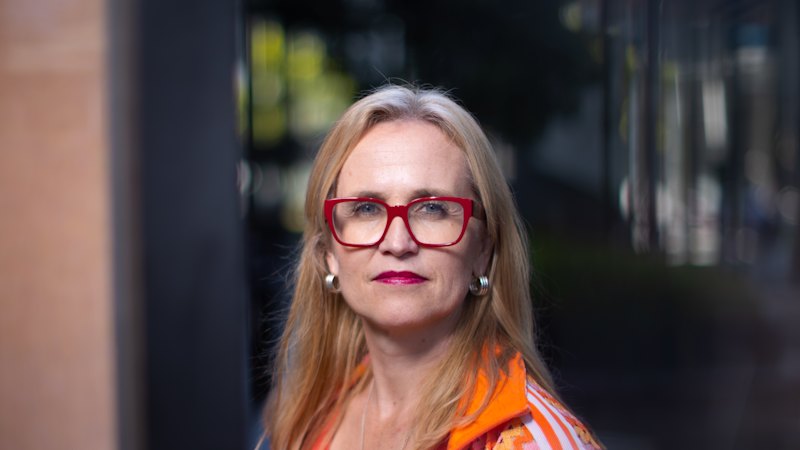


Katie Bennett-Stenton won a top Australian marketing award in 2025, but she struggles to find words for the humiliation of having her parenting investigated by Child Protection Services.
The shame of her best friends needing legal advice to prepare sworn statements “that we were nurturing, loving parents who adored our children and would never harm them” is nearly indescribable, even four years on.
But having experienced the “f—ing hell on earth” anorexia brings for families has left Bennett-Stenton wanting to share even the worst, with her children’s consent, to help reduce isolation for others and to boost understanding.
More than 1.1 million Australians have an eating disorder, and incidence has risen 36 per cent since 2012.
The conditions cost the economy an estimated $67 billion, and when combined with disordered eating – a broader term that can include restrictive eating, compulsive eating, or irregular or inflexible eating patterns – affect 16.5 per cent of the population. Those who have lived through the conditions say the stigma remains worse than for other illnesses.
For Bennett-Stenton, what started with a sick feeling when she noticed how her then-13-year-old daughter’s weight had dropped dramatically under her baggy clothes went on to feel like “your house is on fire; your life is on fire”.
Soon after her daughter turned 14, already ravaged by the most fatal eating disorder (and deadliest mental health condition), the teenager made her first attempt to end her life.
The year 8 student wrote at the time that although she had recently been in hospital for anorexia treatment, her anxiety was causing panic attacks and “an overwhelming crushing fear that something terrible is about to happen”.
Her nine-year-old little brother saw his sister’s suicide attempt, which traumatised him so much that he was interviewed at school by Child Protection Services.
Bennett-Stenton was questioned by police. “I ended up being arrested, a mug shot taken, fingerprints and three hours of video interview, court appearances [due to a temporary restraining order],” says Bennett-Stenton.
Her now 18-year-old daughter, who is healthy and recovered, gave permission for her story to be told.
Bennett-Stenton recalls: “There would be shouting, screaming and more … This disease is not understood.”
Bennett-Stenton relied on loyal friends, anxiety medication and therapy to help get her through – but she feared the ordeal caused by the illness was so shameful that the family could be shunned.
She managed to keep going at work then as a marketing lead at the ANZ bank, “smiling in meetings, crying in lifts”.
But in 2022, she decided to share her experience company-wide on R U OK Day, the annual suicide prevention and mental health awareness event, again with consent.
The grateful reception she received, including another senior employee quietly revealing she had never even told her children about her twin sister’s suicide due to stigma – but would now – encouraged Bennett-Stenton to contribute to a book to be launched at Parliament House in Canberra on Wednesday.
It contains the firsthand insight of 11 family members who have supported loved ones with eating disorders, and was created by the support group Eating Disorders Families Australia. Executive director Jane Rowan said Bennett-Stenton’s family’s experience was not uncommon.
“It comes down to people not understanding the reality … that carers are so incredibly stretched, and the nature of the disease – the battle you’re constantly in with the person who’s got the eating disorder, and it’s [the cause] is nothing to do with the person,” said Rowan.
“It makes the house a war zone, it’s horrendous … The person with the disorder thinks the person trying to care for them is trying to hurt them, and they can’t trust that parent; the person is dictated to by this voice,” she said.
Rowan, a mother of four who also has permission from her recovered daughter to speak publicly, hopes the book, Strong Enough, will encourage people to set aside judgment around a condition some still consider “a choice”.
“Stigma is a big problem; a lot of families are very reluctant to even talk about what they’re going through and admitting what they’re dealing with,” Rowan said.
“I’d love to get to a stage in Australia where eating disorders are talked about in the same way anxiety and depression are – they are just not seen in the same light.”
Jade Gooding, chief executive officer of the Australia and New Zealand Academy for Eating Disorders, said as eating disorders continue to be the only mental health condition whose post-COVID increase has not yet plateaued, services are overwhelmed.
But the new book could increase recognition that families form a core part of treatment for those with eating disorders, and also need support, and could normalise the experience for others.
Katie Bennett-Stenton, who is in Canberra for the launch, hopes more awareness will help others going through what her family went through. “I am a ridiculously optimistic person, and I was certain we were never going to get through it,” she said.
“The shame was so ferocious, most people don’t talk about it. If we barely made it through by the skin of our teeth, and we had a lot of support and help and love and care, my heart bleeds for anybody who doesn’t have that. I don’t know how they get through.”
Support is available from the Butterfly National Helpline on 1800 33 4673 and Lifeline on 13 11 14.
Start the day with a summary of the day’s most important and interesting stories, analysis and insights. Sign up for our Morning Edition newsletter.


