


Updated ,first published
Prime Minister Anthony Albanese has defended his decision to invite Israeli President Isaac Herzog to Australia, as the NSW government invoked rare police powers ahead of planned protests when he arrives in Sydney this week.
Albanese acknowledged there were mixed views about Herzog’s visit among the community but said he was coming as a statesman of Israel, arguing his position was equivalent to Australia’s governor-general.
“President Herzog is coming in the context of the devastating antisemitic terrorist attack that occurred at Bondi,” the prime minister said on Saturday. “The visit of President Herzog is to support the Jewish community at what has been a very difficult time.”
Herzog was invited by Albanese to visit Australia after the Bondi terror attack in December. The pair will meet with the families of victims of the Bondi attack and hold talks with political leaders.
The visit has prompted pro-Palestine activists to prepare for a nationwide day of protests to coincide with Herzog’s arrival on Monday. A United Nations commission of inquiry found Herzog and other Israeli officials were “liable to prosecution for incitement to genocide” for comments made after the October 7 attack by Hamas in 2023.
Albanese said people “have the right to express their views” in democracies like Australia and Israel, but he hoped people were respectful of the purpose of the visit.
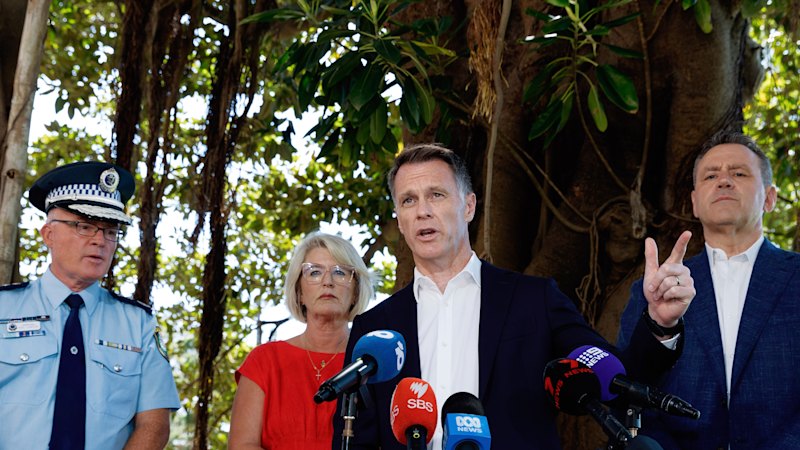
Premier Chris Minns called for calm, respect and co-operation as he announced additional powers for police to separate and move on crowds in Sydney during the visit. The city’s protest restrictions were also extended last week.
“It’s really important that there’s no clashes or violence on the streets of Sydney,” Minns said at a press conference. “We can disagree without it resorting to clashes or violence … In fact, that would be devastating for everybody, regardless of your cause.”
The government announced on Saturday it had declared the visit a major event under the Major Events Act. The legislation is typically invoked to manage crowds during sporting events, such as March’s AFC Women’s Asian Cup.
Minns urged people to avoid the Sydney CBD on Monday afternoon “unless it’s absolutely essential”, confirming there would be a “massive policing presence”.
On Friday, it was revealed 500 NSW Police officers had been assigned to the protest.
The major events declaration was made by Tourism Minister Stephen Kamper on Friday. The powers extend from Monday to Thursday and cover a “major event area” across Sydney’s CBD and eastern suburbs.
“This is an important visit for our country, and it matters deeply to the Jewish community of NSW as they continue to mourn and recover from the horrific terrorist attack on 14 December,” Minns said.
“[We] cannot allow a situation where mourners and protesters come into close contact on city streets without strong police presence.”
Police Minister Yasmin Catley said Herzog was coming “to mourn with our Australian Jewish community” after the state “lost 15 people at the end of last year in the worst terrorist event that this country has ever seen”.
The area covered by the major event declaration was placed under additional 14-day protest restrictions by Police Commissioner Mal Lanyon last week.
Under those arrangements, police may blanket-refuse all applications for protest marches within the area, leaving participants exposed to potential criminal sanction for obstructing traffic and pedestrians.
On Saturday, Lanyon said he was aware the Palestine Action Group was proposing a rally from Town Hall through the Sydney CBD, in an area unauthorised for a march. He said police had offered to facilitate a march from Hyde Park north through to the south of Sydney.
“We are very keen to ensure a safe and responsible protest,” he said.
Lanyon said the declaration gave police greater powers to “give directions to people to move out of an area” and to conduct searches, but they did not intend to use them “unless we need to”.
In a statement, Palestine Action Group Sydney said it would “be exercising [its] democratic and lawful right to protest against the touring of a war criminal”, criticising Minns’ decision to invoke the rare powers ahead of the visit.
“We call on the NSW Police to facilitate a peaceful march to NSW parliament, which is within their power,” the group said.
More than a dozen state and federal politicians, including NSW Labor upper house MPs Stephen Lawrence and Cameron Murphy and several Greens MPs, have written to Lanyon to express support for the planned march from Town Hall to Parliament House.
The state government said the major event powers would allow police to “maintain separation between different groups, and reduce the risk of confrontation in busy parts of the city”.
“These arrangements are not a ban on protests or marches. People retain the right to express their views lawfully,” its statement read.
Under the legislation, police may “limit the number of persons who may enter a major event area” or any part of it, and prohibit “categories of persons” from entering the area.
Penalties for failure to comply include fines of up to $5500.
Start the day with a summary of the day’s most important and interesting stories, analysis and insights. Sign up for our Morning Edition newsletter.
 Mike Foley is the climate and energy correspondent for The Age and The Sydney Morning Herald.Connect via email.