


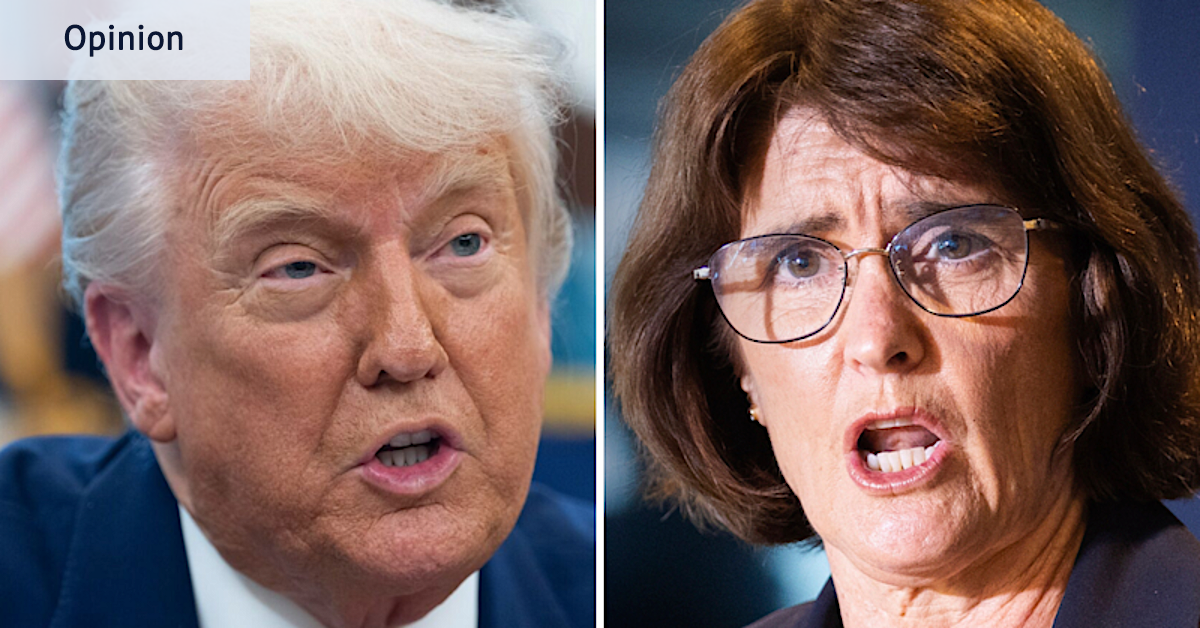
It’s like if Treasurer Jim Chalmers, sick of the Reserve Bank “smashing the economy” with interest rates, decided to pressure the Reserve Bank to lower rates by going after Bullock for the separate issue of cost blowouts on the bank’s office renovations. (Central banks seem to be having bad luck with their office revamps lately).
Trump’s behaviour is probably a reflection of the fact he is a bit of a control freak who clamps down hard on people who don’t do what he says.
But even if his wish is simply to reduce cost-of-living pressures for people, his demands for the Federal Reserve to lower interest rates – if granted – will actually achieve the opposite.
Reducing interest rates tends to increase the amount that people are spending, driving up demand and therefore pushing up prices. It’s one of the reasons why we saw a surge in inflation during and after the pandemic.
Not only were governments spending huge amounts to keep people in jobs and keep businesses moving, but we also had central banks around the world dropping interest rates to record low levels. That was a deadly combination at a time when border closures and lockdowns were already shrinking the capacity of businesses to keep up their supply of goods and services.
Of course, that was a situation in which it may have actually helped somewhat for governments and central banks to work together. Perhaps, if they had co-ordinated their responses, they would have avoided both pouring fuel on the fire in a desperate attempt to keep it burning (which ended up overheating the economy and driving prices up).
But in most circumstances, having an independent central bank is the best way to ensure economic stability.
No one is absolutely immune to political pressure, and economists (at the Reserve Bank and elsewhere) can get things wrong. But it is much harder for elected officials – whose jobs are at the mercy of voters and who often don’t come equipped with economic literacy – to make interest rate decisions that aren’t just for narrow or short-term gain. Sure, borrowers might be happy with lower interest rates, but what about making sure prices across the economy don’t skyrocket?
It’s why, for several decades, the Reserve Bank has been independent, meaning it has been able to make interest rate decisions without interference from the prime minister, treasurer, or anyone else who might try to impose their will or act out of self-interest.
As University of Sydney politics lecturer Henry Maher explains, this is a concept that dates back at least a couple of centuries. David Ricardo, a British economist and politician, warned back in 1824, for example, that governments “could not be safely entrusted with the power of issuing paper money” and that they “would most certainly abuse it.”
That’s probably true. Many political leaders, just before an election, would be tempted to knock interest rates down a bit in an attempt to improve their chances of getting re-elected. Why? Because lower interest rates boost the sentiments of borrowers – especially mortgage holders who make up a big share of the population. This might, however, hurt the economy, especially if it’s done at a time when inflation is high or the economy is already heaving from too much demand.
Loading
But it was only in about the 1970s – when both inflation and unemployment climbed (a situation known as “stagflation”) – that support for independent central banks began to really take hold.
It was at this time that economists such as Milton Friedman argued there needed to be repeated, long-term increases to interest rates to end the stagflation crisis. Governments couldn’t truly be trusted to follow this plan because they wouldn’t want to be responsible for higher unemployment (often seen as a necessary consequence of getting inflation down). So instead, independent central banks, immune from voter backlash, could be tasked with making these tough decisions.
In Australia, the Reserve Bank began operating independently during the 1960s, separating from the Commonwealth Bank and setting up shop in Sydney where it had some physical distance from politicians in Canberra
It then gained more independence after a period of financial deregulation (a move towards more free-market practices) under the Hawke government in the 1980s, before the bank’s independence was formally recognised under treasurers Peter Costello and Wayne Swan in the late 1990s and into the 2000s.
Loading
It’s worth noting that independent central banks aren’t without their faults. While they tend to be good at keeping inflation in check, Maher points out unemployment rates in Australia were generally lower before the Reserve Bank gained its independence, reflecting the bank’s willingness to wield higher unemployment as a tool to keep inflation in check.
That, of course, does not justify ditching its independence entirely, or Trump’s crusade against Powell in the US. The governors of many central banks around the world – including Bullock – have rightly signed a statement in support of central bank independence and standing by Powell.
While the Australian government can still technically overrule the Reserve Bank’s decisions, it’s an emergency power that has never been used.
That’s a good thing because although there’s plenty for everyone to argue about, there are some things almost all of us agree on such as aspiring for lower inflation, higher employment and a more stable economy – which an independent central bank is better placed to deal with than often short-sighted politicians.
Central banks may not always get things right. But when political leaders such as Trump show an interest in playing God, it’s a clear reminder about why central banks need their independence.
Ross Gittins unpacks the economy in an exclusive subscriber-only newsletter. Sign up to receive it every Tuesday evening.
