


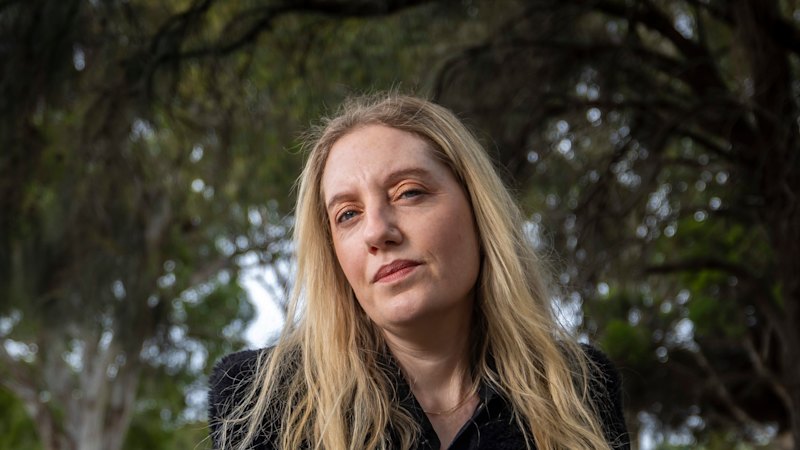

Amanda Bradley froze when her doctor delivered the news. Her rock-hard, bloated stomach was not caused by gluten intolerance; it was housing a cancerous sac the size of a football.
“It was so surreal,” Bradley said, recalling the moment she was diagnosed with ovarian cancer at 34 in 2014. “I quit my job. That’s it, no income, no independence, back at home … I was meant to be in my prime, going out, having fun, meeting people, dreaming of having my own family and kids.
“That vision of a future that I thought I was in the process of working towards just crumbled before my eyes.”
She is now part of a class action in the Victorian Supreme Court against pharmaceutical giant Johnson & Johnson. The lawsuit involves 1300 women who either developed mesothelioma, ovarian or other female reproductive system cancers after using talcum powder products.
Years after Bradley underwent two surgeries to remove her ovaries, she watched a documentary exploring claims Johnson & Johnson’s baby powder was contaminated with asbestos.
“When I saw the documentary, I knew straight away,” the now 45-year-old said. “I was so young when I was diagnosed, and I have no medical history of ovarian cancer. I didn’t have the gene.
“I was using Johnson & Johnson baby powder since I was born. My mother used to smother it all over my body. I would roll around in it when I was two, three months old.”
The class action alleges Johnson & Johnson’s talc products were defective, unfit for purpose, not of merchantable quality and the company was negligent in supplying talc due to its potential to cause cancer.
Talc is a naturally occurring mineral mined worldwide and is a common ingredient in powdered make-up products. Asbestos contamination occurs because the two minerals are found in close proximity during mining.
Mesothelioma is an aggressive, rare cancer that forms in the lungs or abdominal lining and is almost exclusively caused by inhaling or ingesting asbestos fibres.
Johnson & Johnson has denied its talc range was contaminated with asbestos, and said questions should be directed to its former consumer health business, Kenvue, which it spun off in August 2023.
“As a part of that separation, Kenvue retained the responsibility and any purported liability for talc-related litigation outside of the United States and Canada,” a spokeswoman said.
Kenvue said it would vigorously defend the proceedings and the safety of the product.
“While we stand behind the safety of our products, we sympathise deeply with people affected by serious health issues and understand that they and their families want answers,” a spokesperson said.
“The facts are that Johnson’s Baby Powder is safe, did not contain asbestos, and does not cause cancer. The safety of the product is backed by extensive regulatory review, independent testing, and health authority assessments around the world.”
In August 2023, Johnson & Johnson said it would stop selling talc-based products in Australia, transitioning to a cornstarch base.
Tim Driscoll, a professor of epidemiology and occupational medicine at the University of Sydney, said there was an undisputed link between asbestos and mesothelioma and ovarian cancer; talc products contaminated with asbestos could therefore be expected to cause these cancers.
“Talc and asbestos occur in the same mineral deposit, so it’s very common to be contaminated, and even baby powder that was said not to be contaminated, it’s shown that probably at least early on, a lot of it was contaminated with low levels of asbestos, but high enough to cause problems,” he said.
“But the International Agency for Research on Cancer … they looked at talc that was supposedly not contaminated by asbestos, and there were certainly suggestions that talc on its own might increase the risk of ovarian cancer, but the evidence isn’t clear.
“If [manufacturers] say there’s no asbestos contamination, I would have expected them to be confident that was the case. But I think the evidence suggests that it’s difficult to be sure about that.”
In December, a Californian jury awarded $US40 million ($56 million) to two women who said baby powder was to blame for their ovarian cancer and the company knew its talc-based products were dangerous but failed to warn consumers.
Johnson & Johnson said at the time the company planned to appeal.
Craig Allsopp, the head of class actions at Shine Lawyers, which is bringing the class action, said for Australians to discover baby powder wasn’t safe was a deep betrayal of consumers’ trust.
“Australians and people across the world trusted Johnson & Johnson’s products for decades, applying talc to their and their babies’ bodies under the assumption that it was safe to do so,” he said.
Start the day with a summary of the day’s most important and interesting stories, analysis and insights. Sign up for our Morning Edition newsletter.
