


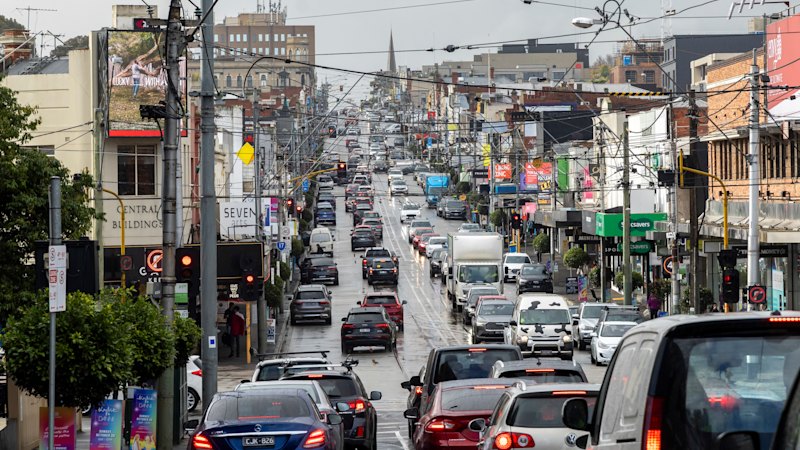

Just 110,000 additional homes – about one-sixth of the total capacity slated for Melbourne’s new activity centres – are commercially viable, casting fresh doubt on the Allan government’s signature housing policy.
While some communities have baulked at the government’s contentious height limits that are proposed in the centres, economists and industry figures are now arguing for even more lenient development rules to kickstart construction in a market where the numbers do not stack up.
Analysis from the Grattan Institute shows that of the 600,000 homes the organisation believes could be unlocked by planning changes in activity centres, only 18 per cent are currently feasible to build.
Grattan’s economic policy program director, Brendan Coates, said a post-pandemic surge in construction costs meant few mid-rise projects in activity centres were viable today.
“And new apartments in some more distant activity centres, such as Broadmeadows and Epping, are in low demand,” Coates said. “The challenge now is to build more of the homes that people want where they want them.”
The activity centres program rezones land for high-density living around 60 established transport and commercial hubs across Melbourne, including inner-city zones such as South Yarra and suburban areas such as Oakleigh and Blackburn.
Core areas of activity centres closest to shops and stations have height limits up to 20 storeys, and as high as 50 in proposed Suburban Rail Loop hubs like Box Hill, while districts a few streets back are usually limited to three to four storeys.
Developer Liam Wallis, the founder of Hip V. Hype, warned that a 40 per cent surge in construction costs over the past five years had become the biggest handbrake on higher-density projects.
“The financial investments being put in place [by the government] are not adequate to attract investment in housing in Victoria,” Wallis said. “Taxes and charges on property at this point in time are very unhelpful.”
Coates, who has praised the government’s planning reforms so far, suggested increasing height limits across outer areas from three to six storeys and removing requirements that force developers into costly land amalgamations. He also urged expanding the program to high-demand hubs such as Fairfield, Ivanhoe and Newport.
Grattan’s analysis found that the government’s combined housing reforms had boosted the total zoned capacity to 1.58 million homes, though only 530,000 are commercially feasible today.
Beyond activity centres, Coates said high-demand suburbs such as South Melbourne and Hampton should say a broad “yes” by default and allow residential buildings of at least 12 storeys.
This feasibility crisis hits as some inner south-east suburbs earmarked for activity centres retain a plethora of established apartments selling at a loss.
The trend raises questions over whether buyers will pay a premium for new apartments when existing stock is cheaper.
David Hayward, an emeritus professor of public policy at RMIT University, said if the government wanted more higher-density homes near public transport, it should not rely on the private market.
“We are seeing a massive disconnect between the government’s planning maps and the financial reality of the banking and construction sectors,” Hayward said. “If the private sector cannot make a return on these sites, the government may have to look at much more direct intervention.”
The government pledged to build 80,000 homes per year in the decade to 2034 but is falling short by about 20,000. While the state builds more than any other, not everyone agrees the extended targets are necessary.
Hayward argued the government’s land tax regime had been highly successful at moderating property prices, making Melbourne affordable for first home buyers.
“Chasing these dreams that are not needed has led to planning reforms that are diminishing the quality of housing stock,” he said.
Wallis said significant bureaucratic hurdles remained despite recent planning reforms, citing a project that spent 12 months and hundreds of thousands of dollars resolving permit conditions.
While Coates argued townhouses were today’s most viable developments, Wallis warned that “under-developing” sites because of current market conditions would be a bad long-term outcome for the city.
“You only get to build infrastructure once; you only get to build the Suburban Rail Loop once,” Wallis said.
A spokeswoman for Planning Minister Sonya Kilkenny said the planning system overhaul was slashing upfront costs and cutting red tape.
“We know there’s been pressures delivering housing right across the world, that’s why we’ve introduced bold reforms including overhauling our planning laws,” she said.
Property Council Victoria executive director Cath Evans said her organisation supported the intent of the program but noted targets must be grounded in market reality.
“Construction costs and ever-increasing taxes and charges mean development in these centres is incredibly challenging,” Evans said.
The activity centre program has sparked a backlash in suburbs such as Brighton, where Liberal MP James Newbury has led rallies against the density push.
Opposition planning spokesman David Southwick – whose seat of Caulfield was recently earmarked for towers up to 20 storeys – said data suggested the activity centre projects did not stack up.
“Victoria has the highest property-tax burden in the nation,” he said. “A credible housing strategy must deliver critical infrastructure, not rely solely on forcing higher density into established suburbs.”
But pro-density group YIMBY Melbourne argued that while commercial viability currently remains a hurdle, the peak of the construction cost crisis appeared to have passed.
“The most important thing to remember is that changing lines on maps enables housing to be built as soon as it becomes economically viable,” lead organiser Jonathan O’Brien said.
Plans for all 60 centres are expected to be finalised by the middle of this year, and the government wants to complete at least 300,000 homes in the centres over the next 25 years.
Start the day with a summary of the day’s most important and interesting stories, analysis and insights. Sign up for our Morning Edition newsletter.
 Daniella White is a state political reporter for The Age. Contact her at da.white@nine.com.auConnect via X or email.