


Towards the end of the pandemic, she moved to New York to pursue her art further. Her work has appeared in Vogue, The New Yorker, The Washington Post and on the BBC. In 2020, she illustrated a piece for Shado Magazine on “the environmental warfare Israel has been doing on Palestinian farmers and their crops”. On Instagram, she wrote: “Presidents come and go, but American imperialism never changes. Thinking of the Palestinians, who suffer no matter who’s in office.”
She soon met Mamdani, whose political rise was in its infancy. The year before, he had become a state assemblyman. They eventually became engaged, and in February this year, they rode the subway from their apartment in Astoria to City Hall to seal the deal.
On Tuesday night, after the final votes were declared, a short clip appeared on Mamdani’s Instagram (which is credited with playing a crucial role in his win) of a pair of subway doors opening while a voice-over says: “The next and last stop is City Hall.”
As Mamdani’s campaign gained momentum, speculation began to swirl around the very existence of this mysterious artist partner who never appeared alongside him, with critics claiming he was “hiding” his wife. In May, to prove a point, Mamdani posted a series of pictures from their wedding day.
“If you take a look at Twitter today, or any day for that matter, you know how vicious politics can be,” he wrote. “I usually brush it off, whether it’s death threats or calls for me to be deported. But it’s different when it’s about those you love.
Loading
“Three months ago, I married the love of my life, Rama, at the City Clerk’s office. Now, right-wing trolls are trying to make this race – which should be about you – about her.
“Rama isn’t just my wife, she’s an incredible artist who deserves to be known on her own terms. You can critique my views, but not my family.”
In the comments, Duwaji joked: “omg she’s real”.
Though she has remained out of the spotlight, Duwaji is said to have been involved with her husband’s campaign behind the scenes, helping to shape his message. She is also said to have worked on the eye-catching iconography and font that features colours inspired by New York Metrocards, the Mets and the famous retro-style signs used by the city’s bodegas (convenience stores).
In April, she told YUNG magazine that things were “dark right now in NYC”, adding her art was a “reflection of what’s happening around me”.
In the interview, Duwaji was questioned about the situation in the Middle East, Donald Trump’s presidency and immigration raids in the United States.
“Right now, what feels even more useful than my role as an artist, is my role as a US citizen. With so many people being pushed out and silenced by fear, all I can do is use my voice to speak out about what’s happening in the US and Palestine and Syria as much as I can,” she said.
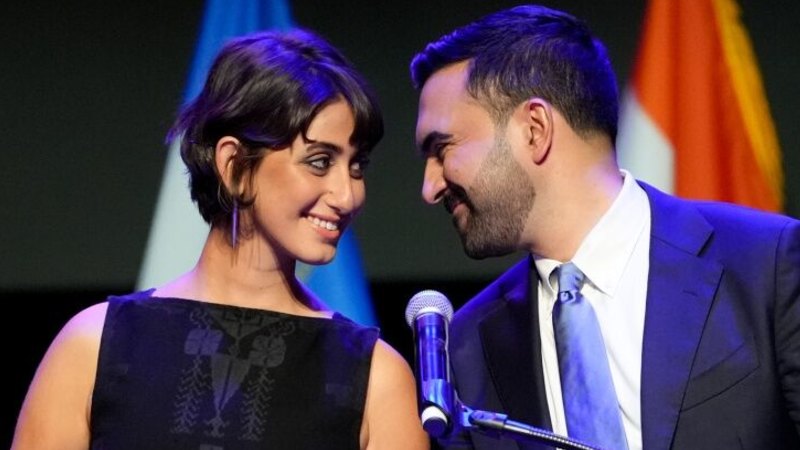
Now, it’s worth noting she appears to be getting the hang of the first lady thing already. Last night, taking to the stage alongside her husband, she wore an embroidered top by a Palestinian-Jordanian designer and a skirt by a New York designer. As on message as it is possible to be for the new, pro-Palestinian mayor, and no sign of the ubiquitous “political wife” stiff dress and court shoe look.
This was a first lady who, to much of New York’s 30-something population (the median age in the city is 38), looks like someone in their extended circle.

Rama is said to have worked on the eye-catching campaign iconography and font that features colours inspired by New York Metrocards, the Mets and the famous retro-style signs used by the city’s bodegas.Credit: AP
That is perhaps the key to Duwaji’s soft power. Last month, while her husband was canvassing final votes, she was running tile-making workshops in Williamsburg, Brooklyn. For $US95 ($146) and a couple of hours, budding artists could “explore underglazing techniques” and “the role of depictions of fruit commonly found in Islamic era ceramics”.
She might not have been front and centre during the campaign, but to young, liberal New Yorkers, Duwaji would have had an everyman appeal – an aura her husband was also keen to cultivate during his run for office.
Then again, one friend told the Times she was “our modern-day Princess Diana”, which is both a stretch and a sign that she may have already transcended the “one of us” thing.
Loading
In June, on the day of the primaries, Duwaji posted another carousel to her Instagram. The first shows a black and white photo-booth strip of the couple; the second, a heart-shaped chocolate box with a New York State voter registration form tucked into it. Then comes a selfie with an “I voted early” sticker in front of a poster of her husband, a clip of Mamdani smiling at her on a New York sidewalk, and finally an old family photo of a young Mamdani toddling towards the camera. The caption reads: “couldn’t possibly be prouder”.
Blink and you’d have missed it. Days later, it was back to regular programming. “Anyways …” she wrote under the next post. “Here are things I saw in June that made me want to make art.”
So when the dust settles, then, when her husband has been sworn in and the removal men have moved her art materials into Gracie Mansion, will it be back to regular programming? Or was last night just the beginning for Mrs Mamdani, New York’s new first lady?
