









The rapid expansion of China’s nuclear-powered submarine fleet and long-range missile stockpile is fuelling its growing ability to hit targets in Australia, a threat that could expand dramatically over the next decade, a new analysis warns.
The Lowy Institute paper, to be released on Monday, finds that China’s existing ability to strike the Australian mainland would be turbocharged by game-changing developments: the addition of a new long-range bomber to its military arsenal, as well as the ability to move existing assets closer to Australia via a military base in the Pacific.
The paper, based on open-source intelligence on China’s military modernisation, finds the Chinese navy is set to have 25 nuclear-powered attack submarines at its disposal by 2035, up from an estimated nine today.
Australia is scheduled to acquire its second such vessel – an in-service United States Virginia-class submarine – by this date under the AUKUS nuclear-powered submarine pact.
Australia’s distance from China is still a strategic asset, but analysts Sam Roggeveen and David Vallance find the direct strike threat “is real and growing, primarily through missiles fired from surface ships, submarines, and potentially from Chinese territory”.
“China can already strike northern Australia with ballistic missiles deployed to its South China Sea outposts, and its capacity to strike the Australian landmass from Chinese territory will grow over the next decade,” Roggeveen and Vallance state in Understanding the Chinese military threat to Australia.
“As China’s submarine fleet grows in size and sophistication, its ability to use these platforms to strike targets on the Australian mainland will also grow.”
Roggeveen was most struck by China’s expansion of its fleet of nuclear-powered attack submarines, which can travel vast distances without having to refuel.
“They appear to be on the cusp of a building boom,” he said.
The report finds the Bohai shipyard in Liaoning province is ramping up to produce between 4.5 to six submarines a year, including three to four nuclear-powered attack submarines [SSNs] and two ballistic missile submarines.
“Of the 25 SSNs we estimate will be in service by 2035, all are likely to deploy cruise missiles or perhaps hypersonic missiles,” the authors state.
A fleet of 25 would give China “the capacity to prosecute sustained strike operations against Australian targets, rotating boats through patrol cycles to maintain persistent threat coverage”, they find.
The US is aiming to produce 2.33 Virginia-class submarines a year by the early 2030s, but annual production has languished at about 1.3. The US navy has 53 nuclear-powered attack submarines, and is hoping to increase the figure to 66 by the mid-2030s.
The Chinese navy is also dramatically ramping up its fleet of surface vessels including destroyers, aircraft carriers and frigates.
The authors stress they are not arguing that China intends to attack Australia, and that Beijing’s primary military focus is closer to home, especially the Taiwan Strait.
“I don’t think it’s alarmist to examine the scale of the threat through a sober, fact-based analysis,” Roggeveen said.
“The chances of a Chinese attack on Australia are small, but governments must look at capability, not just intent.”
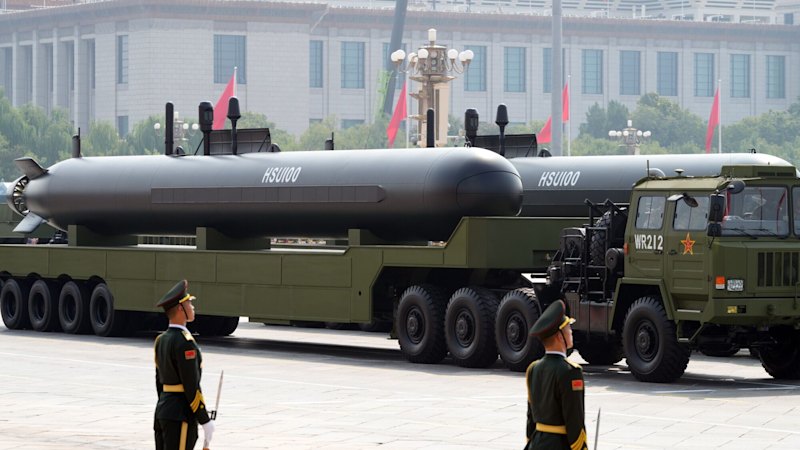
Chinese President Xi Jinping showed China’s military advances at a lavish parade in Beijing last year.
The authors argue it is crucial for Australia to understand China’s military capabilities to manage its own defence planning.
“Governments cannot plan their defences solely on the basis of what a country might do, because
intentions can change in moments,” they state.
“Military action against Australia could occur as part of a larger war involving the United States or as a limited campaign to coerce Australia.”
They canvass scenarios including China striking an offshore oil facility or attacking ports, airports, bridges or railway facilities as a form of economic coercion.
The Lowy report finds the People’s Liberation Army’s Rocket Force (PLARF) is China’s most effective means of long-range strike against Australia.
“In the event of a major regional conflict, bases across northern Australia would be targets for the PLARF,” the authors state.
“The crown jewel of the PLARF is the DF-26, the only Chinese conventional system that can reach Australia without first having to be carried within firing range by a bomber, ship or submarine.”
The DF-26, a non-nuclear ballistic missile that entered service in 2016, could reach northern Australia, but only when fired from one of Beijing’s artificial islands in the South China Sea.
The most significant increase in China’s missile arsenal has been its stock of intermediate-range ballistic missiles. Their range of 4000-8000 kilometres puts them potentially within reach of northern Australia.
China had virtually no intermediate-range ballistic missile capability in 2016, but forecasts suggest it could have more than 1000 such systems by 2035.
China’s H-6 long-range bombers currently have only limited capability to attack Australian targets. The report finds this would change dramatically if it could establish a Pacific islands military base.
Cut through the noise of federal politics with news, views and expert analysis. Subscribers can sign up to our weekly Inside Politics newsletter.


