









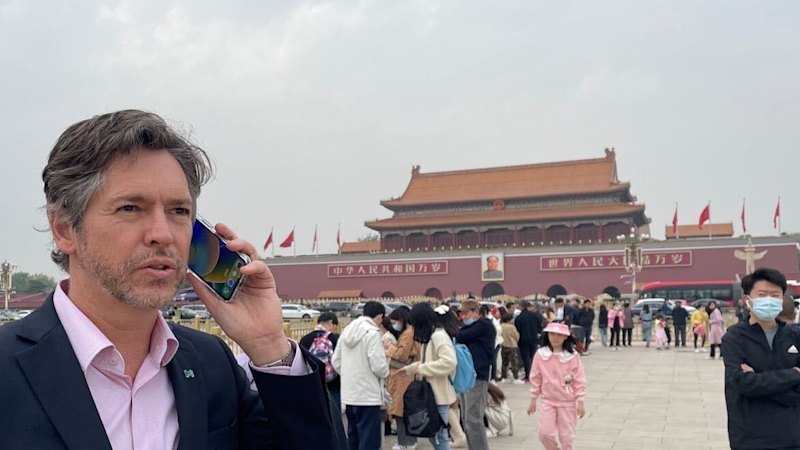


On the tenth floor of a building in the Chinese port city of Tianjin sits the City of Melbourne’s most far-flung outpost.
About 9000 kilometres away from the council’s CBD chambers, the satellite office is staffed by two full-time employees and boasts that it is at the “forefront of business development and civic engagement” between Melbourne and Tianjin, a city with a population of 13 million.
However, most of the council’s ratepayers are probably unaware of its existence, or the near $200,000 pricetag to operate it last year.
The office was opened almost three decades ago in 1998, when the late Ivan Deveson was lord mayor. However, the cost to run the satellite office is not itemised in the City of Melbourne’s budget, there is limited details available on its operations, and the last publicly available report on the Tianjin office’s performance appears to have been filed more than 20 years ago in 2004.
Currently staffed by “chief representative” Bonnie Shao and business development manager Lucy Ning, the first phone call from The Age to the number listed for the Tianjin office on the City of Melbourne’s website rang out, and an email enquiry went unanswered.
The next day, Ning answered the phone but said she was not authorised to speak to the media about the operations of the office.
When asked what the operating costs were for the Chinese office, a City of Melbourne employee mistakenly sent an email to The Age which was meant to be circulated internally only, and which showed the operation’s pricetag to be $194,003 for last year.
Councillor Owen Guest said it was a small example of the overreach of the council.
“For years on end, the City of Melbourne has been expanding into all sorts of areas in ways that ratepayers would have no visibility of,” he said. “There seems to be an opaque culture.”
City of Melbourne’s chief executive Alison Leighton travelled to Tianjin last June for five days at a cost of $13,993, for purposes including “meetings with the City of Melbourne offices in the sister city Tianjin and key government and private partners”.
A City of Melbourne delegation to China and Japan in September – led by Lord Mayor Nick Reece and attended by councillors Gladys Liu, Philip Le Liu, Kevin Louey and two staffers – cost a total of $91,063, according to the council’s travel register. This included $5633 in travel costs for Shao, even though she is based in China.
The trip featured a visit to Tianjin, a city with over 13 million residents, to mark 45 years of the sister-city relationship.
When contacted by The Age, Reece defended the need for the remote office in the Chinese port city, saying strong global relationships attracted investment that benefited local jobs, businesses and ratepayers.
Reece called the office “Melbourne’s gateway into China for the last two decades”, and said that “China has been the biggest source of immigrants to the city of Melbourne, and a huge source of investment”.
He also claimed that the delegation visit last year generated $53 million in economic benefits.
The City of Melbourne has been a sister city with Tianjin since 1980 and claims on the council website that they are “the only Australian local government to have a permanent office in China”. But the Tianjin office operates in addition to the state and federal government’s presence in China.
The Victorian government has offices in Beijing, Shanghai, Chengdu, Nanjing and Hong Kong, while the federal government operates the Australian embassy in Beijing and consulates-general in Shanghai, Guangzhou, Chengdu and Hong Kong.
Councillor Guest said a better pathway would be for the council to sit down with the state and federal governments and work out whether it could share resources.
“It’s a classic example of every tier of government trying to do the same thing, doubling up, tripling up,” he said. “Ultimately, whether or not the value of the office itself is questionable, that we are being taxed at all three levels to do the same thing is unacceptable. At best, it’s inefficient.”
Start the day with a summary of the day’s most important and interesting stories, analysis and insights. Sign up for our Morning Edition newsletter.


