


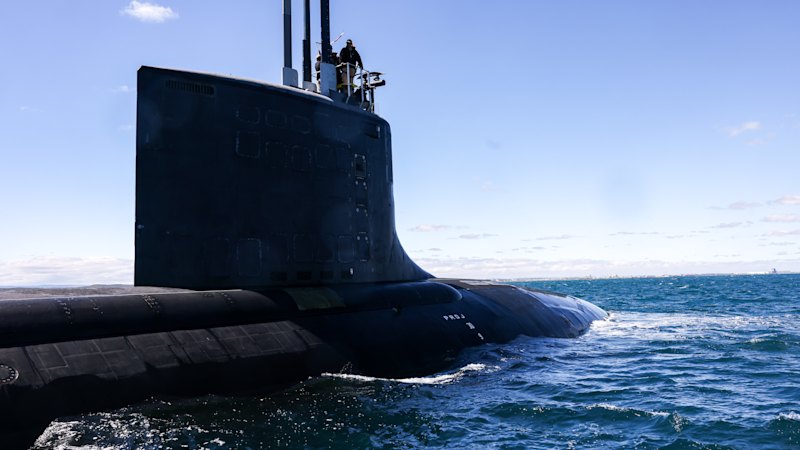

Washington: The United States Navy is preparing for a significant shift in its plans that could reduce its reliance on Virginia-class attack submarines, potentially making it easier for Australia to acquire the vessels as planned under the AUKUS agreement.
There are also signs the lagging rate of US submarine production is improving, with one shipyard boasting of a 14 per cent jump in productivity and saying the Virginia-class boats had a “very good year”.
The navy has recently advertised its plans for a “hedge strategy” that moves away from reliance on large and expensive aircraft strike carrier groups towards more flexible and adaptable fleets. The shift responds to what Chief of Naval Operations Daryl Caudle called “fiscal, industrial and operational realities”.
A January briefing paper by the Congressional Research Service cited a recent report in Jane’s Navy International, a specialist military publication, which revealed the navy was contemplating cutting its target number of attack submarines from its long-time goal of 66 to 54 – only slightly more than it has now.
The Jane’s report was based on draft plans for the so-called Golden Fleet, the navy’s next fleet iteration, that were seen by the author and under consideration by navy leadership.
If confirmed, the change would be significant because it would reduce the US Navy’s reliance on the Virginia-class subs, making it more likely that it can “spare” some for Australia. Under AUKUS, Canberra is due to purchase three to five boats, starting in 2032.
Bryan Clark, director of the Centre for Defence Concepts and Technology at the Hudson Institute, who has worked directly with the navy on its force level planning, confirmed it was heading in that direction.
He said the navy wanted to build a new generation of large-diameter submarines, as well as new unmanned vessels, making it unrealistic to keep growing the fleet of Virginias.
“I think the impact of the AUKUS subs on the US submarine inventory is decreasing over time,” Clark told this masthead. “Their long-term need for Virginia [subs] is going down a little bit. They’re seeing these uncrewed systems as a way of addressing what they need, so they don’t require a submarine any more.”
Clark said it was too early to be certain if the navy would actually reduce its target for the Virginia-class boats. “But I think internally they are starting to lock it down.”
The Pentagon directed inquiries to the navy, which didn’t respond to questions before deadline.
Since US President Donald Trump confirmed the AUKUS agreement was “full steam ahead” in October, the major roadblocks to the first stage of Pillar I remain the capacity of the US industrial base to produce enough of the submarines, and the US’ need for them.
Under AUKUS legislation, the US president of the day must be satisfied that the transfer of any submarine to Australia “will not degrade the United States’ undersea capabilities”.
The official production rate given by the navy last April was 1.13 vessels a year, but it needs to be at least 2.0. Caudle told his confirmation hearing that the rate needed to double for the US to fulfil its AUKUS commitments to Australia, and at the Apex Defence Forum in Washington last month, he noted that the US defence industrial base “continues to lag well below demand”.
However, there are limited signs that production is improving. The Virginia-class vessels are built by two US companies: General Dynamics Electric Boat (GDEB) and Huntington Ingalls Industries (HII) – the only two shipyards capable of building nuclear-powered submarines.
On an earnings call earlier this month, HII reported a 14 per cent increase in throughput – or productivity – on the Virginia-class boats in 2025.
“There’s an incremental walk-up in throughput required to get to the two Virginia-class per year. But they had a very good year last year,” the company’s president, Chris Kastner, said on the call.
The navy has also reported a slight improvement in progress on its first Columbia-class submarine. Head of strategic submarines Todd Weeks told the West 2026 conference that the vessel was tracking for delivery in 2028 instead of 2029.
The aforementioned Congressional Research Service report garnered attention in Australia for presenting an alternative option to AUKUS, whereby instead of selling submarines to Australia, the US Navy could operate up to eight of the vessels from Australian ports. However, that idea is not new, and has been part of the report in every update since June 2024.
Caudle called AUKUS “one of the most consequential defence partnerships of our lifetime” when he addressed the Naval Submarine League in San Diego last week.
“It’s not just about boats. It’s about shared deterrence, interoperability at the deepest levels, and a long-term commitment to peace through strength in the Indo-Pacific,” he said.
“It also sends an unmistakable message – our undersea advantage is collective, united and formidable, and we intend to keep it that way.”
Get a note directly from our foreign correspondents on what’s making headlines around the world. Sign up for our weekly What in the World newsletter.
 Michael Koziol is the North America correspondent for The Age and Sydney Morning Herald. He is a former Sydney editor, Sun-Herald deputy editor and a federal political reporter in Canberra.Connect via X or email.