


A central zone about 200m long also shone through with an intensity of 800 S, while a number of smaller plates measuring about 50m long were picked up with a response of 500 S.
All plates plunge gently southwest, with vertical extent limited to about 100m starting about 150m below surface.
Litchfield Minerals managing director Matthew Pustahya said: “These results continue to strengthen our conviction that Oonagalabi represents a large, well-preserved mineral system, with the work completed to-date only scratching the surface. The close spatial relationship between high-conductance EM plates, intrusive-related magnetic features and confirmed copper-zinc sulphide mineralisation reinforces our view that we are sitting high in the system, with significant potential remaining at depth.”
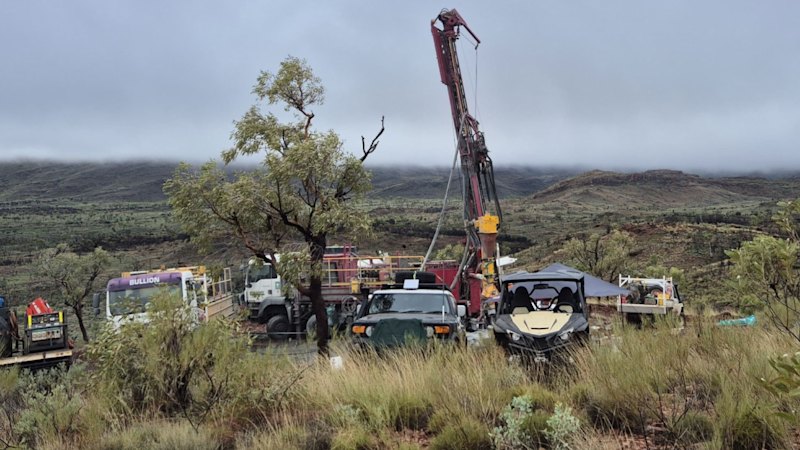
Recent reverse circulation drilling has confirmed amphibolite-hosted pyrrhotite-chalcopyrite-sphalerite sulphides – iron sulphide-copper sulphide and zinc sulphide, respectively – demonstrating the effectiveness of EM geophysics for this style of mineralisation.
Importantly, all strong VTEM conductors across the project are adjacent to or coincident with intrusive-related magnetic anomalies – believed to be amphibolite intrusions – opening new exploration upside in the northeast at the company’s VT4, VT5, VT6, VT13 and VT17 geophysical anomalies.
Drilling at VT2 and VT1 has shown that copper-zinc mineralisation can be tied to the amphibolite intrusions through the occurrence of magmatic magnetite and hydrothermal pyrrhotite. The broader system appears extensive and fertile, with VTEM effective to about 250m depth, although current work has only tested the upper levels of the anomalies so far.
Additional geophysics this year will model deeper extensions around magnetic intrusions, with plans to prioritise the high-conductance plates and IP anomalies at VT1.
Additional high-priority work will include follow-up drilling at VT2 to target the high-chargeability anomalies and expand the near-surface footprint at the Oonagalabi Main Zone.
Litchfield says it also plans to extend its IP surveying southwest along the non-outcropping part of the Oonagalabi Formation and will throw a 750m deep diamond hole at the large Bomb Diggity magnetic anomaly.
The Bomb Diggity deep drilling, which is due to kick off in mid-January, is co-funded by a Northern Territory Geological Survey grant, with the drilling contractor DDH1 scheduled to arrive at site on 17 January.
With its latest geophysical refinements on hand, Litchfield is building a clearer 3D picture of a potentially extensive, intrusion-related mineralised system at Oonagalabi,
The scene is now well and truly set for targeted deeper drilling and resource growth in one of the NT’s emerging base metals districts.
Is your ASX-listed company doing something interesting? Contact: mattbirney@bullsnbears.com.au
