
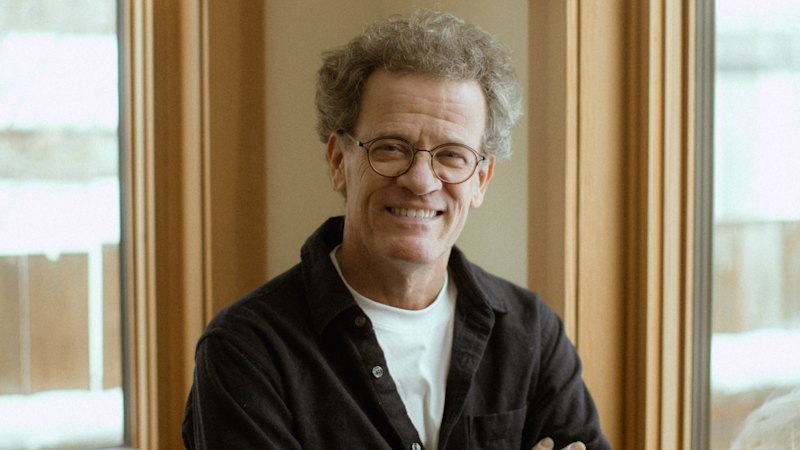




Each week, Benjamin Law asks public figures to discuss the subjects we’re told to keep private by getting them to roll a die. The numbers they land on are the topics they’re given. This week, he talks to Yann Martel. The Canadian author, 62, is best known for Life of Pi, which won the 2002 Man Booker Prize, was published in 44 countries and adapted into a film nominated for 11 Oscars. His latest novel is Son of Nobody.
BODIES
So, you’re in your 60s and look to be in really good shape. Well, I’ve been doing something called CrossFit for 15 years. In fact, the CrossFit Open just started, which is a worldwide competition to get to the CrossFit Games. So I did the CrossFit Open workout this morning.
I love that you’re a Booker Prize winning-author and CrossFit freak. You know what? I love being a writer; it’s lovely to be inside one’s head. But I have a body, too. So I’ve always balanced exercise and writing. Before CrossFit, I used to do a lot of swimming and cross-country skiing. I’ve been exercising, basically, all my life.
And as I speak to you, I can see in your office … is that a treadmill desk? [Nods] God, how long have I had that? The last book – The High Mountains of Portugal – I wrote on my treadmill, so I’ve had it for at least 12 years. It’s no substitute for exercise, but it does mean you’re not sitting for hours on end. I’ve written two books, done research and sent any number of emails while I’m gently walking on that contraption.
What are you liking and disliking about your body right now? I don’t mind my chest, which is hairy and padded with muscles. My legs are too thin. My crazy-scientist hair I don’t mind, although it’s a hassle getting it cut as they don’t know what they’re doing. I have weak eyes; this runs in the family. But, overall, my body has always done what I’ve told it to do. There’s no mountain I couldn’t climb; no lake I couldn’t swim across. I’ve been lucky.
POLITICS
Looking back at your body of work, do you see an ethical framework governing how you write? Or a mission statement? Well, I don’t know if I’d say “ethical”. But I studied philosophy at uni: a three-year bachelor’s degree. I like the big questions philosophy asks: “What is beauty?“; “What is justice?″; “What is reality?” And, in Life of Pi, “What is faith?“. Why do people believe in these unseen, unproven gods? What is faith about? In Son of Nobody, I’m interested in: “What do we do with all this sadness? What do we do with the sadness of mortals?” Every book I’ve written has been the result of a question.
We’re talking politics. How does it feel in Canada right now, given the tumultuous relationship between Canada and the US, as well as that between your prime minister and the American president? It’s awkward. But I always say, “We’ve been there before, guys.” We’ve all had terrible leaders who’ve let us down. Of course I hate Donald Trump: his incessant lying; his manipulation of the judiciary system; his insulting of judges and hoping they’ll cower. He’s terrible. But it’s sometimes good to have your democracy tested. Right now, Trump is testing American democracy to its limits.
Former US president Barack Obama is a fan of yours. Is it true that after he read Life of Pi with his daughter, he sent you a letter? Out of the blue, I got a letter: a little card, handwritten by Barack Obama. And I’m not even American! The letter said, “The White House” and I thought, this must be some clothing store called The White House. But it was the White House. I’m very happy about that. It was nice to see. You can see his vision. Here is a man who reads and gave those wonderful speeches. At the same time, I don’t know if he pushed against China enough, and I don’t know if he pushed Israel enough …
You’ve got the name recognition. You’re admired and respected. Would you ever run for office? No. But they did ask me …
Really? Who? The [Canadian] Liberal Party, and another party called the New Democrats, who are left of centre. But I said no. I’m not cut out to be a politician. Politics is about attention to public policy and the minutiae. I’m interested in writing stories.
MONEY
What was your life like before you won the Man Booker with Life of Pi, and after? I imagine those are two different financial realities. They were both good lives. Before Life of Pi, I was living in Montreal, which – among Canadian cities – is the cheapest. I had roommates. My first book – a collection of short stories – only sold 500 to 600 copies in Canada. When I started writing Life of Pi, my income every year was less than $10,000. I was, in a sense, under the poverty level. It didn’t matter because I was working on this wonderful book that I loved. It felt as if every day in my little office I was on a lifeboat, and I had to keep this tiger alive.
Did you think anyone would read it? Of course not. But you shut out the world and say, “This is important.” Then, unexpectedly, the book started doing well. Then, unexpectedly, I won the Booker. Then Life of Pi sold 15 million copies. It was turned into a movie and a play. Everyone in the UK who went to school has read it. And from having no money, I had this tidal wave of money.
Whoa! But, in many ways, it’s funny how wealth doesn’t change you as much as you would think. I made stacks of money with Life of Pi, and now have a reasonably big house, albeit in a small city in the middle of nowhere [Saskatoon, Saskatchewan]. I have four kids, and both my partner and I work at home, and we have a Toyota Sienna – which is a little bus – and a Mazda 3. But every book I’ve written since has had nothing to do with trying to be successful. It’s about: “How can the story speak to me? And how can it speak to others?”