








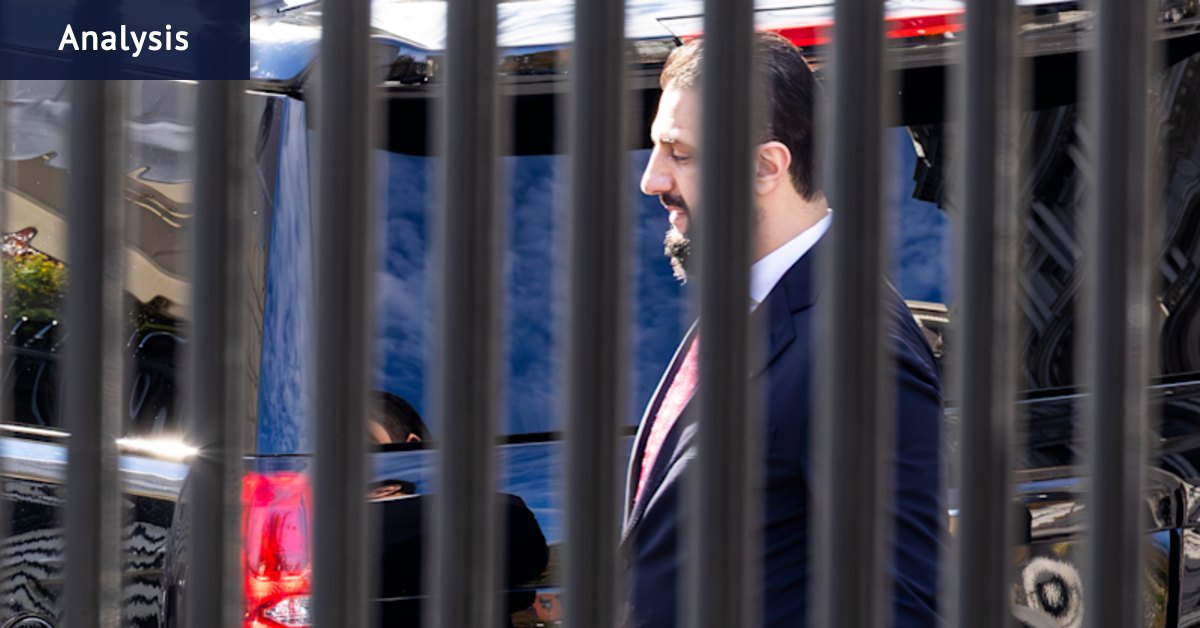
The man formerly known as Abu Mohammed al-Jolani left the White House about two hours later and greeted a throng of supporters gathered outside under the watchful eye of his large security detail.
Trump and Sharaa first met in May in Saudi Arabia. At the time, the US president described Sharaa as a “young, attractive guy. Tough guy. Strong past, very strong past. Fighter.”

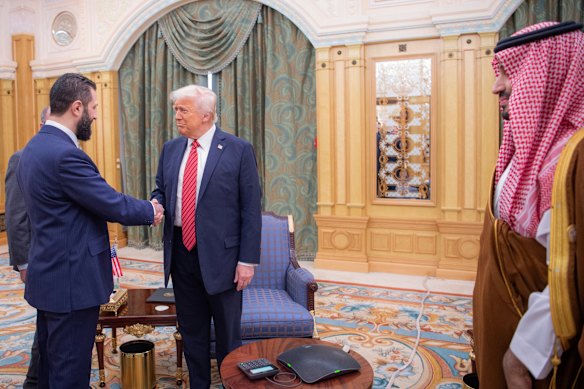
Sharaa shakes hands with Trump in Riyadh, Saudi Arabia, in May.Credit: AP/Saudi Royal Palace
This time, the pleasantries of the meeting remained closely guarded, but the US president is said to have agreed to lift sanctions against the state for 180 days.
Pictures later released by the travelling delegation showed the two leaders shaking hands and smiling in the Oval Office. JD Vance, the US vice president, was also in attendance.
At a later event, Trump praised the Syrian mission he had hosted, but ignored reporters’ questions about whether any deals had been made.
“He’s a very strong leader,” he said in the Oval Office.
“He comes from a very tough place, and he’s a tough guy. I liked him. I get along with him … the new president of Syria, and we’ll do everything we can to make Syria successful.”
The last time Sharaa was officially a guest of the Americans was as an inmate in Iraq’s military prisons between 2005 and 2011. For a while, he was held at Abu Ghraib, whose notorious regime of abuse can hardly have endeared him to the US cause.
The exact reason for his arrest remains unclear, though he was reputed to be a skilled bomb maker and is alleged to have been caught planting roadside bombs targeting US troops.
After returning to Syria in 2011, as the uprising against Assad began, he founded a Syrian branch of Abu Bakr al-Baghdadi’s Islamic State movement. His group’s suicide attacks against regime targets killed hundreds of civilians.
‘He could be a valuable ally. He could be the devil incarnate.’
A former Western diplomat who served in the Middle East
Later, after falling out with Baghdadi – who was killed on Trump’s orders in 2019 – Sharaa realigned himself with al-Qaeda.
Given this chequered past, some question the wisdom of Trump’s courtship of the Syrian leader.
“It’s a colossal gamble,” says a former Western diplomat who served in the Middle East. “He could be a valuable ally. He could be the devil incarnate.”
Loading
Trump has chosen to give him the benefit of the doubt. Last week, the United Nations Security Council backed a US resolution lifting sanctions on Sharaa.
Ahead of their meeting, the US president said: “I think he’s doing a very good job. It’s a tough neighbourhood, and he’s a tough guy, but I get along with him very well.”
Trump may govern by instinct on occasion, but his embrace of the Syrian leader is unlikely to be based on mere hunch. There are clear strategic advantages to a rapprochement.
Spurning Sharaa could drive him towards Moscow and Tehran. By contrast, a Syria inside the Western fold could be less likely to permit Iran to resupply its Lebanese proxy Hezbollah through its territory, cutting the group’s main lifeline.
Damascus has already cancelled Russia’s naval access to the port of Tartous, undercutting the Kremlin’s reach in the Mediterranean.
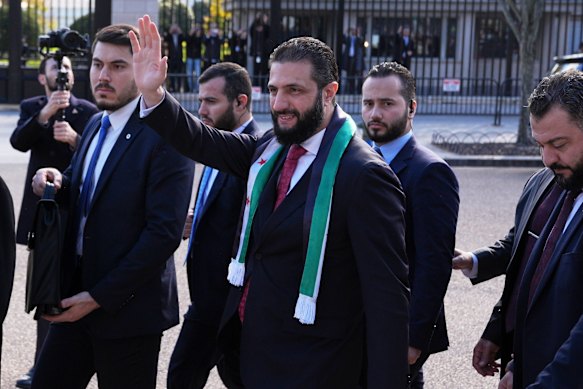
Sharaa waves to supporters outside the White House after his meeting with Trump.Credit: AP
Sharaa also has incentives to align with Washington. He needs the goodwill of Turkey and Saudi Arabia – Western allies crucial to Syria’s reconstruction – and has shown himself to be a pragmatist more interested in power than ideology.
Those Westerners who met him as a jihadist commander believe he used political Islam as a vehicle for ambition rather than conviction.
After carving out a fiefdom in Idlib in north-western Syria in the midst of the country’s civil war, he evolved from a hardline Islamist who banned Christmas and persecuted minorities into a leader who apologised to Christian clergymen and restored their property.
Under Turkish encouragement, he allegedly began quietly co-operating with the CIA, MI6 and other Western services – even while still on Washington’s terrorist list.
At the West’s request, he detained wanted jihadists, particularly those linked to Europe, and is said to have allowed Western spooks to interrogate them in his jails. He may even have assisted the American operation that killed Baghdadi.
Sharaa denies any intelligence ties, but he cultivated Western contacts. Such relationships have fuelled claims in jihadist circles that he is a Western intelligence asset – claims that seem far-fetched.
In reality, Syria’s new president appears to be acting, as ever, in his own interests. For now, those interests align with Washington’s. Since seizing power, he has continued to restrain extremists and help foreign intelligence agencies pursue al-Qaeda and Islamic State cells.
Loading
Whether he can succeed is another question. Syria remains riddled with armed factions and Sunni extremists nominally loyal to his government have carried out atrocities against minorities, most notably targeting the Druze and Assad’s Alawites.
Some analysts warn these militants could yet turn on Sharaa himself, reigniting civil war.
For Washington, then, Syria’s president is an unlikely ally – but in a shattered country with few alternatives, the Trump administration appears to have concluded it is worth taking the risk.


