



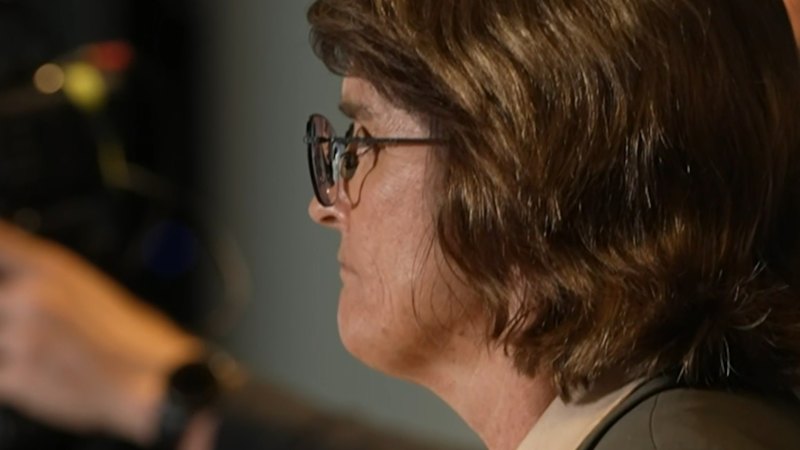




When Australian academic Kylie Moore-Gilbert was released from one of Iran’s most notorious prisons, 5½ years ago, Australia celebrated.
After falsely being accused of espionage, she’d spent 804 days in prison – a year, cumulatively, in solitary confinement – an experience so psychologically torturous that on one occasion she found herself beating her skull against the wall, dozens of times. “I don’t know how it happened,” she later wrote in her memoir, The Uncaged Sky.
And finally, she was free.
But now, she has a message for the federal government. So-called “hostage diplomacy”, of which she was a victim, is on the rise. This is the result, she says, of the disintegration of the international rules-based order. With that disintegration, countries like Iran, Venezuela and China have become emboldened to “act with impunity and do whatever they like”. Which, in some instances, means kidnapping someone in exchange for something the country wants, like a ransom, or the release of its own political prisoners.
And in order to combat hostage diplomacy, the Australian government needs to begin considering out-of-the-box ideas, says Moore-Gilbert, a research fellow in security studies at Macquarie University who was arrested at the Tehran airport in 2018 after she’d attended an academic conference in the country.
In today’s episode of The Morning Edition podcast, host Samantha Selinger-Morris and Kylie Moore-Gilbert discuss the ways in which Moore-Gilbert thinks she could have possibly been freed sooner had she been able to publicise her case in the media earlier, which would have gone against the long-time use by Australian diplomats of so-called “quiet diplomacy”, or using back channels to communicate with hostage-takers.
Click the player below to listen to the full episode, or read on for an edited extract of the conversation.
We also discuss arguably the most contentious proposal, featured in a special edition of the Journal of Policing, Intelligence and Counter Terrorism, which Moore-Gilbert edited, and which is published today. It’s one floated in Canada that would allow the country to offer monetary awards or refugee protection to foreign nationals who helped secure the release of detainees.
Selinger-Morris: We know that this was controversial in Canada. I don’t believe it’s passed. It’s not been legislated yet. But do you think that Australia should consider offering this?
Moore-Gilbert: This is a really, really interesting proposal, and I think we really need out-of-the-box thinking here. We need to have these kinds of ideas floating around. And it is controversial to offer refugee protection or other immigration status to people who assist in freeing hostages or wrongful detainees because obviously those people are probably going to be within the system that’s taken those hostages in the first place.
You know, we take Iran for example; if you’re an Iranian, a senior Iranian official working in the Islamic Republic who covertly provides information to Canada to help them get their hostage back, well, you’re giving immigration status to an official from a nasty authoritarian regime who may have done other nasty things in their own past. That’s a controversial move. It’s not set in stone. I think it would be assessed on a case-by-case basis, but it is an innovative way of trying to incentivise people from within those regimes to help you get control of your hostages and your detainees again.
It didn’t pass the Canadian parliament, but I think it’s going to go up again. I don’t think the issue is over. It was opposed by Canada’s version of DFAT.
Selinger-Morris: What would you say to listeners who hear that, and think, ‘Wait a minute, we’re trying to crack down on extremism here, especially in the wake of the Bondi massacre in December. This is really scary. That person we might be welcoming, a person in a really nasty system into our own country …’ What would you say to people who are listening and thinking that?
Moore-Gilbert: I would also be concerned about that. I mean, I’m very concerned about Iranian Islamic Republic officials, intelligence operatives, sympathisers in Australia. Unfortunately, there seem to be quite a lot of them that have flown under the radar. It endangers me and anyone else, mostly the Iranian-Australian community that’s been very vocal against that regime, and we see it with China, obviously as well, and a number of other regimes too, that operate here in Australia. So the last thing we want to do is, would be to insert somebody like that into our country unnecessarily. So I think, you know, they would have to be vetted by ASIO, or whatever the equivalent is, very closely. I think it’s encouraging defections. Essentially, you’re encouraging some of these people to defect and give you their information, probably beyond just on the hostage or the hostage taking, but all their intelligence or information they might have.
And in exchange for that, you’re offering them protection. We already do that when people want to defect. I understand. So this is just sort of an additional layer specific to hostage-taking on top of that.
Listen to the full podcast episode in the player above or click here.
Hear the story behind the headlines on The Morning Edition podcast, every weekday from 5am on Apple, Spotify or your favourite podcast platform.


