


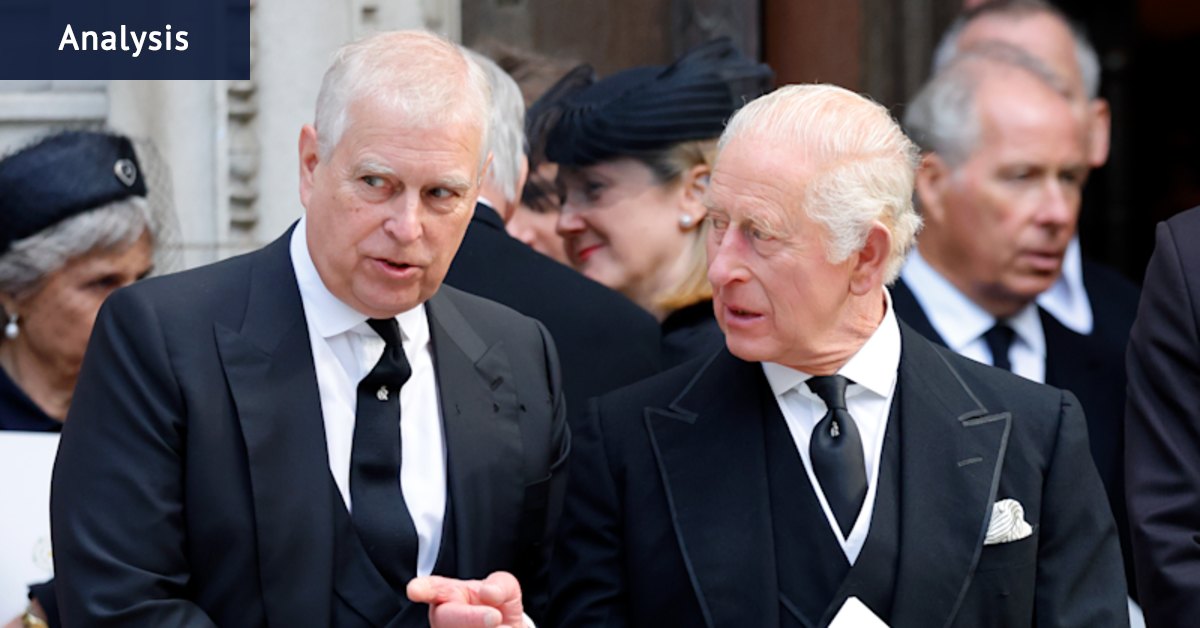

Buried in the latest Epstein files are new details that flatly contradict the claims that Andrew Mountbatten-Windsor made when he was trying to save his reputation.
This is why King Charles III wants the public to know he will support British police if asked to help their inquiry into the former prince over allegations he shared confidential information with convicted sex offender Jeffrey Epstein.
In an unusual step, the King authorised a statement by a spokesperson to leave no doubt he would work with the inquiry into his brother.
“The King has made clear, in words and through unprecedented actions, his profound concern at allegations which continue to come to light in respect of Mr Mountbatten-Windsor’s conduct,” the spokesperson said on Tuesday, London time (Wednesday AEDT).
“While the specific claims in question are for Mr Mountbatten-Windsor to address, if we are approached by Thames Valley Police, we stand ready to support them as you would expect.”
The message came with a reminder that Queen Camilla shares the concerns, saying: “Their Majesties’ thoughts and sympathies have been, and remain with, the victims of any and all forms of abuse”.
Thames Valley Police have confirmed hey are assessing the latest claims against Andrew, who has consistently denied any wrongdoing.
The King’s move follows the public statement from Prince William and Princess Catherine about their concern for Epstein’s victims in light of the latest revelations.
“I can confirm the prince and princess have been deeply concerned by the continuing revelations. Their thoughts remain focused on the victims,” said a spokesperson for William and Kate, an hour before the King’s message.
Mountbatten-Windsor is under serious pressure because we now know much more about his ties to Epstein, thanks to the release of 3 million documents from the US Department of Justice on January 30.
The former prince has lost his dukedom, his titles and his honours. But this does not provide him with any protection from police questions about what is in the latest files.
The key factor is the discovery that he sent files to Epstein as a government trade envoy, drawing a parallel with the way Peter Mandelson sent confidential documents to his friend during his time as a cabinet minister.
This has to be treated with care because one of the files is a briefing on a trade visit and is unlikely to be a cabinet document or a matter of national security. More could emerge because nobody can be certain about what else is in the latest Epstein files.
Thanks to BBC journalists, including Andy Verity, we now know that Mountbatten-Windsor passed documents to Epstein about his trade missions to Singapore, Hong Kong, Vietnam and Afghanistan.
The objective appeared to be to keep Epstein in the loop on investment opportunities. The documents could be covered by government rules about confidentiality.
On Christmas Eve in 2010, for instance, Mountbatten-Windsor sent Epstein a confidential briefing on Helmand Province in Afghanistan prepared by the Provincial Reconstruction Team. The file released online did not include the attachment, so it is challenging for the media to draw any conclusions about a breach of secrecy.
Another set of documents in the latest release highlights a different question hanging over the former prince: Did he lie to the public when he claimed that he sought to end the relationship with Epstein?
The files show that he seemed more than happy to stay in touch with Epstein despite the fact that his friend had emerged from detention in 2010 after being convicted of sex with an underage girl and serving time in prison.
Mountbatten-Windsor used to play down his friendship with Epstein, of course, and he told the world that he had gone to New York in December 2010 to sever the relationship.
This was key to Andrew’s attempt to extract himself from scandal in his interview with Newsnight host Emily Maitlis on the BBC in 2019, when he had to explain why he stayed with Epstein in Manhattan, joined him at dinner with a dozen guests and went walking with him in Central Park.
He claimed he said the following words to Epstein: “Look, because of what has happened, I don’t think it is appropriate that we should remain in contact.”
He told Maitlis that the relationship ended. “To this day, I never had any contact with him from that day forward.”
It was hard to believe at the time, but it helped Mountbatten-Windsor keep his title and his honours. And now there is proof it was bogus. The dinner was on December 2, 2010. An email almost three weeks later showed there was no end to the relationship at all.
“Wishing you a wonderful Christmas and spectacular entry into 2011. It was great to spend time with my US family,” Mountbatten-Windsor wrote to Epstein on December 22.
“Looking forward to joining you all again soon.
“I’ll call you tomorrow around 1800 my time as I am moving the family up to Sandringham during the day.”
The email signature was: “HRH The Duke of York KG.”
Mountbatten-Windsor has the presumption of innocence, like others. It will take a police inquiry to decide whether the documents about his trade missions were so secret that his emails amounted to a breach of public sector confidentiality rules, let alone a breach of the law.
The much bigger question hanging over him has always been about his treatment of young women, and especially the claim by Virginia Roberts Giuffre that she was forced to have sex with him. Mountbatten-Windsor has always denied this.
We cannot be sure whether the latest documents reflect on him further, as it is taking time to review millions of files. At this point, the questions about his conduct are increasing with each new document.
He could, of course, choose to answer those questions himself. For the past six years, he has usually decided that his best defence is silence. But this will not save him from what is in the files.
Get a note directly from our foreign correspondents on what’s making headlines around the world. Sign up for our weekly What in the World newsletter.
 David Crowe is Europe correspondent for The Sydney Morning Herald and The Age.Connect via X or email.