


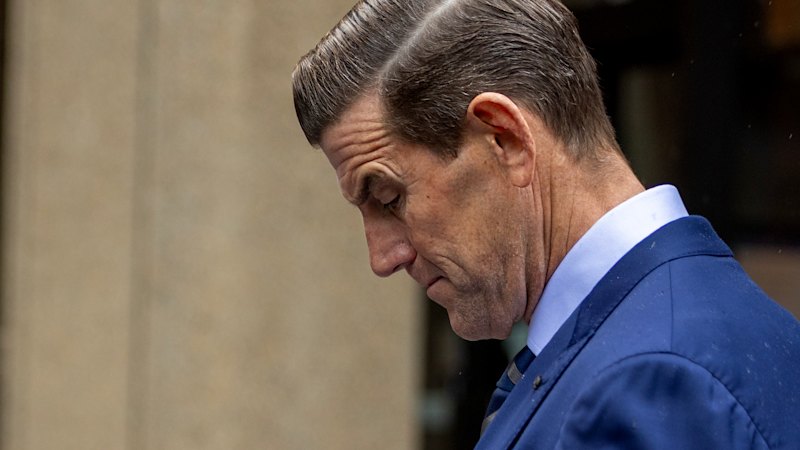
At noon on Tuesday, less than an hour after Ben Roberts-Smith was arrested at Sydney Airport, investigators from the most secretive federal crime-fighting agency in Australia sent out a series of co-ordinated messages.
They went to about two dozen men, all over Australia. Some were on friendly terms with each other. Others were not. Some hadn’t exchanged words for years. But all were bound together by a shared history they can never shake.
The messages came from the special war crimes investigation agency, the Office of the Special Investigator, and their recipients were former and serving soldiers or their lawyers.
These were men who had passed the rigorous physical and psychological testing to join Australia’s most elite fighting force, the Special Air Service Regiment. Then they served in Afghanistan with Roberts-Smith – the nation’s most famous soldier.
Now they will be bound by something else.
The messages indicated the start of a process in which they will be subpoenaed to give evidence for the prosecution in the Supreme Court of NSW. Their testimony will be about what they knew of allegations that Roberts-Smith had executed, or ordered the execution, of five Afghan prisoners and civilians.
Former war crimes prosecutors say that, in the absence of other evidence, the case against Roberts-Smith will stand or fall on the testimony of these men.
The story of how the OSI has built its strongly contested case will emerge in time as the court case proceeds over the next two years or so.
But an investigation by this masthead has pieced together some of these details by speaking to more than a dozen military sources, including some once close to Roberts-Smith.
The key investigators
OSI head of operations Ross Barnett has never been to war. But he has been shot.
In 1991, Barnett was a Queensland detective who received a tip-off that a heavily armed and violent criminal, Harold McSweeney, was hiding out in the Toowoomba area, west of Brisbane.
McSweeney was on the run after escaping from Boggo Road Gaol and Barnett had been warned that he would shoot cops to avoid capture.
“We found him … We rammed his car into a parked car in the street,” Barnett told a reporter a decade ago. “We unfortunately ended up side by side with him in the driver’s seat, and I was in the passenger’s seat … he just started shooting.”

Vision from the scene filmed shortly after the shootout shows a bleeding Barnett on the footpath.
“He got me once in the hip and missed a couple more times, so it was my lucky day. It was a very violent time and that was our job … not going after McSweeney was not an option because simply, if we didn’t capture him, there would have been more armed robberies, and he would have shot an innocent member of the public.”
Barnett eventually rose to deputy commissioner of the Queensland Police, then head of the anti-corruption unit for the state’s horse-racing industry.

In December 2020, his career took a big step in a different direction. Barnett, who appeared in a press conference alongside Australian Federal Police Commissioner Krissy Barrett on Tuesday to announce the war crimes prosecution against Roberts-Smith, was appointed to recruit and oversee detectives working for the newly established OSI.
The office was established by then prime minister Scott Morrison to probe the “credible information” uncovered by the Brereton inquiry into war crimes that about 20 SAS soldiers may have executed several dozen civilians and detainees in Afghanistan.
Barnett has never explained what drew him to the role. Apart from the grim-faced press conference on Tuesday, he has given no interviews. But law enforcement colleagues say that, on his appointment, he quickly grasped the enormity of his task.
His first step was to start recruiting experienced homicide detectives around the country.
One senior role went to Matt Stock, another former Queensland homicide detective described by former police colleagues as like “a dog with a bone” when investigating.

If cops tend to lean conservative, Stock is among them. After he left the state police, he served as a high-ranking border force officer combating people smuggling and drug trafficking.
A murder investigation unlike any other
The joint OSI-AFP inquiry, which on Tuesday led to five war crimes-murder charges being laid against Roberts-Smith, was always going to be different from a state-based homicide investigation.
“There are a lot of practical challenges,” Barnett deadpanned at the press conference.
“We can’t go to that country, we don’t have access to the crime scene … we don’t have photographs, site plans, measurements, the recovery of projectiles, blood spatter analysis … we don’t have access to the deceased, there’s no post-mortem, therefore there’s no official cause of death, there’s no recovery of projectiles that might be linked to weapons that might have been carried by members of the ADF.”
The alleged war crimes at the centre of this investigation had been exhaustively investigated before, by journalists at this masthead, during a defamation case after Roberts-Smith brought to try to prove his innocence, and by Brereton, the then deputy inspector-general of the ADF in his own inquiry between 2016 and 2020.
But law enforcement sources familiar with the OSI’s work have stressed that much of their tasks have involved throwing out cases after exhaustive investigations failed to produce enough compelling and corroborating eyewitness testimony.
These prosecutions needed to pass the criminal standard of beyond reasonable doubt, and to convince a jury of that.
So, cases based on circumstantial evidence or surmise were rejected. Former SAS medic Dusty Miller, who had an injured Afghan taken from his care by an SAS soldier and executed out of sight, was one of these. Two years of exhaustive investigation by the OSI found no direct witness, and therefore no prosecution could follow.
Cases involving the fog of war or split-second decisions were also quickly shredded.
Barrett made this clear at the press conference when speaking of the counts against Roberts-Smith: “It will be alleged the victims were not taking part in hostilities at the time of their alleged murder in Afghanistan.”
The fog of war applies to none of the five war crime-murder allegations faced by Roberts-Smith.
“It will be alleged the victims were detained, unarmed and were under the control of ADF members when they were killed,” Barrett said. And under Australian and international law, these people should have been allowed to live.
Perhaps ironically, one of the most straightforward confirmations of how these laws apply was made by Roberts-Smith himself – when he testified in his failed defamation case that every member of the SAS, including himself, knew it was a crime to shoot dead a “PUC”, or person under confinement.
Executing a prisoner, he confirmed, would not only be a grave crime, but it would disgrace the Australian Army and the nation for which he fought.
Even as Roberts-Smith uttered his words as a witness in 2021, however, he was emerging as the OSI’s key target.

As he spoke, the OSI’s exhaustive process of elimination was at work. Brereton’s inquiry had implicated Roberts-Smith in at least 11 summary executions – all of which the soldier denied. In the defamation trial, the newspapers alleged six killings, and proved four to the civil standard.
On Tuesday, the OSI announced five charges. One of these was an allegation that remains unproved after the defamation judge declined to order the key witness to answer questions that might incriminate himself; another was one that was simply not raised in the defamation case.
Sources who have had dealings with the OSI investigation, but who are not authorised to speak publicly, said each of the five charges was underpinned by eyewitness testimony of SAS soldiers who were at the scene – or in the cases of executions allegedly ordered by Roberts-Smith, the witnesses were the people who actually participated in them.
The other key concern of those who oppose these charges is the time that has passed before getting to this point. As former prime minister Tony Abbott wrote in a Facebook post: “After doing their best to serve our country, dozens of former special forces soldiers should not still be in limbo years later because of ongoing investigations that have only resulted in charges in two cases.“
One of the reasons for the delay is Roberts-Smith himself. Prosecutors were reluctant to move against him until the defamation case was entirely done, including through the full Federal Court appeal and the High Court. That process concluded in September last year.
The stickler for detail who made all the difference
War crimes, of course, can be prosecuted at any time.
In 1990, a former Nazi soldier, Ivan Polyukhovich, was put on trial in Adelaide for alleged war crimes committed in Ukraine in 1942 and 1943. He was acquitted by the South Australian Supreme Court in 1993.
The prosecutor in that case was Mark Weinberg, KC, who went on to become a senior judge and Commonwealth director of public prosecutions. In late 2020, Weinberg was appointed by Morrison to head up the OSI.
Multiple law enforcement sources say Weinberg’s OSI has taken elaborate pains to make sure its work will withstand the rigours of a trial.
His first challenge was to avoid the mistakes that had plagued an earlier AFP probe into Roberts-Smith.

That investigation collapsed in 2021 over fears it had inadvertently been tainted because it had used some evidence obtained by Paul Brereton while he was using royal commission style powers that allowed him to force former soldiers to answer questions.
Sources close to the investigation say that, to avoid the AFP’s possible legal missteps, the OSI created a “sterile corridor” under which teams of lawyers reviewed every piece of Brereton’s evidence and quarantined anything that was problematic.
That left a vastly reduced trove of information for Barnett’s and Stock’s investigators. Nevertheless, they came out hard, looking to firm up the allegations. Multiple SAS insiders who spoke to this masthead, including some who described dealing with the OSI, said detectives took witness statements and returned multiple times to gather more details.
Some found this frustrating – they had already helped the AFP and they had been questioned by Brereton. Some had been on the stand in the defamation case. But the seriousness with which the OSI’s detectives were approaching the task won over many.
Still, the years wore on. Some detectives left to other tasks, leaving edgy witnesses to meet and get to know new investigators.
Weinberg, meanwhile, was a stickler. He had lost the Polyukhovich case, which featured multiple witnesses about years-old events in a faraway country. He was aware of the potential shortcomings of witness testimony. Weinberg was also the dissenting appellant court judge in George Pell’s successful appeal against his child sexual abuse conviction who concluded in a judgment ultimately backed by the High Court that the eyewitness accounts of Pell’s crimes could not support the jury’s guilty finding.
Over and over again, driven by Weinberg’s fine-grained attention to detail, the OSI’s pace was slowed to dot i’s and cross t’s.
Last year, the eminent jurist became gravely ill, slowing down proceedings again. As witnesses got frustrated, they started venting to colleagues – they’d taken huge risks to speak out, and perhaps nothing would ultimately come of it.
According to the sources, the OSI investigators began assuring them that the effort would not be in vain and that, by the end of the first quarter of 2026, Roberts-Smith would be charged.
What comes next
At the end of last year, Weinberg retired as the special investigator. His legacy, though, shows through in the charges laid against Roberts-Smith.
One alleged killing at a place called Chinartu was found by the judge in the defamation case to be proved on the balance of probabilities. However, it is not included in the prosecution.
The Whiskey 108 allegations, however, one alleged murder by Roberts-Smith of a prosthetic-legged man, and another that he allegedly ordered to “blood” a new soldier, are backed by three separate eyewitness accounts.
So, four days ago, Ben Roberts-Smith was finally arrested and charged. It happened just six days past the OSI’s promised first quarter deadline.
One well-placed source suggested investigators might have waited to arrest Roberts-Smith in NSW because they wanted access to a wider and more diverse jury pool. Roberts-Smith, who clearly knew this was coming, might have preferred a jury in a more conservative state, either his original home of Western Australia or his adopted home town of Brisbane.
Former war crimes prosecutor Graham Blewitt, who took part in the 1990 Nazi prosecution, told this masthead and 60 Minutes he expected the case to take until 2028 to reach its conclusion.
Meanwhile, as Roberts-Smith spends the weekend in Sydney’s Silverwater prison, the OSI’s investigators continue their work. As Barnett made clear at the press conference, “other investigations remain ongoing”.
Sources say the joint investigation is open to more witnesses coming forward on the Roberts-Smith charges. A number of other SAS soldiers – including some of Roberts-Smith’s co-accused – also remain under active investigation for their own alleged crimes.
We might be hearing much more from them before a jury is empanelled, and before those two dozen SAS witnesses are required to make their appearance before a Sydney court.
Read more on Ben Roberts-Smith’s arrest:
Start the day with a summary of the day’s most important and interesting stories, analysis and insights. Sign up for our Morning Edition newsletter.
