











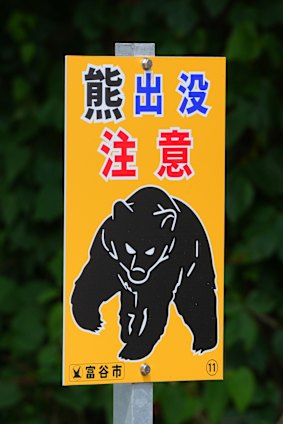
A sign warning golfers at a tournament in Miyagi about the risk of bears.Credit: Getty Images
Kevin Short, a naturalist and former professor of cultural anthropology at Tokyo University of Information Sciences, said several factors lay behind the recent spike in bear incidents. He estimated there were about 44,000 Asian black bears on Honshu, the main island, and a further 11,600 of the larger, more aggressive brown bears on Hokkaido.
“There have been poor beech nut crops in recent years, which means that bears have to forage further afield to get the food they need to get through hibernation,” he told London Telegraph.
“The rural parts of Japan have been experiencing depopulation for a long time as well, and bears are just not as nervous around people as they used to be.”
Experts say warmer weather is also disrupting hibernation patterns. Brown bears can weigh about half a tonne and can outrun a human.
Loading
Japan has two bear species: Asian black bears (also called moon bears) and the larger brown bears found on the northern island of Hokkaido.
Prefectures with large bear populations have urged residents to take precautions, such as making loud noise to deter bears and not leaving food where wildlife can access it.
The Telegraph, London
Get a note directly from our foreign correspondents on what’s making headlines around the world. Sign up for our weekly What in the World newsletter.


