


Opinion

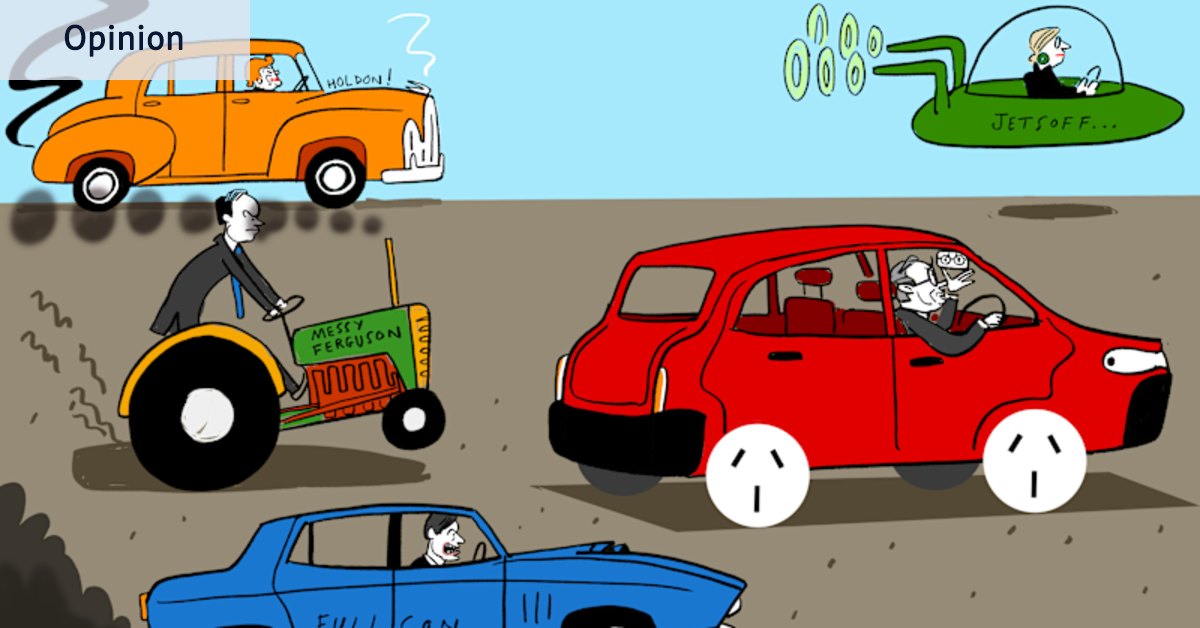
Parliament House in Canberra is a kind of time machine. The various parties can gather together physically, yet they can be decades apart in time.
Starting on the insurgent right, Pauline Hanson prefers to be in the 1950s. White Australia is in force, Indigenous Australians aren’t allowed to vote, all industry is protected and electricity comes from coal only.
On the left, the Greens like to imagine that it’s 2050. The energy transition is complete. Trucks, tractors and aircraft are all-electric and carbon fuels are banned. Farms are fertilised organically and all identities are equal, although some are more righteously angry than others.
The provincial conservative Nationals are in the late 1960s. White Australia is out of favour but trade protectionism is firmly in favour. Tariffs are high, loss-making manufacturers are subsidised. Renewable energy is the Snowy Hydro. Coal is beautiful.
As for the Liberals, Angus Taylor is in the late 1980s. Immigrants generally are OK, but some particular types are less OK. Women are welcome to vote but not to lead; climate change is a fringe fetish; and the free market reigns supreme. Andrew Hastie has other plans, but that’s all they are for now.
Then there’s Labor. Encumbered by exigencies of office, it has less scope for fantasising. Anthony Albanese came to power hoping that he could hold the status quo he inherited from Scott Morrison but with some adjustments.
The free-market 1980s and ’90s prevailed broadly but with some 21st century government intervention at the margin to accelerate the renewable energy transition, to promote some essential manufacturing and to encourage home building.
There were traditional Labor-style catch-up equity measures for the low-paid, some social benefits like Medicare and childcare were bolstered, but there was no Shorten-esque threat to redistribute wealth with the “politics of envy”.
Albanese hasn’t been as timid as alleged – the social media ban for kids was a big call, for example. His government’s embrace of Asia and the Pacific has been energetic. But, broadly, no sudden moves. He would make Labor the natural party of government by, as far as possible, being all things to all people.
But crisis has struck, repeatedly. Albanese’s unthreatening, slow-moving incrementalism was designed for a comfortable country, a cautiously conservative electorate and a stable world. His government has been mugged by reality.
National Party leader Matt Canavan stood on the stage at the National Press Club this week and called Albanese “Captain Status Quo”. Australia, said Canavan, was trapped in the thinking of the Thatcher and Reagan era of the 1980s and ’90s, and, in a fun flourish, he added: “But I don’t think microwaved Milton Friedman is going to save the day.”
Albanese “was here at this stage last week just saying more of the same. More of the same, the same status quo”, said Canavan.
But he, like just about everyone, overlooked the most important line in Albanese’s speech: “There is no security in maintaining a status quo that doesn’t work for people,” said the prime minister. Change, he said, was “urgent”.
This was not the speech that Albanese had intended to give. When it was conceived at the end of last year, it was to be a speech that gave an accounting of promises kept. Last year he’d promised “a year of delivery” and this was to be his statement of mission accomplished. It was supposed to build trust with a sceptical electorate.
Instead, he sent a signal that times had changed. And so had his thinking. This is the only rational response to today’s reality.
Since Australia’s 2025 election, US President Donald Trump has upended the global trading system with his “Liberation Day” tariffs. A fracturing of the Coalition combined with economic frustration to deliver some four million voters into Pauline Hanson’s arms, based on current polling. Islamist terrorists conducted a massacre on Bondi Beach.
Now Trump has accepted Benjamin Netanyahu’s invitation to a war on Iran, and together they’ve ushered in an oil shock with world-shaking economic consequences to follow.
Iran’s defiant control over the Strait of Hormuz has given us a sobering lesson that supply chains are fragile lifelines. And we are vulnerable. We needed to be reminded. We’d forgotten the same lesson delivered by COVID a few short years ago.
The oil crisis, says Lowy Institute China expert Richard McGregor, “is about something much bigger that could play out in our region, and with far greater ramifications”.
Iran’s chokehold on Hormuz “has given China a real-life example of something they have been practising for years to do to Taiwan,” McGregor writes in The Australian Financial Review.
Disruption of the Taiwan Straits, the South China Sea or the East China Sea would interfere with the world’s most valuable commercial artery. “The short-term economic impact on the Australian economy and budget of any blocking of our resource exports would be calamitous. For our partners, it would be existential.”
Sceptics will say that China would not take such a risk. It could entangle its own supply lines, surely. “But China’s planners have long put national security at the heart of economic and trade policy by building what is in many respects a war economy,” McGregor says. Beijing is positioned to take the initiative if it so chooses. And there remain over a thousand days of Trump’s term.
Treasurer Jim Chalmers has told business audiences that economic shocks once punctuated long periods of calm. But today we suffer long periods of crisis punctuated by calm. In other words, Australia needs to adjust to a world in near-continuous crisis.
Albanese took power four years ago with the intention of caretaking a successful country. New realities have persuaded him that he needs to be an emergency manager. Canavan, and others, missed it, but Albanese explicitly rejected the free-market orthodoxy.
He said Australia had been able to survive in the globalised free market because “there would always be someone else, somewhere else, who would sell us what we needed cheaper than we could make it ourselves. This approach put our nation in this position of vulnerability; it will not take us out of it”.
The government now finds itself operating in four different eras. First is yesteryear. The government is putting new emphasis on propping up corporate operations that, in the past, would have been allowed to die. For instance, Rio Tinto’s Boyne aluminium smelter in Queensland, the steelworks in South Australia’s Whyalla, the Perdaman fertiliser plant struggling to completion in Western Australia. And, of course, the two remaining petrol refineries in Australia – Viva and Ampol – both sustained by federal subsidies.
The second era is the present moment of crisis. The government is taking daily action to find fuel, fertiliser and plastics for the operation of the country in the weeks and months ahead.
The third is the near-term horizon of building sovereign resilience while, at the same time, designing economic reforms to be announced in the budget. The resilience agenda is huge and underappreciated. One obvious need is to increase fuel stockpiles from one month, as it stands currently, to a minimum of three.
Albanese this week confirmed that the government was considering a long-proposed strategic fleet of merchant vessels. At the moment, there are no more than a dozen Australian-flagged merchant ships. They carry less than 1 per cent of the country’s seaborne trade.
The budget’s reform agenda is another near-term priority. Albanese’s speech described an “intergenerational equity at the heart of the oldest and most Australian aspiration of them all – passing on greater opportunity to your children”.
This is a hint at the government’s plans to cut tax benefits for property investors to improve opportunity for first-home buyers. Albanese is considering options that he would have rejected only a few months ago.
The government’s fourth horizon is the longer term work on the renewable energy transition, among other things. The opposition is seizing on the fuel crisis to argue that fossil fuels must be the top priority, with renewables relegated.
The government’s conclusion is the obverse: that renewables are the only truly sovereign energy solution to oil instability. The transition, in other words, must go on even as the government seeks to stabilise oil supply.
The next election is not due for another two years. The government expects that a successful transition to renewables will be irrefutably plain by then, yet it is open to accelerated approval for new oil and gas fields.
A carbon dating of Australia’s political parties would locate all in either the past or the future, with Labor the exception. The demands of office require the government to operate in the past, present and future. Australia has spent delinquent decades in complacency. There’s not a moment to waste.
Peter Hartcher is political and international editor. His world column can be read in The Sydney Morning Herald and The Age each Tuesday.
 Peter Hartcher is political editor and international editor of The Sydney Morning Herald and The Age.Connect via email.