











Updated ,first published
You could almost describe this as a golden age for Italian sport.
Milano Cortina 2026 was a raging success, both as an event for the world to enjoy and for the host nation, which had its best medal haul ever from a Winter Olympics. In the Six Nations rugby, Italy beat England for the first time in 33 attempts last month. Before that, the Italian cricket team notched their first ever T20 World Cup victory over Nepal. Even the national baseball team is making history, having upset the United States at the World Baseball Classic.
Yes, you could almost describe it as a golden age – but you’d have to ignore the big, blue elephant in the room.
Critics would argue that ignoring the obvious is precisely what Italy’s football federation, the FIGC, does best. It ignored a 900-page report from the legendary Roberto Baggio in 2011, which proposed a revolution of the country’s footballing structure, philosophy and youth development system. Baggio’s recommendations were never carried out, so he quit as the FIGC’s technical chief two years later.
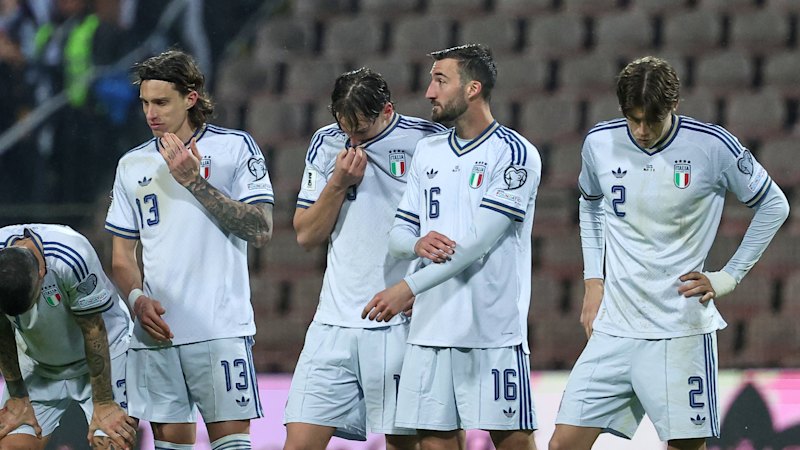
That snub, many argue, has led directly to the decline of the Azzurri, a once-proud team which sunk to a new low on Wednesday (AEDT) as it missed out on a spot at the 2026 World Cup on penalties, losing their shootout 4-1 to Bosnia and Herzegovina.
Missing one World Cup, in 2018, was a shock. Missing a second in 2022 pointed to deeply rooted underlying issues.
Missing a third in a row? Unfathomable, and yet to those who have followed closely, somewhat unsurprising.
At club level, Italian football is struggling. Clubs are stuck with crumbling stadiums which inhibit their ability to match the spending of their European rivals, most of whom play out of redeveloped or entirely new venues.
Serie A’s biggest sides are packed not with Italian stars, but foreigners; Como 1907, a club which has done wonderfully well to be in a position to compete for a UEFA Champions League spot in their second season back in the top division, has only one Italian player in their first-team squad.
The competition is drifting in relevance, a pale imitation of what it was in the 1990s, when it was indisputably the best league in the world, comparable in status to what the English Premier League is today.
So it follows that the Azzurri’s fortunes have tanked accordingly, while the FIGC remains stubbornly resistant to the root-and-branch reform that is clearly needed.
Assuming they make the next World Cup in 2030 – which, on the available evidence, is no guarantee – it will have been 16 years between appearances for Italy.
“I’m not interested at all in talking about my future today,” said Italy coach Gennaro Gattuso, a member of the team what won the World Cup in 2006.
“It hurts, it really hurts. More than hurting me, it hurts to see this group which has really given everything in these months and I think we deserved to get back what we put in, and I honestly think it’s too reductive and too immature to be talking about my future today.
“Here we should be talking about Italy, about the national team shirt, that it’s yet another blow even though this time we didn’t deserve it. We deserved more and that’s why my future doesn’t matter.”
Scores were tied at 1-1 after extra time at the Stadion Bilino Polje in Zenica, where the Azzurri were reduced to 10 men just before half-time as Alessandro Bastoni was sent off for chopping down Amar Memic as he was running in on goal.
It took until the 79th minute for Bosnia and Herzegovina to equalise through Haris Tabakovic, sparking a late rally spurred on by a vibrant and partisan home crowd – but neither side could produce a winner, and so it came down to a penalty shootout.
Francesco Pio Esposito, however, blazed Italy’s first over the bar – and then Bryan Cristante slammed their third into the woodwork, allowing Esmir Bajraktarevic to etch his name into national folklore with the winner.
Gianluigi Donnarumma, who came to Italy’s rescue time and again during the preceding 120 minutes, could not get near any of the home side’s penalties, which drove Bosnia and Herzegovina to just their second World Cup since the break-up of Yugoslavia in 1990.
Azzurri players were left stunned and shattered, with disbelief etched all over their faces.
Socceroos to face Turkey in Cup opener
Meanwhile, Turkey ended a 24-year wait to qualify for the World Cup by beating Kosovo 1-0 in their play-off final on Tuesday, sealing a return to football’s biggest stage for the first time since 2002.
Forward Kerem Akturkoglu scored the only goal in the 53rd minute, turning the ball in from close range after Orkun Kokcu’s shot, following a driving run from Kenan Yildiz down the left.
It means Turkey will join Australia, the United States and Paraguay in Group D, with their opening match to be played against the Socceroos at BC Place in Vancouver on June 13.
Turkey, ranked 25th in the world, had fallen short in qualifying campaigns over the past two decades and arrived under pressure to deliver, with coach Vincenzo Montella overseeing a squad blending emerging talents and experienced internationals.
Elsewhere, Sweden defeated Poland 3-2 to book their ticket to the World Cup as Viktor Gyokeres struck two minutes from time to decide a frantic clash in Stockholm.
The Swedes will slot into Group F alongside the Netherlands, Japan and Tunisia for their first World Cup appearance since 2018.
Bosnia’s famous victory was not the only shootout in Europe as the World Cup qualifying play-offs concluded. Czechia also defeated Denmark 3-1 on penalties.


