



Updated ,first published
Israel’s new chief diplomat in Australia has declined to directly apologise to the family of Zomi Frankcom, as her relatives push for the Israeli investigation into the soldiers who killed the Australian aid worker in a drone strike two years ago to be resolved.
Frankcom’s brother Mal met with Anthony Albanese in Parliament House on Tuesday, before the two-year anniversary of her death, to urge the prime minister to use all possible diplomatic levers to pressure Israel’s military advocate-general to complete its investigation into the killing of seven World Central Kitchen workers.
Frankcom’s family is also calling for confirmation that Israeli investigators have reviewed the audio of the drone strike after it was not provided to former Australian Defence Force chief Mark Binskin when he examined the circumstances of her killing on April 1, 2024.
“I don’t want to have to be here saying this again in another year, with this still not having been resolved satisfactorily,” Mal Frankcom said.
“Seven innocent aid workers, who were all amazing human beings, were killed.
“We don’t find it acceptable that those responsible were simply dismissed from their roles and can go about their lives with little to no repercussions. That does not feel like justice to us.”
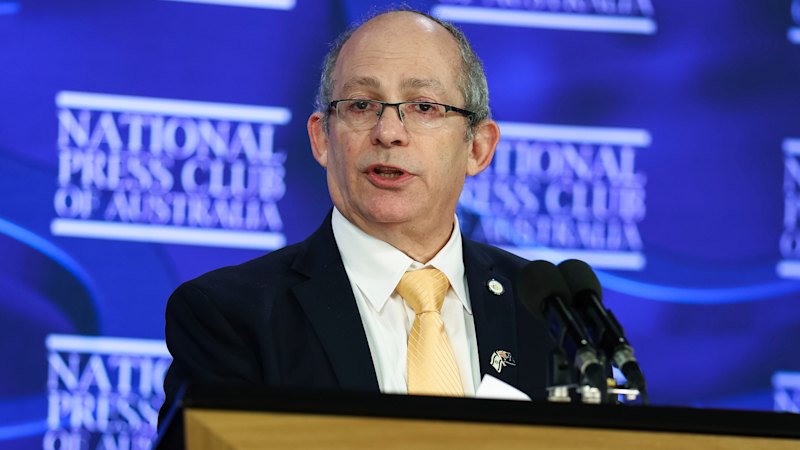
Israeli ambassador Hillel Newman also defended the Israeli parliament’s passage of a new death penalty rule for Palestinians in the Israeli-occupied West Bank after Australia joined other countries to condemn the bill for undermining Israel’s commitment to democratic principles.
After being asked several times whether he would apologise directly to Frankcom’s relatives, Newman described her death as a tragic mistake.
“Every incident of an innocent person or aid worker that is affected by a war situation is tragic, and we’ve expressed full sympathy with the family,” he told the National Press Club.
Newman said he did not believe the military advocate-general’s investigation had been shelved, saying: “As far as I know, it has not come to a conclusion.”
Frankcom said his family would like to receive a formal apology from the Israeli government, but he believed this was unlikely because it “could be seen as an admission of guilt”.
“The more important thing for us is seeing the military advocate-general make a decision on whether they believe it needs to be referred for further investigation, or whether they think that just dismissing those involved is sufficient,” he said.
Binskin’s final report found the strike on Frankcom’s World Central Kitchen aid convoy was “not knowingly or deliberately directed” at the aid workers, in line with Israel’s own conclusion that it was a “grave mistake”.
Two Israeli officers were dismissed from their positions and three senior officers were formally reprimanded, according to the Israeli military.
Binskin was given access to unedited drone footage of the strike, but it did not include audio.
Newman also answered questions about Israel’s conflict with Iran, saying he believed there was a “high probability that the people of Iran will then hit the streets and topple the regime”, even though regime change was not an official objective of the military operation.
Newman was speaking to the press club just hours after Israel’s parliament, the Knesset, passed a law imposing the death penalty on Palestinians convicted of fatal terror attacks.
“Just like in the United States, in Japan and in India, which have capital punishment, Israel has the right, as a sovereign state, to decide [to use] capital punishment,” Newman said.
Foreign Minister Penny Wong told the Labor caucus on Tuesday that Australia opposed the death penalty “in all instances”, pointing to a joint statement Australia signed alongside France, Germany, Italy and Britain that opposed the Israeli legislation.
“We are particularly worried about the de facto discriminatory character of the bill,” the joint statement said. “The adoption of this bill would risk undermining Israel’s commitments with regards to democratic principles.”
Independent MP Zali Steggall wrote to Albanese this month saying that the Frankcom family “remains deeply dissatisfied with both Israel’s response and Australia’s efforts to secure accountability” for her death and that “significant questions remain unanswered”.
Steggall, who raised the issue in question time, wants Australia to demand an “independent, third-party investigation into the attack, including whether it may have constituted a violation of international law”.
Albanese described Frankcom’s death as a “tragic loss”, saying he raised the issue with Israeli President Isaac Herzog during his February visit.
“We’ll continue to work each and every day to do our best to ensure that there is transparency and appropriate action,” he said.
Cut through the noise of federal politics with news, views and expert analysis. Subscribers can sign up to our weekly Inside Politics newsletter.
 Matthew Knott is the foreign affairs and national security correspondent for The Sydney Morning Herald and The Age.Connect via X, Facebook or email.