


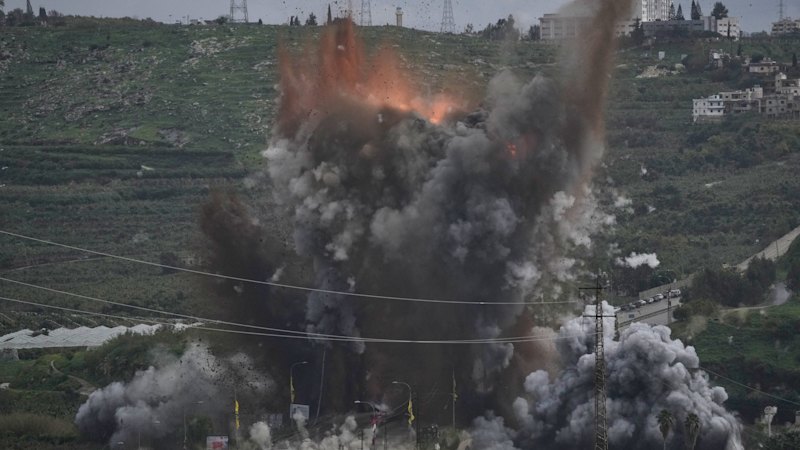

London: Israel has outlined plans to occupy a “security zone” in southern Lebanon after bombing bridges along a key river that will serve as a new demarcation line, adding to pressure on 1 million people who have already fled their homes.
Israeli Defence Minister Israel Katz set out the plans with a new call on the Lebanese government to disarm Hezbollah fighters or face even greater military assaults and a long occupation that could make it impossible for families to return to their communities.
The move deepens the humanitarian crisis in Lebanon after more than three weeks of aerial attack from Israel, leaving 1072 dead and 2966 wounded, while large numbers are now living on streets or in shelters after being told to evacuate their homes.
Israeli authorities have named the Litani River, about 30 kilometres north of the border with Israel, as a key marker of the occupation zone, telling everyone living south of the river to move north. The Israel Defence Forces destroyed five bridges along the river, saying this would halt Hezbollah, but the impact has also stopped civilians from returning to their homes.
The IDF has also ordered residents to head north of the Zahrani River, which is 15 kilometres north of the Litani, and deepened concerns in Lebanon about the huge area that could be occupied by Israeli ground forces.
Hezbollah, which attacked Israel on March 2 in a show of support for Iran, described the new warning from Israel as an “existential” threat to Lebanon and stepped up its rocket fire on northern Israel.
Israeli emergency services said a woman in her thirties was killed in the district of Mahanayim Junction on Tuesday when a Hezbollah rocket struck the area in northern Israel, while two others were wounded.
The death followed a Hezbollah attack on Monday that wounded four Israelis in the northern town of Kiryat Shmona, heightening fears in Israel of continued attacks on civilian communities despite the attempts to eliminate the Lebanese militia.
French President Emmanuel Macron called again on Tuesday for peace talks that would protect Lebanon while disarming Hezbollah and shielding Israel from further attack, while Australia has also urged an end to the war.
Macron spoke with Israeli President Isaac Herzog to express solidarity with Israel against the attacks from Iran and Hezbollah, but he argued for a peace deal that would preserve Lebanese borders.
“I also highlighted the urgency of preventing a new escalation of the conflict in Lebanon, whose stability and territorial integrity must be preserved. Hezbollah made a major mistake by deciding to attack Israel,” he said on X.
Foreign Minister Penny Wong spoke with Israeli counterpart Gideon Sa’ar late on Tuesday, Australian time, according to a statement from Israel that defended its military action despite the global concern about the death and displacement of civilians.
Sa’ar said he told Wong about the danger to Israelis in communities near the border with Lebanon, saying residents had been kept out of their homes for a year.
“I emphasised the massive scale of missile, rocket, and drone attacks against Israel from Lebanon,” he said on X.
“Israel is acting to defend its communities and citizens. Most international media outlets are currently portraying the situation on only one side of the border.
“Unfortunately, the Lebanese government is not taking practical steps against Hezbollah, neither to stop the attacks on Israeli civilians, nor in other contexts.”
Wong, who announced $5 million in humanitarian aid for Lebanon on Saturday, has criticised Hezbollah, which is listed as a terrorist group by Australian authorities.
“Australia condemns Hezbollah for its ongoing strikes on Israel and for dragging Lebanon into conflict,” she said on Saturday.
“Australia calls for all parties to adhere to international humanitarian law and for the protection of civilians and aid workers. A major Israeli ground offensive into Lebanon will only exacerbate the worsening humanitarian situation in the country.”
The area being claimed by Israel for its “security zone” includes the southern city of Tyre, known as Sour in Arabic.
When this masthead visited Tyre on March 10, the residential districts were largely evacuated, but some business owners remained in the area, and some fishermen continued to gather at the historic harbour. One fisherman, Mehdi Istambouli, said he had to stop fishing because of the Israeli airstrikes.
While the Lebanese government has said Hezbollah should disarm, it has not taken any practical step to achieve this goal, highlighting the power of a militia with deep roots in local communities and decades of loyalty to the Iranian regime.
Lebanon’s Health Ministry said a 15-year-old boy was killed early on Tuesday when Israeli troops carried out an incursion into the south-eastern town of Halta and abducted a man. The Israeli military did not immediately respond to a request for comment.
An overnight strike on an apartment south-east of Beirut killed three people, including a three-year-old girl, according to the Health Ministry. The blast tore open walls and scorched furniture in a neighbouring apartment.
The owner of the apartment, Rawaa Eido, told Reuters that militants who expect to be targeted should not be staying in residential buildings.
“We don’t have any political affiliation to anyone at all … Why, when they’re being targeted, do they want to hide in houses among people?” she said, in tears. There was no comment from the Israeli military.
With Reuters
Get a note directly from our foreign correspondents on what’s making headlines around the world. Sign up for our weekly What in the World newsletter.
 David Crowe is Europe correspondent for The Sydney Morning Herald and The Age.Connect via X or email.