






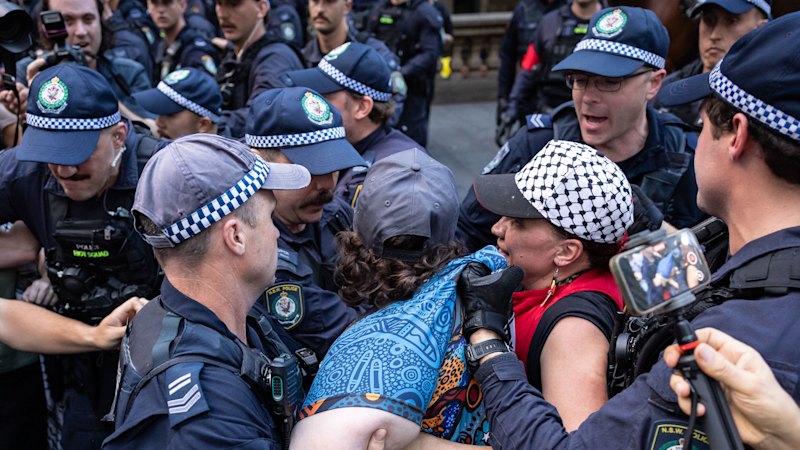
A grandmother pushed to the ground by police. Officers raining punches on a bloke in a business shirt and on a man they’ve pinned to the ground, who’s allegedly chomping on one of their hands. A wall of navy-clad officers storming down George Street. Pepper spray, bruises, blood.
Some believe police went too far on Monday night; “The police are supposed to protect us, not to abuse and brutalise us,” said protester Jann Alhafny, who ended up in hospital. Others thought they didn’t go far enough. “We need to see tear gas and rubber bullets,” former prime minister Tony Abbott said on radio.


There are conflicting versions of what happened, and ongoing debate over whether the police violence was justified. A Law Enforcement Conduct Commission inquiry, announced on Friday, may shed some light. What is clear already, though, is that new protest laws designed to foster unity – “We can’t just have a situation where mass protests rip apart our social cohesion,” said Premier Chris Minns in early January – have failed. Division and anger have intensified.
In the past few years, the phrase social cohesion has become a part of the vernacular. Australia’s leaders worry about discord within Australian communities over events in the Middle East, and about verbal violence turning into the real-life kind. Since the massacre of 15 people at a Hanukkah festival at Bondi Beach in December, the stakes have become even higher, the tensions deeper and the concern about safety and social cohesion more pressing. The ugly scenes when protesters angry about the visit of Israeli President Isaac Herzog clashed with police on Monday underlined those fears.

Politicians are wrestling with what to do about it. The NSW government acted quickly after Bondi to limit protests in the hope that muffling what it considers to be performative, persistent and provocative pro-Palestine protesters would ease the tension. But decades of experience in rebuilding social cohesion in places such as Northern Ireland suggest that laws are a blunt instrument that address the symptom rather than the problem, and that the more effective strategy is to create connections across the divide. That’s far more easily said than done.
Social cohesion isn’t just a buzzword; it’s essential to a flourishing democracy. Anthea Hancocks, chief executive of the Scanlon Foundation Research Institute, describes it as “the glue that holds society together”; a mix of the things that make people feel part of their community, like their sense of connection and belonging, their trust in institutions, and their involvement in local organisations. A society with strong cohesion is brought together by a sense of common good, a tolerance of diversity, and shared values. The stronger the social cohesion, the greater the resilience against external shocks.


Frayed social cohesion can cause serious problems. A UK review – which highlighted how globalisation is increasingly fanning different countries’ internal issues borders, such as the way George Floyd’s death in the United States became the international Black Lives Matter movement – found that while damage to cohesion tends to bubble under the surface, it’s a serious national security issue because it erodes democratic rights and freedoms, and can be manipulated by those who want to undermine democracy.
A particular problem was the rise in “freedom-restricting harassment” (where people experience or witness threats or abuse intended to make them self-censor out of fear).
External events can damage cohesion. Financial stress is a big one; Australia’s took a dip during the Global Financial Crisis. Uncertainty is challenging, too. Monday’s violence in Sydney – a city still reeling from the December attack that killed 15 residents – would have left many of those who watched it feeling unsettled, regardless of which version of events they believed; it was frightening if that level of police force was required, and frightening if it wasn’t. This insecurity can make people question whether “those who are in a position to create some level of safety and security aren’t necessarily able to do it”, Hancocks says.
The good news is that we’re not as divided as it seems. While Australia’s social cohesion declined from 2020 to 2023, according to the institute’s annual measure of 8000 Australians, it’s still pretty strong – it has fallen to 78 from a high of 92 in 2020 and has stayed relatively stable since. Hancocks puts this down to personal connections within neighbourhoods. Even multiculturalism, a concept under attack from some quarters, has widespread support (although of the main religious groups, Muslims are by far the least supported). “People see multiculturalism as an innate part of who we are as Australians, and they’re proud of that,” Hancocks says.
In NSW, Minns’ concerns about social cohesion prompted his government to pass laws 10 days after the Bondi attack, which gave the police commissioner the power to temporarily declare public areas restricted from assemblies after a terrorist event. They’ve applied to sections of the city ever since. In early January, Police Commissioner Mal Lanyon said protests would heighten tension and present a risk to community safety. He said that police would ensure the restrictions were “carried out in a way that strengthens safety and unity across our state”.
The laws are controversial; the United Nations Special Rapporteur on human rights and counter-terrorism, Ben Saul, argues that they have made NSW one of the most draconian anti-protest jurisdictions in the democratic world.

Monday’s rally (or as Minns later described it, riot) against Herzog’s visit was their first test; the first time protesters decided to openly flout them, and the first time police had to defend them. The laws don’t prevent protesters from gathering, but they allow police to exercise powers to move them on if they’re deemed to be causing harassment, intimidation or traffic obstruction.
Protesters accused police of using disproportionate violence when they tried to march to Parliament. Minns said police acted with restraint and had no alternative to force because they wanted to stop protesters from coming into contact with Jewish mourners gathered at the nearby convention centre with Herzog (there was no indication from organisers that this was their intention, and the ICC was in a different direction to parliament, but authorities worried that the two groups would mingle at Town Hall station).
When asked for his view on social cohesion, Minns says it doesn’t “require complex academic theories. It just means living with people who look different, who think differently, who have different views on the big topics. The good news is, nearly every Australian will happily sign up to this principle. For most people in this country, politics isn’t the most important thing in their lives. They reject having their communities riven down the middle by foreign wars or even national elections.
“Right now, we all need to take responsibility for lowering the temperature. And on Monday night, that meant avoiding a direct clash between mourners and protesters. I can’t think of anything that would have more effectively aggravated the community than that.”
Emeritus Professor Simon Rice from the law school at the University of Sydney is an expert in protest. His view is that targeting rallies is not a strategy to improve social cohesion, but rather a way to stop behaviour that’s undermining social cohesion.
“It’s not social cohesion to demonise public assembly, public expression and to criminalise it,” he says. “Yes, it’s a sensitive issue, but not one in which opposing views should be suppressed. [Existing vilification laws] draw a line that can’t be crossed, but the fact that they leave room for opposing views has to be respected … [on Monday] the policing wasn’t respectful of freedom of speech … it was violent, it was unprovoked, it was wildly disproportionate to what was being done.”
Federal Coalition MP for Berowra Julian Leeser, who is Jewish, has a different view. He believes an element of social cohesion is obeying the law, and protesters refused to do so in this instance. “What’s slipped is we’ve increasingly got people in this country who don’t think the law applies to them,” he says. “The protesters were welcome to protest in Hyde Park, yet they chose to go ahead [at Town Hall] anyway. They were deliberately trying to test the authority of police. There’s a radical element among this group.”
Research over decades has shown that the best way to repair social cohesion is to bring opposite sides together to find commonality. Northern Ireland spent decades building bridges between Catholic and Protestant communities after the Troubles by committing to shared education, shared spaces, educating children and building positive relations.
Reflecting on Northern Ireland’s experience, Queen’s University professor and former UN Special Rapporteur on counter-terrorism and human rights Fionnuala Ni Aolain told Rethinking Security that “many states consolidate authority by leaning into a security lens – and this usually makes insecurity worse. Northern Ireland was unique in being an exception to this trend. There were some kinetic elements, but it was clearly a more human security-centred approach.”
Applying the empathy model, Australian Federal Police Commissioner Krissy Barrett has recently announced a Social Cohesion Consultative Board to deal with crimes that threaten national security, to bring together “people who are generally not in the same room as each other”.
Rice says it’s the harder but more constructive approach to social cohesion. “It’s a long, slow road that gets led by politicians and leaders who engage in reflective and respectful dialogue,” he says. “It doesn’t deliver a headline tomorrow, which is what politicians want. It requires a public patience and a tolerance that we’re not seeing at the moment.”


On this, Leeser agrees. “You make societies stronger when you have different groups working together on mutual projects,” he says. He also believes the education system is key, and has failed when it comes to teaching young people about antisemitism.
Josh Szeps is a Jewish Australian broadcaster who believes so strongly in dialogue over silencing that he runs a podcast called Uncomfortable Conversations. He finds pro-Palestinian protesters’ chants such as “Globalise the Intifada” deeply offensive – “It has overtones of buses blowing up in the street and cafes exploding,” he says – but he doesn’t believe in outlawing them, as has happened in Queensland and is proposed in NSW.
“You might like Chris Minns and think he’s banning the right things,” he says. “But history is long, and at some point it’s not inconceivable that NSW will be governed by a MAGA-style, family values, nationalist government that will be enforcing its own speech codes, which you may not agree with. The long-term survival of democracy and the flourishing of civilisation depends upon our having thick skin and warm hearts and cool heads.”
He understands passions run high over what’s going on in Israel and Gaza, and that simplistic positions are attractive in times that feel chaotic, but he despairs over the lack of nuance and the binary nature of the debate. “On one side, Palestinians are terrorists and Israel is an upstanding Western democracy, and on the other Israel is a genocidal apartheid state and the Arab world is blameless for the plight of the Palestinian people,” he says. “It goes without saying that neither of these touches the reality on the ground when you talk to Jews and Muslims, Arabs and Israelis who actually live there and have been wrestling in the mud and the blood of this stuff for longer than many people at Monday’s protest have been alive.”
Silencing opposing voices is not limited to this issue. It’s been going on for decades, mostly by the right of politics in the United States – outing communists and banning Bibles. But it was heartily embraced by the left in the 2010s, when people expressing views on a range of issues were regularly subject to widespread moral opprobrium (also known as a pile-on) for taking an unpopular stance on a social issue, such as author JK Rowling’s cancellation for insisting that biological sex is real. The tricky thing about the principle of free speech is that it must be applied consistently.
“I think it was an enormous own goal for the left to start becoming as censorious and identitarian as it became because that strategy has been picked up by [Donald] Trump in America, [Nigel] Farage in the UK and the far right in Europe to far greater effect,” Szeps says.

Even though the division in the community shows no sign of easing, Hancocks says Australians need not worry too much about the state of their social cohesion. “I’m always cautious of suggestions that [social cohesion] has gone off a cliff,” she says. “It will have a wobble because society is not pure and comfortable all the time. Over the past three years, our level of social cohesion has stayed the same, it’s a testament to the strength of society within our neighbourhoods – that’s where we have the strongest cohesion.”
Start the day with a summary of the day’s most important and interesting stories, analysis and insights. Sign up for our Morning Edition newsletter.


