


Opinion

The brouhaha surrounding Melbourne being crowned Time Out’s world No.1 city has inevitably unleashed a bout of civic braggadocio, especially since Sydney, inexplicably, did not even make the top 20. But I come here today not to praise Melbourne, a cultural, culinary and sporting powerhouse thoroughly deserving of global acclaim, or to defend Sydney, a city which for the past decade has realised it cannot simply rely on the staggering beauty of its harbour or the memory of the 2000 Olympics. Instead, I want to raise up Australia’s most improved metropolis.
Two decades ago, that might have been Brisbane. On my first visit, back in the noughties, I was told to adjust my watch by 10 years before landing in the Queensland capital, a sledge that itself seemed a decade out of date. For years, Perth has also been on the rise, its skyscrapers landmarks to its resources boom prosperity, its beaches and mighty Swan River affirming its enviable quality of life. No, the most improved city in this great southern land is the capital we all love to hate: Canberra.
Patently, it is an easy city to mock. Those suburbs in search of a city centre. A good sheep station ruined. One only has to retrieve that lofty quote from King O’Malley, the American-born parliamentarian at the time of federation who became such a cheerleader for the new capital.
“We desire to have a city that will be the Gotham of Australia,” he proclaimed, with Trumpian excess, that “in a few years will rival London in size, Athens in art and Paris in beauty.”
If only the vision of Walter Burley Griffin and his more lavishly talented wife, Marion, had been fully realised, Canberra might at least have been a Copenhagen. That, though, would have meant constructing a casino where the National War Memorial now stands, which would have been unbecoming if not entirely unfitting given how gambling rivals the ANZAC legend as a national preoccupation.
I used to be a bush capital basher. Donald Horne got it right, I thought, in The Lucky Country: “Canberra is a poor thing compared to Washington.” “Pyongyang without the dystopia,” noted The Economist in 2009, although for me it was more reminiscent of Islamabad without the minarets. In his bestseller Down Under, humorist Bill Bryson gave it both barrels. “Canberra: Gateway to everywhere else” and “Canberra: why wait for death?” he wrote. But it could have been worse. Imagine the fun Bryson might have had with some of the names bandied around for the new capital. Olympus, Paradise, Spamb and Cookaburra, not to mention the portmanteau from hell, “Sydmelperadbrisho”.
For me, early trips down the Hume Highway as the BBC’s then Australia correspondent were usually made to cover leadership spills. “The democratic coup capital of the world,” I dubbed it. Canberra, it seemed to me, was part of the problem. Devoid of other forms of amusement, internecine plotting became the highest form of entertainment. The bush capital was a political garrison town. Parliamentarians were estranged from their families. Pollies even cohabited in party-political frat houses. One night, after explaining to a hotel concierge that I had never really had a good night out in Canberra, he directed me to the Kingston Hotel – “the Kingo” – where, historically, much of this grog-fuelled Machiavellianism had fermented.
Back then, I avoided the city. Now, though, I look forward to visiting. For a start, politics, at least on the governing side, has become more stable. Westminster, which has seen six prime ministers over the past decade, has displaced it as the coup capital. Admittedly, I still prefer for my kids to make school excursions when parliament is not sitting, to save them from being exposed to question time. At least the presence of so many well-mannered crossbenchers has lowered the temperature and lifted the tone.
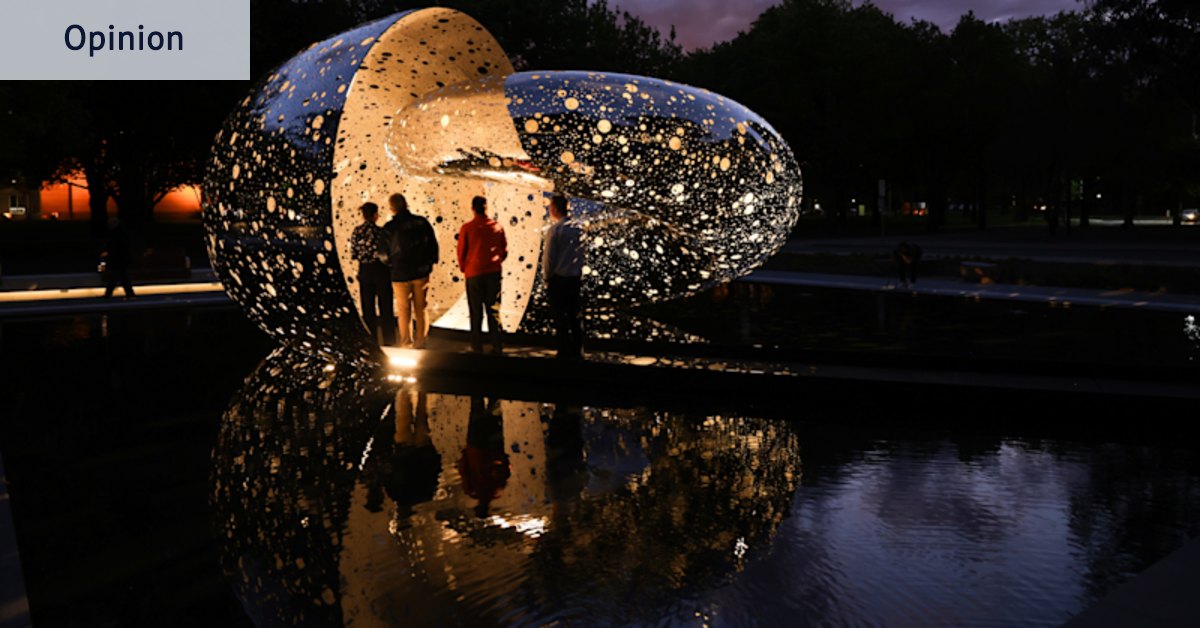
The point is, however, there is now so much more to Canberra than politics. No longer does it feel like such a one-horse town. Only recently have I come to fully appreciate the treasures of the National Gallery of Australia, with Jackson Pollock’s glorious Blue Poles and Lindy Lee’s dreamy Ouroboros immersive sculpture outside. The High Court has one of the best atriums in the land. The National Library, mimicking the proportions of the Parthenon, is another jewel. In fact, Canberra could market itself as an architectural hub centred on the brutalism of its architecture to offset the brutalism of its politics.
The museums are top-notch. The War Memorial (though quite why they thought it made sense to demolish Denton Corker Marshall’s fan-shaped 2001 Anzac Hall is beyond me), the Questacon National Science and Technology Centre and that unexpected delight, the Museum of Democracy at Old Parliament House.
The alpine setting is as pretty as ever. The food scene is an eye-opener. There are some stylish boutique hotels, that modern-day marker of civic chic. No longer does checking into a Canberra hotel feel like time-travelling back to the early 1980s. The Australian National University, I know, has had its issues, but its campus has real intellectual energy. Local vineyards lend themselves to a Sideways-style tour.
Let’s not over-egg the pudding. Canberra is not about to leap, kangaroo-like, into the Time Out top 50, but its position as the most improved city on the continent is unrivalled.
The bush capital, moreover, could do with a little love right now, because as One Nation’s populist surge continues it is going to come under heavier fire. The Voice referendum, when the then opposition leader Peter Dutton railed against the “Canberra Voice”, the “Canberra-based Voice” and the “Canberra knows best” approach of Anthony Albanese, provided a preview. In an echo of MAGA’s attacks on Washington, Canberra will become shorthand for “the political establishment”, “politics as usual” and a “woke bureaucracy”. The city itself can now mount something of a rear-guard. Take it from a one-time detractor, the Canberra charm offensive is for real.
Nick Bryant hosts the substack History Never Ended. A former BBC correspondent, he is the author of The Rise and Fall of Australia: How A Great Nation Lost its Way.
 Nick Bryant is a former BBC correspondent and the author of The Forever War, America’s Unending Conflict With Itself.