





[ad_1]
Fellow 2021 alumni, 2025 world surfing champion Molly Picklum, was matched with water polo champion Debbie Watson. Marissa Williamson, the first female Indigenous Australian boxer to compete at an Olympic Games, at Paris 2024, had Sydney 2000 beach volleyball gold medallist Kerri Pottharst, golfer Jed Morgan had Ricky Ponting and Paralympic long jumper Ari Gesini had George Gregan.

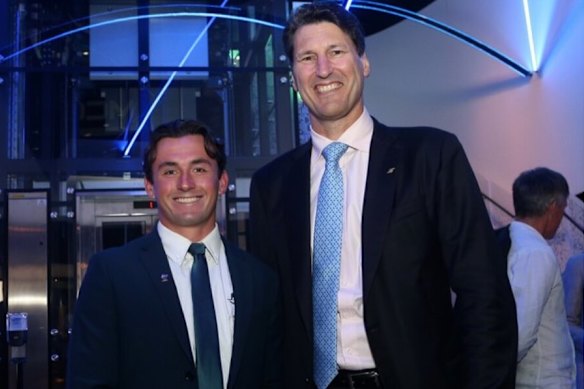
Winter Olympics gold medallist Cooper Woods with John Eales, World Cup-winning Wallabies captain.Credit: Instagram
The following year, Cooper Woods – the Milano Cortina 2026 gold medal-winning moguls skier and another contributor to Australia’s most successful Winter Olympics – received the same scholarship and was mentored by rugby great John Eales.
“He’s really an outstanding young man,” Eales says. “You could tell that from the start. He was so interested in whatever you said. He would call back and always try to apply the different things you’d tell him in different ways.
“I think the most important relationship an athlete will have is with their coach; that’s what will drive the ultimate success of the athlete or not. But I found through my career, I had many different mentors in different ways – there was not one person who taught me everything. There are different people who just had that little bit of information that would help you in a small way, and the accumulation of all those can make a big difference – if you’re prepared to listen and learn from it.
“You’re speaking with people [the mentors] who’ve been there in their own way and done it. As an athlete, you’re going through different thoughts, but perhaps it helps if someone can help you clarify your thought process and bring it to life in a more practical way.”
Loading
O’Neill says the young Baff, who has just missed out on a historic second gold after teammate Adam Lambert crashed in the mixed team snowboard cross final, was already “pretty switched on” and knew what she wanted to achieve.
It was a similar case for her latest mentee, Paris 2024 diver Ellie Cole, who mainly sought advice about whether to accept a scholarship at Stanford University (they discussed the pros and cons, and she accepted).
In this sense, O’Neill believes one of the best takeaways she can offer a young athlete is simply a realisation that the best of the best – the World Cup winners, world champions and gold medallists – are also “normal people” just like them.
“I wasn’t ever involved in a formal program, but for me it was meeting athletes like Jon Sieben, because he was the guy I watched when I was 10 win the 200m butterfly in LA (1984 Games). From that point, I wanted to make the Australian team, and then four years later I was training with him on camps and thought, ‘if he can do it, I can definitely do it’.
“Sometimes when you’re younger, you have this perception of people who do really well that are untouchable, but they’re still normal people.”
Like Mary T. Meagher, the American who held the women’s 200m butterfly world record for 19 years until O’Neill broke it at the Sydney 2000 Australian Olympic trials. “I thought she was a complete freak, I thought there’s no way I’d beat her record,” she says. “And the same sort of thing: I met her and she was just normal. So I think it’s just normalising success in your sport.”
[ad_2]

