


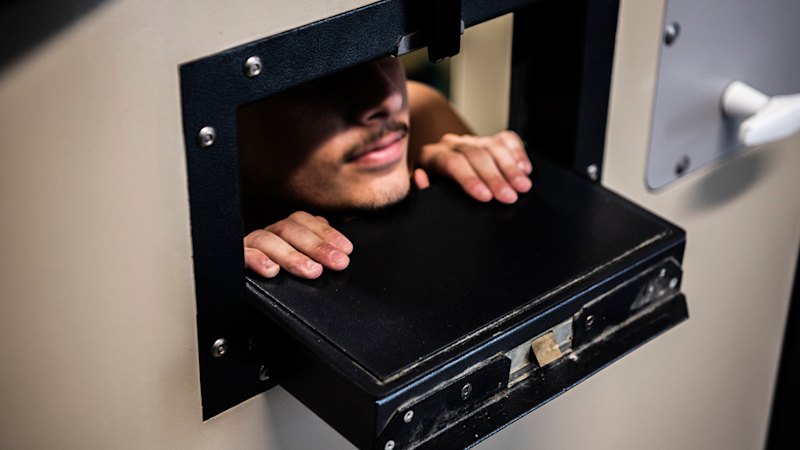
In a row of dank concrete cells reserved for the most dangerous at Silverwater Correctional Complex, an inmate is wailing and screaming his way through a 14-day stint in solitary confinement.
“Why am I in here for so long? It’s doing my head in!” he shouts at a guard. A foul-mouthed tirade follows, along with repeated smashing of the steel door. Patrick Aboud, the prison’s governor, approaches the cell and delivers some tough love. “If you do the right thing, you will come off segregation,” he says. “But you’ve got to stop assaulting our staff, mate. That’s the bottom line.”

Nearby, the reception facility is bracing for the next truckload of human cargo. The area is what alleged offenders first see when they arrive, and this morning, it has the distinct smell of vomit. Five men are there when the Herald visits, each staring blankly through cell bars. They will soon be scanned for contraband hidden in body cavities, told to don prison greens in cubicles that look like Kmart changing rooms, and assigned a six-digit identification number.
“Once you’ve spent a night in prison, you are labelled forever,” says NSW Corrective Services deputy commissioner Leon Taylor. “It follows you your whole life.”
In movies and television shows, prisons are the setting for crooks to serve out lengthy sentences. But in Sydney, a different story is playing out. Driven by a surge in domestic violence accused being taken to court and denied bail, nearly half the state’s prison population is now made up of those on remand – that is, refused bail, or awaiting the next steps of the case against them.
Today, 13,133 people are in NSW prisons. Of that, 6081 are on remand – an increase of nearly 37 per cent over five years. The sentenced population is 7052, down from a high of 9000 five years ago.
The total increase is so large the government is mulling whether to reopen mothballed facilities. And in rare public comments, NSW Chief Justice Andrew Bell has told the Herald courts need a “radical” injection of funding to keep up.
One in three adults on remand is now being detained in relation to a domestic violence offence. Silverwater, just down the road from Sydney Olympic Park, is ground zero of the justice system’s response to the epidemic. Of the 1370 prisoners there when we visit, 471 are in for domestic violence charges. An extraordinary 406 of those are on remand; only 47 are actually serving a custodial sentence.
In a newish wing built on the grass exercise yard where John Killick famously escaped on a helicopter hijacked by his girlfriend in 1999, prisoners in Unit O spend about 16 hours a day locked in their cells with a roommate. The cells have natural light, but they are small and they share an open toilet. Some do prison jobs like cooking, laundry and gardening for $50 a week, which they can use to spend on groceries like noodles, Coco Pops and tins of tuna.


Aboud, the affable prison governor who has also run Sydney’s notorious Long Bay prison, spends a lot of his week talking to the inmates. “We never used to do that,” he says. “Now it’s essential. I need to know what they’re thinking, and they need to know what I’m thinking.”
When Aboud started work in 1988, prisoners who hit women were targeted for retribution, similar to violence still dished out to child sex offenders.
“It was wrong to hit a woman – that was a rule that once applied inside,” he says. “But generations have changed and, unfortunately, in here there’s not that stigma around it.”
At 10.30am on April 20, 2024, CCTV captured Daniel Billings walking into a tobacco shop on the main street of Parkes to buy a hunting knife. The following day he drove half an hour to Forbes, broke through the bedroom window of his former partner Molly Ticehurst, and stabbed her 15 times in the neck, cheek, left ear, left breast, chin, forehead, arms and abdomen. The attack started at 11.27pm and ended just one minute later, when Billings drove off in his Ford Ranger, covered in blood.
Billings had two weeks earlier made bail after appearing in court on a raft of allegations of sexual and violent assaults against Ticehurst. He had also killed a dachshund puppy with a hammer – a classic predictor of further violence. A Dubbo Local Court registrar granted him bail despite a police prosecutor arguing Billings was displaying signs of a dangerous man careening towards “the most disturbing conclusion”.

When the bail decision was revealed, something snapped in a nation that to that point had still been remarkably complacent about the scourge of domestic violence. Among other reforms, the Minns government swiftly vowed to strengthen bail laws, which sailed through NSW parliament in June that year.
Under the new laws, people charged with serious domestic violence offences must show why they should not be detained until their case is determined – reversing the presumption of bail.
The Bail Act was also reconfigured to make magistrates and judges look at a raft of “red flag” prior behaviour like violent and sexually abusive conduct, stalking and death or injury to an animal. The views of victims and their families about safety concerns must also be considered.
Had the laws been in place in April 2024, Billings would almost certainly have been denied bail in the fortnight before he killed Ticehurst.
“Every violent offender behind bars is one less in the community and that can make all the difference to whether a victim-survivor feels safe,” says Corrections Minister Anoulack Chanthivong.
Silverwater played a role in the fallout from Ticehurst’s brutal death. Billings spent time there after his arrest, and as Taylor, the Corrective Services deputy, says, “there are inmates on remand here now who probably would be in the community if not for that change”.

The most recent data shows about 15 per cent of those accused of domestic violence offences are refused bail, but over recent months, government officials believe it will have jumped to about 25 per cent.
Another curious shift: while the number of reported domestic violence-related assaults has remained largely stable in NSW for the past decade, the number of people in the slammer for it is up 45 per cent.
Why? NSW Bureau of Crime Statistics and Research executive director Jackie Fitzgerald believes it is because DV has become a bigger policing priority, and the force is pushing more cases to a resolution in the courts. If they don’t, many victims struggle to justify the risk of reporting their partners in the first place.

Fitzgerald also says the number of reported intimidation and stalking offences has “rocketed up” over the past decade. Last year, there were 50,000 offences in this category – far more than the 38,000 domestic violence related assaults before police. “Police are doing a really good job at looking for intimidation behaviours, whereas previously they probably focused more on the physical violence,” Fitzgerald says.
The busiest part of Silverwater is not the gritty segregation unit or the more traditional blocks, but a facility off the central courtyard in which prisoners are regularly shepherded into thick plastic-encased cells.
They wait inside for a guard to call their name, take them across a corridor and put them in one of 13 small rooms fitted with audiovisual equipment to beam into court for their latest appearance. With about 250 people going through there each day in Silverwater alone, it is the correctional equivalent of a seemingly never-ending warehouse production line. There is even a room reserved to hang the hundreds of suits the prisoners have had their families bring in.
Some in these pre-court holding cells look genuinely scared. Others clearly see the whole thing as a joke, laughing and whooping as the Herald walks through. It is a reminder that not all see time inside as a deterrent.

That this is the biggest hive of activity in Silverwater speaks to the impact a climbing remand population will have on the state’s prisons. Instead of the relative stability of inmates who are sentenced, those on remand have more complex needs. They also can’t be forced to undertake rehabilitation programs.
It costs about $116,000 per year to keep a prisoner behind barbed wire. The government knew its bail changes would lead to a spike in the prison population and it set aside $100 million in last year’s budget to help pay for it.
But recruitment remains a challenge, and Aboud, the Silverwater governor and his boss Taylor, both say drama-filled TV crime and prison shows don’t help attract staff.
“I can’t watch them; they are too much,” Taylor says. “Prisons are actually 99 per cent mundane and 1 per cent fireworks.”
The increase in the number of serious alleged offenders being locked up is widely celebrated by advocates against domestic violence, political figures across the divide, and police officers who feel they spend huge time in bringing dangerous men before the courts only to see them walk out and reoffend. Nobody wants another case like that of Molly Ticehurst.
But there are lesser-known consequences that must be addressed. Bell tells the Herald the court system needs more funding to deal with these shifting dynamics.
Bell recognises there is “understandable disquiet when an accused who has been granted bail” goes on to offend. But he said some who had been held on remand pending their trial were later acquitted. “In those cases – which do not attract any entitlement to compensation – incarceration pending trial and ultimate acquittal is often criticised strongly as having been in violation of the presumption of innocence,” he says.
Of the 6081 people on remand in NSW prisons, 1571 have been there between one and three months. Another 1009 have spent between three and six months inside, 955 between six and 12 months, and 949 more than a year.
Bell says the implications of the “significant spike” in remand numbers is profound, given the lack of courts equipped for jury trials, the limited pool of resources for both prosecutors and legal aid, and the finite number of judges.
“Short of a radical injection of resources for the building of more fit-for-purpose criminal courts and increased funding for prosecution and defence lawyers – through Legal Aid – and the appointment of additional judges, the implications will be an increasing remand population with a corresponding and very significant drain of resources which may otherwise be available for the administration of justice and programs directed to diversionary programs and rehabilitation.”
The state’s top judge says cases where people were refused bail only to eventually be sentenced without imprisonment were good examples of the social and economic costs of higher remand numbers, citing BOCSAR research that found 40 per cent of First Nations individuals who are on bail and come before the court for sentence receive a non-custodial penalty.


Bell is a fan of a quote by his predecessor Tom Bathurst, who in 2012 said there were few people as much in touch with the realities faced by victims, accused and convicted as are the judges of the criminal courts. “They are in the thick of it every single day,” Bathurst said.
Carolyn Hodge, the acting chief executive of Domestic Violence NSW, the peak body for specialist DV support services, is also in the thick of it on the front line of the escalating cycle. While Hodge is a fan of the government’s bail reforms, she has asked it to stump up a 50 per cent increase to funding for specialist domestic and family violence services, which would be worth $177 million (spending was lifted in the last budget). The average wait time for support is two months, and some services are operating at up to nine times their funded capacity.
“Staff are absorbing the shortfall through unpaid labour, covering essentials like food and clothing for victim-survivors out of their own pockets, and fundraising in their own time just to keep services running,” Hodge says.
“Goodwill should not be a funding model, particularly when it comes to life or death.”
Anyone needing support can contact National Sexual Assault, Domestic and Family Violence Counselling Service 1800RESPECT (1800 737 732); Lifeline 131 114; Beyond Blue 1300 224 636.
Get the day’s breaking news, entertainment ideas and a long read to enjoy. Sign up to receive our Evening Edition newsletter.
