





[ad_1]
“Death brought me to this work,” says Amelia Best. She’s sitting in her parked car, wearing denim overalls, her short hair tousled, looking every inch the gardener. We’re video-chatting: if she lifted a hand into the frame and it held pruning shears, I wouldn’t be surprised. There’s a plane tree out the window behind her, and on this windy Melbourne morning, a cheeky branch keeps whipping and waving, trying to interrupt, or perhaps nodding in avid agreement.
Best, 47, tends people’s gardens one day a week but her first career is psychotherapy. Over the past two years, she’s fused her professions by working as a horticultural therapist in private practice and at the Royal Children’s Hospital in Melbourne, where sick kids and their families might be distracted by watering plants, soothed by tending herbs or regain a bit of control by choosing which seeds to plant where. An adult with depression might be encouraged to grow sunflowers and find hope in the surge of life and the possibility of change.
The death that steered Best to combine her two callings was that of her big brother and only sibling, Andy, an artist, who succumbed to liver disease in the bleak Berlin winter of early 2022. Best and their -father rushed to be with him when he fell sick, hoping for a lifesaving liver transplant that never came, and staying with him through an agonising three-month decline. Andy was 46.
“It was traumatic and complicated and, after I came home, I knew I was in shock,” says Best, her face crumpling like leaves, the branch behind her thrashing as the wind picks up. During those first months of bereavement, her garden in Melbourne’s northern suburbs drew her like a magnet. “It was the only place that felt right, other than playing with my son,” she continues. “Because I’m a clinician, I realised I was having a post-traumatic stress response. The garden somehow matched the depth, breadth, complexity and mystery of my inner experience. I spent a lot of time pulling out clover weeds from the lawn, noticing the difference at the end of the day. I planted seeds. I sat on the front steps staring into space and was slowly pulled towards a branch to prune, or a weed to remove, or a plant to shift, so that it looked more pleasing.
“Grief is bad enough, but there can also be loneliness in the mismatch between your inner life and the external world. The garden supported me. It resonated somehow and made me feel a little bit better.”
A growing body of research suggests gardening could treat all manner of ills. There’s the physiological boon of movement and weight-bearing: gardening is ranked as moderate exercise alongside hiking and dancing. There are potential health gains from eating fresh, nutritious produce: a 2023 study reported a 7 per cent increase in dietary fibre consumption by gardeners versus a control group. Wins around mental health, well-being and quality of life are possibly even more profound, especially when busy urban lives can be distant from natural cycles.
The Australia Institute’s Grow Your Own survey from 2024 found 67 per cent of respondents who grew food said it made them feel happy and relaxed. Gardening correlates with positive impact in many measures of wellbeing, according to a 2024 review of 40 studies published by Systematic Reviews. Depression, anxiety and stress may be alleviated by getting in the garden.
‘It helps people understand that we are part of nature, not separate from it. That connection to place is spiritual, physical.’
Bundjalung woman Mindy Woods, author of Karkalla at Home
Even looking at outdoor spaces is good for us. Trees and plants often display patterns of unending complexity that repeat at different scales; think of broccoli, ferns or forest canopies. These patterns are called mid-range fractals, and the way our brain processes them is calming. “This human adaptation is called fractal fluency and generates both an aesthetic experience and a reduction in stress,” explains Australian landscape architect Sandra Schwarz in her new book, Restore: How Green Spaces Support Human Restoration. A garden may look busy with all its shapes and colours but gazing upon verdant spaces alleviates mental fatigue. Buildings and screens do the opposite.
It would be an overreach to call myself a gardener, but I do have a scrabbly bit of space at the side of my home that I’ve tended from time to time. There were some radishes once, lettuces I donated to snails, five cherry tomatoes one victorious summer and rosemary because it seems to flourish via neglect. Mostly, though, I go outside to hang the washing, and if I bring something in from my little patch, it’s likely to be an uncollected deposit from the dog.
However, I am stressed about getting this story written by deadline, and I have learnt how good gardens can be, so I go outside to see if mine will calm me down and help me focus. In the vegie patch, rocket is running wild. I pluck a leaf, check it for bugs and eat it. It’s way more spicy than the supermarket stuff, waking up my insides. My eyes are drawn to the rocket’s stalky white flowers, nodding sagely as they will themselves to seed. I chew another leaf, then another, and start pulling some weeds.
A skink darts from a sunny patch to shadows. I -notice a wattlebird preening on the fence. Is it too late to plant tomatoes? My story isn’t getting written any faster but I do feel more relaxed and attuned to nature, even after 10 minutes outside. I head back to my desk, dirty fingertips tap-tapping my computer keyboard.
Well, hopefully it’s soil, not simply dirt I’m carrying into the house. A teaspoon of rich, healthy soil with a large proportion of organic matter can easily contain a billion microbes of tens of thousands of different types. Interacting with this multiplicity may be a large part of gardening’s feel-good factor, both from being in the bugs’ proximity and via ingesting food grown in such a life-stuffed medium.
“When soils have a high degree of microbial activity, the food grown in it is far more nutrient-dense and carries microbes on its surface and within it,” says Felice Jacka, a professor of nutritional psychiatry who directs the Food and Mood Centre at Deakin University. “They help keep our gut microbiome resilient and healthy, and that in turn influences our mind, mood and behaviour.” A healthier gut has been linked to hormones that make us feel good, such as serotonin and dopamine.
Last year, Jacka assessed 15 students each at Bellarine Secondary College and Geelong High School, both west of Melbourne. The Bellarine kids participate in Farm My School, a program which sees disused school land turned over to productive gardens. Vegetables are tended, cooked and eaten by the kids and their families, used in the school canteen and sold locally. The Geelong cohort stuck to their normal activities and diets.

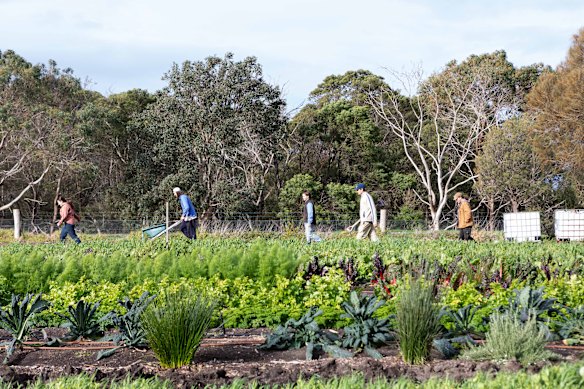
“Over 12 weeks, the gut microbiology of students at Bellarine Secondary College who spent at least an hour a week in the garden was more health-associated and had evidence of microbes that are in the environment and the soil,” says Jacka. Diet is probably not the only factor. “They are exposed to soil microbes through working on the farm; even the microbes in the air could be adding to their microbial diversity, including on their skin, which is linked to immune function.”
Because of the study’s small size, Jacka is cautious about overegging the results but, basically, it suggests working with good soil boosts gut complexity, and the more complex the gut biome, the more content and happy the person. Farm My School CEO James McLennan is less circumspect. “We’ve heard ridiculous anecdotal evidence, especially behaviourally and in terms of wellbeing. One mother approached me about her daughter, who had various mental health issues, and said, ‘I don’t recognise my child. We’re getting along. We are cooking together, we’re laughing together, we have never had this. The impacts are profound.’ ”
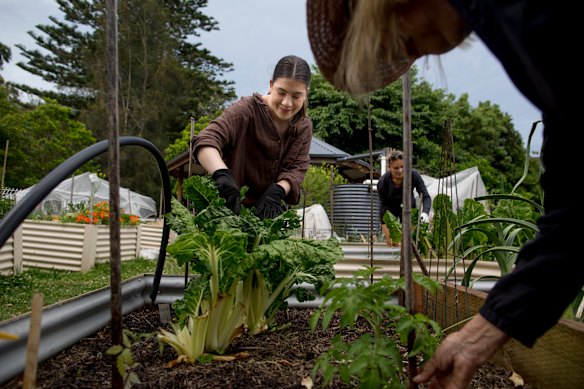
Community garden co-ordinator Millie Allsopp, 26, has a trowel in one hand and a tomato seedling in the other. It’s a warm Sunday afternoon in Manly Vale, in Sydney’s north, where she co-ordinates 25 members who each pay $25 a year to be part of the group. This entitles them to work shared gardens on council-owned land, nurturing silverbeet and daikon, spring onions and cauliflower, whatever they want to grow. Private plots are an extra $50 a year. Members discuss the week’s green bean progress while kids play hide and seek between raised planting beds. Allsopp chats to Gisela, a long-time member, about ways to prepare chokos and different types of persimmon.
“I’m eating more widely and trying new things,” says Allsopp. “You meet people you wouldn’t encounter through sport or work, a nice cross-section, older people and families, people who’ve never gardened before, people who’ve been doing it their whole lives.” Allsopp is a landscape architect, but she hadn’t grown vegies until recently. “There’s trust in the group, you lean on each other for knowledge, it’s given me a soft spot for the area, which I only moved to recently.” (She lives in a nearby apartment.) “It’s easy to go to work, come home, watch TV,” she says. “It’s not like I have nothing else to do but having the garden means I’m not inside cleaning and I know I feel better afterwards.”
It’s not all beauty and bounty. Every gardener knows failure. Maybe there’s not enough water, too much of the stuff, an absence of a nutrient, sudden cold or brutal heat, hungry grubs or marauding possums. “I love watching people when they kill something,” says Allsopp. “They stop and think. They care about it. Then you see them turn it into a lesson – next time we’ll put it on a trellis, move them from the greenhouse when they’re bigger. You don’t decide, ‘Oh, I’m a plant murderer’ and give up.”
Allsopp was taught a lesson by some radishes she grew from seed. “They went all squiggly … I might have planted them in the garden beds too early, rushing that precious point of moving them from cosy greenhouse to the harsh world. It’s relatable to life. You get thrown out in the middle of nowhere and have to cope.”
Attempting to grow food has made Allsopp appreciate her own harvests as well as store-bought ingredients. “I produce a lot less food waste now,” she says. “I buy what I will use and it’s rare that I have rotting fruits and vegetables because I know the effort and carbon footprint that goes into it. I use what I get and my food waste goes into compost.” The Grow Your Own survey found 67 per cent of gardeners used worm farms, compost systems or both. Extrapolated across Australia, at least 361,000 tonnes of waste are -diverted from landfill by gardeners each year.
Some community gardening is peripatetic, allowing even those with no access to land to get their hands in the soil. Melbourne Pollinator Corridor musters volunteers to create insect-friendly street gardens on nature strips in a densely urbanised eight-kilometre swathe running between the Royal Botanic Gardens and Westgate Park. The group just planted its 56th garden of a planned 200. Insects are loving it: a site at Park Towers social housing in South Melbourne saw a 2400 per cent increase in species identified in a year. The insect uptick helps nearby food gardeners because their crops are more reliably pollinated. The plantings are mostly native groundcovers.
“When you grow plants endemic to Country, they tend to thrive because they’re part of Country like we are,” says Bundjalung woman Mindy Woods, author of Karkalla at Home, a celebration of growing and cooking native ingredients. “Growing native foods can be a powerful way to connect to the land, not just for mob, for everyone. You’re connecting with Country every moment you’re tending to these plants: you have that reciprocal relationship with Country, taking and giving in equal measure.” Insects and food are good but there’s more to it. “It helps people understand that we are part of nature, not separate from it. That connection to place is spiritual, physical and good for mental health in this busy and chaotic world.”
Amelia Best’s garden is on the march. The tomatoes are going, the zucchinis are off and running, the herbs are lush and fragrant. Daylight saving means she can put an hour or two into the garden after a day’s work, which might have included therapeutic horticulture counselling with children or adults. “Working in a garden, or even having a pot on a windowsill, supports my clients’ wellbeing: the plants respond to their care, ask little in return and offer comfort simply by growing and changing. And at home, my garden continues to support my connection to myself. I love the physicality and I can drop down and reflect.” There’s also the delight of producing food. “I’m always proud to bring something in from the garden to eat at the family table. It brings the outside in. It’s fun and beautiful and tastes terrific. Growing food also brings a sense of curiosity and play: you turn around and the zucchinis have turned into giants.”
The potential goes way beyond a nice salad. “So many complex issues facing humans today are due to a disconnection from ourselves, each other and the environment,” Best continues. “Mental ill health, social disintegration, the climate crisis, the rise in non-communicable diseases … gardening works on all these huge things in small ways that are pretty big, really. Gardening may well save the world.”
Get the best of Good Weekend delivered to your inbox every Saturday morning. Sign up for our newsletter.
[ad_2]

