



Norman Weston Toms floated between addresses and was “practically penniless” when he was found murdered on the back verandah of a Perth house 50 years ago.
He was one of six children and lived in Western Australia, working on-and-off as a miner before he became partially paralysed and lived between boarding houses in the Perth city.
Toms came to police attention several times over the years – once for stealing two watermelons and three tomatoes from an address in Subiaco, and again for drunk and disorderly behaviour on Murray Street in Perth’s CBD.
His 1974 death was quietly reported in the state’s daily newspaper.
“Norman Weston Toms was found strangled and savagely beaten on the back verandah of a [boarding] house in Newcastle Street, Perth on May 11,” it read.
“[Mr Toms] was known to be almost penniless [at the time of his death], and there was no indication that anything had been stolen.
“No motive has been established for his murder.
“The savagery of the attack on him was almost maniacal.”
Six months later, Toms was back in the paper.
An eerie likeness
Gwenneth Graham was reported missing by her husband in September 1974, after she failed to come home from a Balga pub.
Malthouse Tavern staff said they called her a taxi, but it’s not known whether she got in it, accepted another lift or attempted the 20-minute walk home.
She was found sexually assaulted and murdered with her body concealed in local bushland about nine days later.
An exhaustive search of the cars that had been seen parked at the Malthouse Tavern and along Balga Avenue on the night of her murder had turned up little to no information, but detectives were continuing the hunt.
A week after Gwen’s body was found, Norman Weston Toms came back into the spotlight.
The Daily News reported detectives believed Gwen’s case had an eerie likeness to Toms.
“There are extraordinary similarities in the murder of a woman at Balga and a middle-aged man in an unoccupied boarding house … in May,” the report said.
The paper said while the homicide squad at the time would not publicly link the two killings, detectives were privately concerned about the possibility one person may have murdered the pair.
“Both people were naked when they were found and had been strangled and savagely beaten,” the report said.
“Both received broken ribs and detectives believe that the fractures may have been caused by the murderer jumping on the victim’s chests.”
One aspect the report was at pains to point out was how both Toms and Gwen were frequently seen “in the company” of Aboriginal people before their deaths.
A community under suspicion
Balga was home to a large population of Aboriginal people at the time of Gwen’s murder, due to a government policy attempting to force assimilation in Perth’s suburbs.
The policy advocated “scattering” families in the city’s outer suburbs, and the Native Welfare department in the 1970s purchased a number of homes in Balga in particular to rent while others took to camping in bushland.
One of these camps was around the corner from the Malthouse Tavern in 1974, and reports implicating Balga’s Aboriginal population in Gwen’s murder came through thick and fast.
A bartender said Gwen had been speaking with an Aboriginal man for about two hours at the bar before he upped and left, and she followed shortly after.
Another said Gwen had allegedly been seen in an argument with a “group of Aboriginal people” outside the pub the night of her death, and a young boy said he saw a “part Aboriginal” man shove a woman matching Gwen’s description into a car on the same evening.
Police were never fully able to substantiate any claims against any Aboriginal people who had been living in Balga at the time of Gwen’s murder, and in the case of Norman Weston Toms, there was never any evidence his “association” with Aboriginal people had anything to do with his death.
Nevertheless, the camp up and moved from Balga shortly after Gwen’s murder.
By November, police had looked at about 4000 cars, spoken to 3000 people and followed up about 220 phone calls during the investigation.
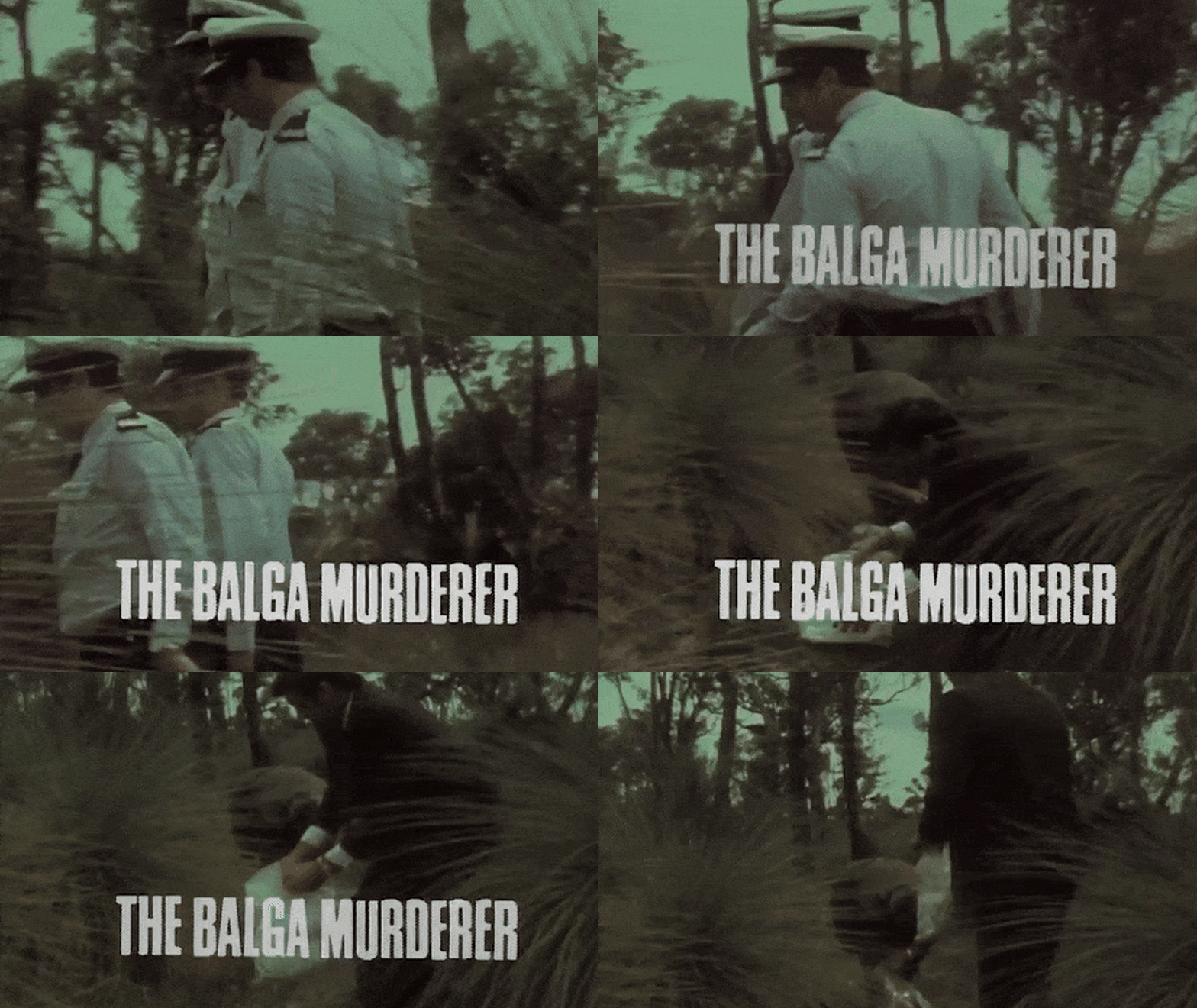
A dozen senior detectives remained on the case, and a reenactment had even been aired on 9 News Perth.
The broadcast focused on the detective’s most widely believed theory – that Gwen had been taken to a location by a suspect, they had sexually assaulted her, she resisted and they murdered her.
The reenactment shows the suspect attempt to hide Gwen’s body.
While the spotlight was on Balga in the aftermath of the murder, one Perth man who was in his teens at the time remembers both the media and the police descending on his small suburb.
In particular, he recalls a head teacher coming to the door of the classroom a few weeks after the murder.
“For whatever reason he picked out a few boys, probably five or six, and took us outside,” he said.
“A copper [was there], and he said ‘we need you to come down with us’.”
“We were put into a couple of cars and drove down into the bushland … I remember standing off the road and they explained we need to go through this bushland area and see if anything is out of place.”
The officers didn’t tell the boys what they were looking for, but a 1974 WA police gazette would later shed light on the matter.
“[Gwen Graham] was wearing a wristlet watch … may have been wearing or carrying a pair of bi-focal glasses with blue frames at the time of her death,” the report said.
“These have not been located.”
And despite a $5000 reward on offer at the time – the equivalent of about $50,000 in 2026 – no one has ever come forward.
The West Australian police force’s cold case squad have previously expressed their desire to find either the watch or glasses missing from the crime scene.
Both items could hold significant information about Gwen’s killer – whether it be someone who has handed the watch down to their children, or even a pawn shop that may have sold them on.
A $1 million dollar reward
Gwen Graham and Norman Weston Toms murders’ were included in a tranche of West Australian cold cases and other missing person’s investigations in 2023 that had their reward money upped to $1 million.
Nearly 40 cases were included in the announcement, causing fears from some families their loved ones had gotten lost in the mix.
But WA police said every unsolved case was being looked into with great care.
“Detectives remain steadfast in their commitment to uncovering the truth and delivering long-overdue answers for Gwenneth’s family and loved ones,” a spokesperson said.
“Her death was a devastating act of violence, and those responsible have never been held to account.
“A $1 million reward is still available for information that leads to the arrest and conviction of the person or persons responsible for Gwenneth’s death. Police continue to believe that someone in the community knows what happened and it is time for that information to be shared.
“Detectives are urging anyone who knew Gwenneth, or who has knowledge about her movements or associates, to come forward. Even information that may seem minor could be critical to progressing this investigation.”
Steven Wrightson, Gwen’s now 77-year-old son, said he hoped highlighting the specifics of the case, and helping people remember his mum as a person rather than just a murder victim, would compel someone to help.
“I thought the cops had given up,” he said.
“I’d feel very, very relieved if I found out what happened.
“I just hope someone out there who does know something comes forward and tells the police and the authorities – everybody.”
