







Labor had planned to spend this week fighting the Coalition over housing and negative gearing.
But by Thursday, Housing Minister Clare O’Neil was making reels about tech bros. “Does anyone else find it weird that a whole bunch of internet finance bros are suddenly concerned about renters?” she posted to Instagram.


Instead of a political fight with its traditional opponents, the Albanese government had been drawn into a meme battle with the country’s young start-up founders.
When Labor handed down the most risky and high-taxing budget in more than a decade, its selling point was about levelling the playing field for young Australians. The package of tax changes would eliminate negative gearing for future investors in existing properties while overhauling the capital gains tax discount.
But the CGT changes were not limited to property – they would affect stocks and other assets, including businesses. The most cut-through criticism is now coming from Millennial company founders who fear they will be stung and short-changed as soon as they start getting ahead.
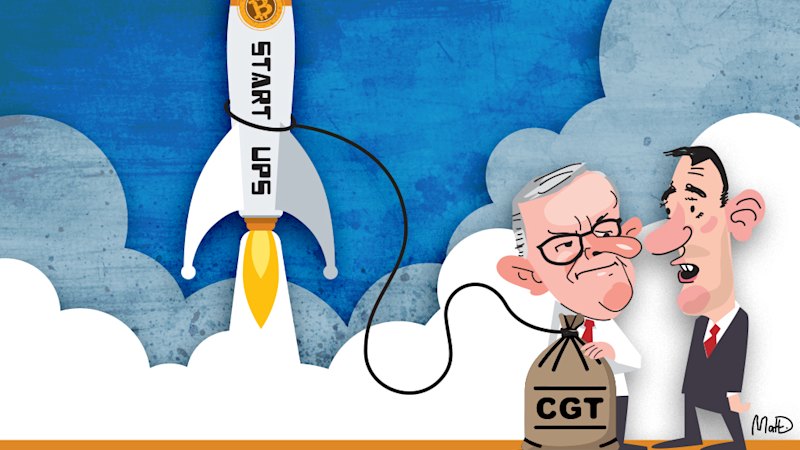
Their meme campaign, which features AI-generated images of Anthony Albanese playing the role of their slack business partner, has gone viral among small businesses, whose owners are now delivering that feedback to Labor MPs.
The prime minister has two options. He can offer extra concessions, in line with his habit of seeking consensus and limiting blowback under pressure. Or he can plough ahead, demonstrating a new crash-through style where he will use his power early in the political term to create enemies in the name of making big changes.
The early verdict on last Tuesday’s budget, as polls results trickled in on Sunday night, was conclusive: voters didn’t like it.
It was the worst-received budget since this masthead’s Resolve poll started tracking sentiment five years ago. More than a third of those surveyed said they had a dimmer view of Labor and their own household would be worse off. Newspoll’s result showed it was the least popular budget since 1993.
That was not unexpected, Treasurer Jim Chalmers told the 7am podcast on Thursday. “I think it’s important to acknowledge that when you’re making a significant change – a controversial change – to the tax system, then obviously not everybody is going to be supportive of that,” he said.
“In the midst of a pretty full-on scare campaign, in the midst of a big global oil shock which is putting extra pressure on people, and in a budget which is full of hard decisions rather than handouts, I think that that kind of reaction is not especially surprising.
“Our job is to try and do the right thing for the right reasons, even if it means paying a short-term political cost in the polls.”
There was a surprise, however, in the scale of backlash from start-ups and small business.
While former Labor leader Bill Shorten’s tax packages had featured a 25 per cent flat capital gains discount – half the Howard-era 50 per cent discount – the Albanese government reverted to the inflation-adjusted model introduced by Paul Keating. This assesses how much an asset has grown in real terms, after inflation, and applies a minimum 30 per cent tax rate only to capital gains made on top.
Chalmers and Albanese say the scheme brings tax rates on assets into line with wages, although some members of cabinet struggle to explain privately why that specific design was chosen. Others familiar with the decision-making said there were harried conversations about unintended consequences of the indexation model in the final stages before the budget.
One of those consequences quickly became clear: for businesses that start from nearly nothing, there’s no base to index, so there’s no discount.
It was unclear that Labor would include all asset classes in its CGT overhaul. While a public conversation about housing had been running for years, and leaks about property tax emerged months before the budget, the decision to expand CGT changes to shares, cryptocurrency and other investments was made later in the piece – about mid-April.
So when last Tuesday’s budget papers were published, company founders whose businesses were roped into the changes felt ambushed.
It started, as many cut-through moments in politics these days do, with a meme.
Fintech entrepreneur Julian Fayad, the founder of LoanOptions.ai, watched last Tuesday’s budget and came out feeling deflated. “This was the most surface budget tax grab for small business,” he says. “The government said it’s in the interest of intergenerational equity, but they grandfathered all the Boomers. It’s not a knock on Boomers, it’s a knock on the government.”
Still reeling on Wednesday, Fayad shared those feelings in a meeting scheduled with Frank and Jacques Greeff, brothers who are also start-up founders.
Fayad told them he’d had an idea for a meme, which his head of content was working on, in which he would introduce Albanese as his “new cofounder” about to take on 47 per cent of the company. (That 47 per cent figure was a reference to the top marginal tax rate, which founders whose companies started from a low base could be required to pay in tax upon a company sale, public float or share sale.) The Greeff brothers laughed, saying they’d jump on board with their own content as well, and encourage other businesses to do the same.
They each posted Instagram carousels featuring an AI-Albanese. Tongue-in cheek-but still scathing, they introduced the prime minister as a slacker sitting at the back of team meetings on his phone while claiming almost half of business profits.
It caught on quickly. Most people who liked the posts shared them onwards, according to Fayad’s data. Feeds were awash in AI images featuring Albanese – with varying degrees of likeness – lifting weights in their gyms, snoozing through meetings, even in the hospital delivery room.
“The reason it took off like wildfire was that everybody felt the same way I did: that there was nothing in this budget for young people,” Fayad says.
They were posted alongside founders’ stories of sleepless nights, deferred income, re-mortgaged homes, failed launches, lawsuits, low cashflow and staff stresses. “The reward needs to be worth the risk,” wrote Vizio founder William Wang on LinkedIn. “Otherwise fewer people take the risk.”
Then the shadow treasurer, Tim Wilson, leant in. Wilson reposted Fayad’s LinkedIn post, and created his own Instagram reel tagging the entrepreneur. “We didn’t co-ordinate,” Fayad says. “I posted on my story – ‘oh shit, the shadow treasurer just posted me on his reel’ – leaning into the moment. By Thursday, his office reached out.”
They organised a roundtable for last Sunday, when Wilson would be in Sydney, and invited other entrepreneurs. Within days, news channels, breakfast shows and newspaper front pages had all featured a cast of founders threatening to move overseas or airing their concerns.


Young business leaders united with an open letter. Forty founders under age 40 said they supported the government’s decision to remove tax incentives on property, but the broader capital gains changes would “suck the ambition, drive and hope out of the hearts of young business builders nationwide.”
They were backed by some of the biggest names in Australia’s tech industry, who warned Labor was stifling innovation: Seek founder Paul Bassat, Canva co-founder Cliff Obrecht, Atlassian co-founder Scott Farquhar. Those who agreed span the political divide; the Coalition’s concerns were echoed by former Labor adviser Lachlan Harris and independent MP Allegra Spender.
It went further than them too. Small businesses, from gyms to hairdressers, plumbers, landscapers and veterinary clinics were all making memes about having to give half their business to the government, losing all incentive to innovate.
There was a glaring omission in the social media campaign, which Labor has described as misinformation. That is, most business owners won’t be taxed 47 per cent when they sell under the revamped CGT scheme.
According to tax data and treasury modelling, about 2.5 million small businesses – classified as those with less than $2 million annual turnover, or $6 million assets – will remain eligible for existing CGT exemptions and concessions. These are the vast majority of business operations in Australia.
Businesses with higher turnovers will be captured by the new rules, under which their overall tax rate will depend on inflation and their asset’s rate of growth. Some will pay more tax than under the current system; some will pay less. It’s the start-ups that deliver huge windfalls from a small base in a short period of time that will be hit hardest by the new indexation method.
“Not all businesses are going to be taxed at 47 per cent, that’s correct,” Greeff said, when the question was put to him by the ABC this week. “But it said up to 47 per cent.”
The memes sacrificed detail to go viral – barely a crime on the internet. “The truth of social media and attention is like, unfortunately, the more nuance you have, the quicker someone will scroll past and not really care about what you’re saying,” Greeff said.
Others in the start-up world have watched on sceptically.
If the 60-second reels and meme carousels of Instagram are where political rants go viral, LinkedIn is where founders were penning short essays and engaging in more nuanced debates.
Jessy Wu, a former venture capital investor who has since founded a small business, thinks the debate is playing out in a low-information environment. “Wealthy tech elites have skilfully co-opted the voices of small-business owners – such as plumbers and Vietnamese restaurant owners – many of whom will remain eligible for significant small-business tax concessions on asset sales,” she says.
“Tech founders seem to think their blood, sweat, and tears belong in a special class, and that the fruit of their efforts should be rewarded differently. A cohort of people will end up paying more tax, that’s a given. The question is, what’s the fairest way to distribute Australia’s tax burden?”
Wu says the uproar is loudest among a network that is traced back to a small handful of venture capital funds whose partners have significant money on the line. “What looks like howls of displeasure from across the whole ecosystem is in large part coming from the portfolio companies of big Australian [venture capital] funds.”
Even within that network, views diverge. Daniel Petre, co-founder of major VC firm Airtree Ventures, was among the first to lash his peers. “I’m just so over rich people who’ve made money complaining about tax rates,” he told The Australian Financial Review. “I call complete bullshit that founders or employees are saying they are going to move overseas because of tax.”
Others on LinkedIn followed. Jamie Hall, the co-founder of Lorikeet, wrote on LinkedIn that even if he got taxed at the top marginal rate, he was set to make “many millions of dollars”.
“There are many reasons to build a start-up in the world’s greatest country. The health and education systems, the climate, the coffee, the strong social safety net, the people. If it was only a matter of money and tax rates, my brothers in tech would have moved to Monaco already,” he wrote.
Jevon Le Roux, the chief executive of Keeyu, argued the government’s research and development incentives were just as important – “I’m not thrilled about parting with 47 per cent on an exit one day. But I’m grateful the government has this program … It’s keeping a lot of start-ups alive. Maybe we should talk about that instead” – while Gary Donovan, who’s been involved in nine start-ups without a major payout, called for his industry colleagues to “propose a solution that doesn’t look like tax avoidance … and doesn’t make our industry look like a bunch of entitled whingers.”
And while Canva’s co-founder joined the chorus of concern, a research engineer with the company was unimpressed: “The average person will never see millions in their life & are not sympathetic to you having to pay an extra ~$200k per million you make, god forbid,” they wrote.
Chalmers has promised to consult on the changes. Treasury was this week talking with industry groups and business founders. Ideas being put on the table include concessions for employees who have been given stakes in the company as part of their package, averaging windfalls over a longer time period to reflect they’re a one-off gain, and a flat 30 per cent rate for people selling shares in a company they had a direct role in starting.
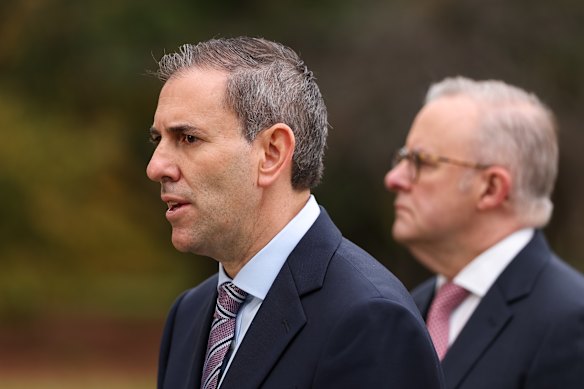
While consultation was always on the cards, Labor’s language has nonetheless softened throughout the week. Assistant Minister for the Digital Economy Andrew Charlton was strongest on this when he addressed the backlash on Nine’s Today show on Friday morning.
“The point that many start-up founders, the point that many small businesses have been making is valid,” he said. “There are real concerns out there … There was a statement in the budget recognising them, and we are consulting on them.”
The government is weighing up its next moves.
Narrow concessions could be on the way, although if Labor wants to ameliorate the broader concerns, it could make bigger exemptions and go close to unwinding its CGT proposals for shares and firms.
But Albanese is not yet persuaded to back down on the broader CGT proposal.
Former Labor leader Bill Shorten told the Inside Politics podcast that Albanese and Chalmers would probably get through the storm. “There’s a lot of noise, a lot of commotion, a lot of fireworks, but I’m not sure that the government’s not winning the argument,” he said.
“The Abbott-Hockey cuts were stuck in the Senate. If Anthony and the Treasurer, Jim Chalmers, were able to negotiate these matters through the Senate in quicker time, the onus of proof changes back to the opposition. Will they repeal these changes? Then it’s a different debate.
“At heart of it, I think if the government sticks to the position that … income is taxed too heavily and that property interests are taxed preferentially too light, I think a lot of Australians will nod their head in agreement”.
Some Labor MPs are rattled at the widespread negative coverage, while others are confident the issue with start-ups will be resolved. The fact that public debate moved on quickly from housing is also being read as a sign the government has won the bigger fight.
Albanese and his allies are calm. They recall the even more ferocious outcry about killing off business investment in the mid-1980s, when Keating decided that capital gains should first be taxed. And the scale of the backlash has not yet hit anywhere the fever pitch of Labor’s last controversial budget, from 2010, when a $40 million campaign by the mining lobby undid all planned tax reforms.
There is also hope inside Labor that this fight will kill off the argument that Albanese lacks ambition. Explaining the decision to go after wealth and benefit workers, one senior party figure said: “This is what Labor is for.”
Start the day with a summary of the day’s most important and interesting stories, analysis and insights. Sign up for our Morning Edition newsletter.


