


Opinion

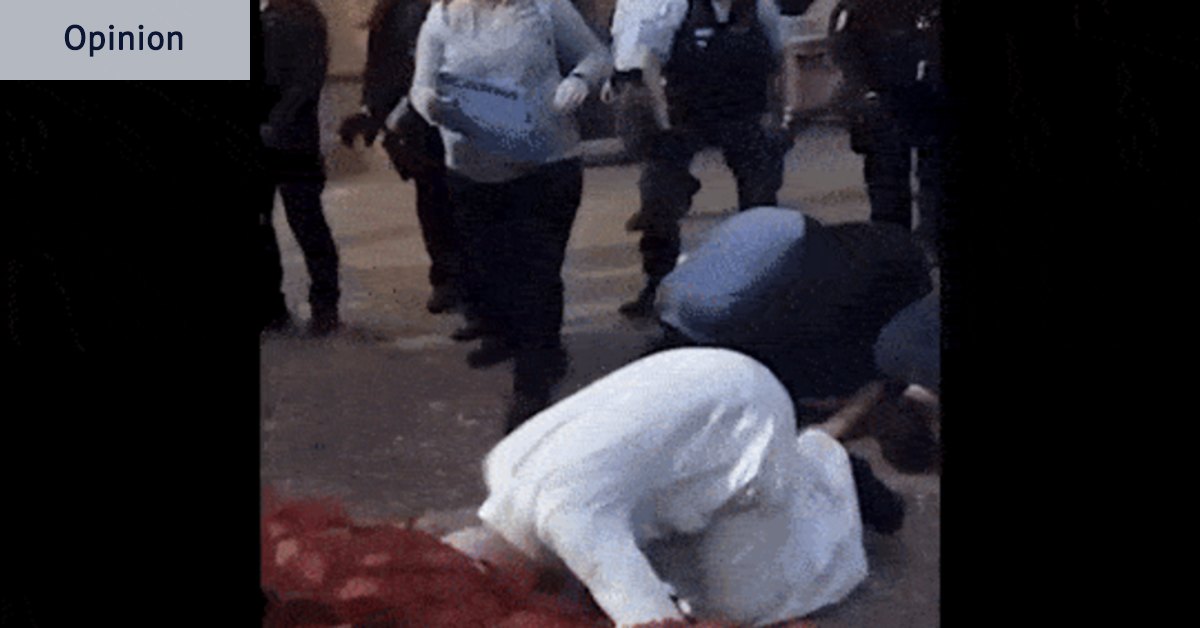
Muslims are obliged to pray five times a day. Sorry to begin with something you likely already know, but it’s relevant context in understanding what we saw this week when video emerged of police shoving and dragging Muslim protesters while they were praying outside Sydney Town Hall.
It’s tempting in this hyper-political moment to assume everything is some kind of political confection, calculated to provoke or propagandise. Some have seen this prayer as a kind of provocation, designed to get a police response.
But what happened here was not remotely so strategic, for reasons that are obvious to anyone familiar with how prayer works in Islam. This wasn’t designed to invite any police response. It’s no more than what it appears. The police response would likely have been a total surprise. And that’s probably why the Muslim community’s response has been so unanimously visceral, demanding an apology and an investigation, threatening legal action.
Muslims don’t merely do these prayers at their whim. They are the single most serious, non-negotiable practice that exists in Islam: the thing that separates belief from disbelief, in the Prophet’s famous description. Those who can’t stand or prostrate as the prayer requires may sit. Those who can’t sit may lie down. Those even more incapacitated than that can reference the various movements by moving their eyes. But you don’t, under any circumstances, abandon it.
The prayers are also scheduled, spaced carefully throughout the day from before sunrise through to the onset of darkness. These are not singular moments, but windows of time determined by the sun’s position, during which the prayer is valid at any time. So for example, in Sydney today, the window for the noon prayer runs for more than four-and-a-half hours, beginning just after 1pm. But this time sensitivity is why every Muslim knows the feeling of being out somewhere, the time closing in, and having to find somewhere to pray urgently: a park, a quiet courtyard, a storeroom. Everyone has a story of a strange place. I once prayed in a stairwell at the MCG. A friend of mine once copped a pin in the eyelid prostrating in a fitting room in some mall or other.
The specific prayer at the protest was the one called maghrib, which begins at sunset. The darkening blue sky makes that plain. It is also, as it happens, the prayer with the shortest window, something around 90 minutes, and therefore the one most likely to put you in this position of having to find somewhere to pray wherever you happen to be. This was therefore not some kind of gratuitous performance. It was not some entirely optional act of stalling or occupying space.
A wide shot shows a generous, open space around them. They’ve chosen what looks to be an unobtrusive place. And judging by the light, time was rushing on. It would help, too, that maghrib is one of the shorter prayers, often done in a few minutes. So, whatever happened before the video starts, it’s unlikely this had been going on very long.
They’re praying together in rows behind an imam because this kind of prayer is meant to be congregational. So important is this that there is a special method to maintain the congregational practice even in dangerous situations like a battlefield: a group keeps watch while the rest pray, and they swap positions through the prayer so each will have taken part in the one congregation. Again, there is nothing deliberately obstructionist about this, and in any event, it probably takes up less room than everyone praying separately.
When praying like this, it is the only thing that exists. It is a total retreat from the world, a kind of spiritual cocoon from which you only emerge upon completion. Until then, you don’t engage your surrounds. You don’t speak to people or respond to them, even with a gesture. You don’t halt it to perform some other task or attend to something. Such things break the prayer, requiring you to start again. You keep your eyes fixed on the ground in front of you. You try to block out everything around you.
Imagine then, what it might be like to dragged and thrown by a police officer while in prostration. This is the climax of the prayer – the posture of ultimate submission, where the head is lower than the heart – where you see nothing of the world, even in your peripheral vision. Do you notice how the rest simply keep praying? They don’t react. This is why.
There is therefore no prospect of them being unruly or a threat. Their act is not only peaceful, but constrained by design. But then: “What you saw last night was chaos in part … The police were restoring order,” said NSW Police Commissioner Mal Lanyon. “It was in effect the middle of a riot,” offered Premier Chris Minns by way of defence. Not around that congregation, it wasn’t.
Whatever else happened that day, as these people prayed they were surrounded by nothing of note: no pushing, no gridlock, no people trying to get past, no resistance, no chaos. In short: order. Unless there is some other astonishing video out there, the chaos here looks entirely initiated by the police. Specifically by two or three officers who chose to use force against people at the moment they adopt the least threatening, most vulnerable posture.
Lanyon and Minns insist there was no intention to cause offence. What exactly, then, was intended? Or was it instead a matter of instinct? Were the police primed to see a threat following months of political heavy-handedness? Or did they just see an inconvenient obstacle; objects to be removed? At this point, in the absence of serious answers, we can only guess. And when you leave people to guess at something like this, having told them not to believe their eyes, you can’t be surprised when they conclude they’ve just been targeted.
Waleed Aly is a broadcaster, author, academic and regular columnist.
The Opinion newsletter is a weekly wrap of views that will challenge, champion and inform your own. Sign up here.
From our partners
