


Singapore/Hat Yai: The family had dealt with floods before. During some of the bigger ones – in 2000 and 2010 – the water had crept into their home.
So when the warnings flashed on social media that their southern Thailand city, Hat Yai, was again to flood, Krongkarn Jantarasavad and her family readied for what they expected would be little more than another costly irritant.
What the city got instead, authorities said, was a one-in-300-year catastrophe.
“We never thought this was going to happen,” Krongkarn, 42, told this masthead from her flooded street during the week.
“Now, we just need to get my dad to the hospital before he dies.”
By Saturday afternoon, the worst floods in Krongkarn’s memory – and anyone else’s, for that matter – had killed at least 145 people and affected 3 million more in Thailand’s southern provinces, according to local media.
Declaring a state of emergency in Hat Yai’s Songkhla province, Thailand’s Prime Minister Anutin Charnvirakul cited the “unprecedented severity” of the damage.
Emergency crews had been rescuing people from the tops of buildings and flooded interiors. Tens of thousands of people fled to official or makeshift shelters, such as hardware stores.
Supermarkets were swept clean of food, and whatever hotels remained opened were fast booked out. Electricity and connectivity was cut.

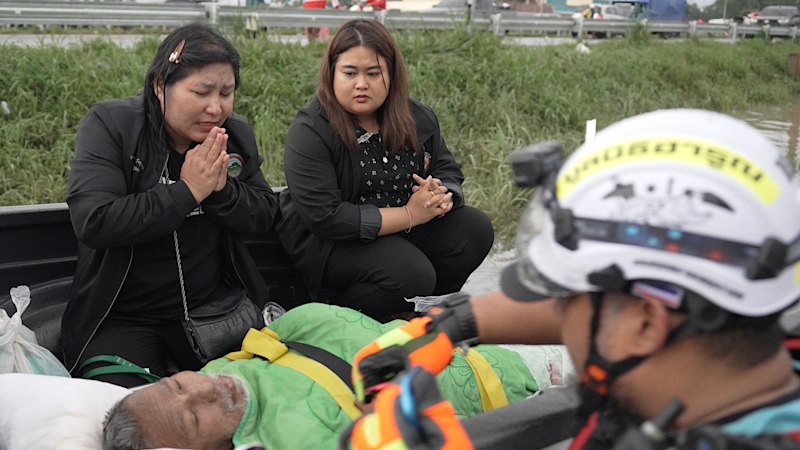
Krongkarn Jantarasavad (left) praying over her father – 76-year-old Damrong Chantarawasat – who missed dialysis treatment because floods had trapped him inside the family home.Credit: Steve Sandford
The flooding is just one of a rash of disasters unfolding concurrently across the vast expanse of South-East Asia.
A rare tropical cyclone that formed over the Malacca Strait barrelled into Indonesia’s Aceh province on November 25, hovering there for a while before doubling back through Malaysia as a rainstorm.
The floods and landslides across the large island of Sumatra are believed to have killed more than 248 people. Days earlier, at least 30 people died on Indonesia’s central island of Java after the region was hit by a different system of torrential rain.
In Vietnam, storms this year are estimated to have caused at least US$3 billion ($4.6 billion) in damage. Most recently, flooding in the central regions last week killed more than 90 people. Much of that rain was delivered from Typhoon Kalmaegi, which had killed more than 200 people in the Philippines.

A resident returns to what remains of a home after Typhoon Kalmaegi devastated communities in Talisay, Philippines, this month.Credit: AP
In Hat Yai, southern Thailand’s tourism and commerce hub, more than 630 millimetres of rain fell in three days from November 19.
By November 22, turgid water had reached the second floor of Krongkarn’s suburban home, trapping her elderly parents, sister, brother-in-law and a niece and nephew – both toddlers – inside.
This masthead found Krongkarn shortly after she had made it back to Hat Yai – and to her ill 76-year-old father, Damrong Chantarawasat – from a neighbouring area where she had been working.
“My dad is a bedridden patient and needed to get kidney dialysis last Saturday, but he couldn’t get out from the house,” she said.
“Today, his condition is very bad – he can’t wait any more. My sister called me to get him evacuated immediately.
“The Hat Yai hospital that we were supposed to go to is flooded as well. They told us their patients had to be evacuated and that I would have to take him to Rattaphum hospital instead.
“We checked and found out that the road to Rattaphum was also flooded.”
Mercifully, a rescue boat was able to collect Damrong. The latest update from Krongkarn was that he remained in a critical condition in hospital.
The north-east monsoon season, typically from November to February, corresponds with wetter months in the southern portion of South-East Asia.
Hat Yai’s extreme rain may have also been influenced by a La Nina at the same time as a negative Indian Ocean Dipole, according to the Singapore-based ASEAN Specialised Meteorological Centre.
But that phenomenon is not unusual. The last time they coincided was in 2022.
“Intra-seasonal variability also plays a significant role in influencing the region’s actual rainfall patterns,” said a spokesman for the centre.
Meteorologists have suggested the extreme weather in South-East Asia could be from the interplay of Typhoon Koto in the Philippines and Cyclone Senyar in the Malacca Strait.
Then, of course, there is climate change.

A family receives water from relief workers in Hat Yai.Credit: Steve Sandford
Asia’s average temperature in 2024 was about 1.04 degrees above the 1991–2020 average, ranking as the warmest or second-warmest year on record, depending on the dataset, according to the World Meteorological Organisation.
The changes make predicting the weather even harder.
Flood mitigation works in South-East Asia – an area exposed to future sea-level rises – have not always kept pace with the increased threat of sudden, unpredictable and extreme weather.
“While South-East Asia has experienced a clear warming trend due to climate change, it is more challenging to identify such trends in the region’s rainfall as it is highly variable,” the ASEAN Specialised Meteorological Centre spokesman said.
The centre’s projections suggest wettest and hottest day records throughout South-East Asia as the century rolls on, courtesy of climate change.
As this month shows, the region is also particularly vulnerable to typhoons: Scientists believe global warming may increase their intensity, but not necessarily frequency.

Flood victims clamber for aid in Hat Yai.Credit: Steve Sandford
As the water recedes in Hat Yai, revealing mud-caked cars and sludged-out shops, climate change is on people’s lips.
“Normally, we have three seasons – hot, rain and cold. But our seasons have changed. They are not stable,” said Teerapat Kutchamath, the director-general of Thailand’s Department of Disaster Prevention and Mitigation.
“This might be from the climate change that is affecting the world.”
Teerapat had just returned from a helicopter ride over Hat Yai to survey the damage and help distribute water, instant noodles and milk to the tens of thousands of people made homeless by the floods.
“In the past two years, Thailand has experienced drought. The farmers have been impacted – there has not been enough water for their crops. Now there is rain and flooding,” he said.
“Thailand is facing more storms like this.”

Displaced people at a gymnasium in Hat Yai during the week. It is being used as an evacuation centre where thousands are taking shelter. Credit: Getty Images
Get a note directly from our foreign correspondents on what’s making headlines around the world. Sign up for our weekly What in the World newsletter.
