


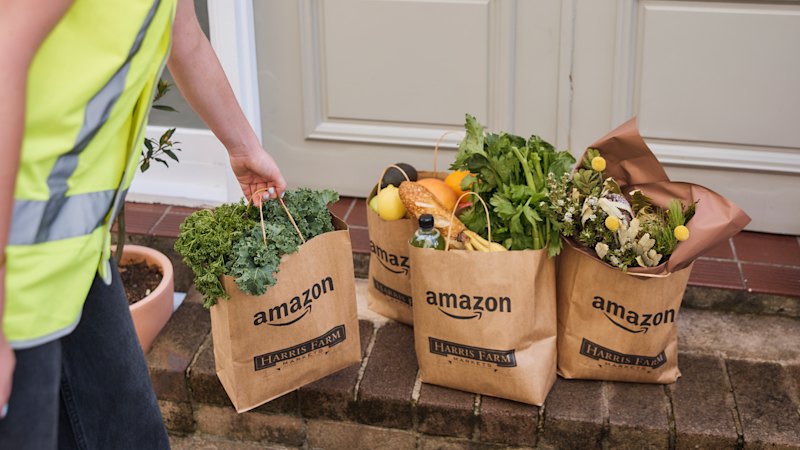

Amazon has made its first foray into fresh produce deliveries after striking a partnership with premium grocery chain Harris Farm, putting the international megastore into direct competition with Coles’ and Woolworths’ core products.
From Wednesday, Sydneysiders in 80 suburbs will be able to buy thousands of items across Harris Farm’s fresh produce, bakery, butcher and fish market range, with the only exception of frozen food, through the upmarket retailer’s page on Amazon’s website.
Arno Lenior, Amazon Asia Pacific’s director of its Prime subscription shopping program, said the company’s essentials category had been growing rapidly. “It has seen more than 30 per cent growth year-on-year,” Lenior said.
The partnership took more than a year to seal after Amazon noticed its customers were buying other items such as pantry goods and personal care products. “Fresh food was the missing piece, and now they can do a complete grocery shop on Amazon,” Lenior said.
Customers will be able to select their two-hour delivery window for same-day or next-day delivery or choose an unattended delivery option. Amazon Prime members will receive free shipping on orders over $100. Non-Prime members will get free shipping on orders exceeding $200. Orders below that threshold will be charged a flat $15 delivery fee.
Harris Farm products would be charged at a 10 per cent premium on in-store prices, said co-chief executive Angus Harris.
Founded in 1971, Harris Farm Markets is a family-owned grocery chain that provides an upmarket alternative to Coles and Woolworths by offering a farmers’ market experience and boutique products sourced from local farmers and suppliers. It has since expanded to a network of nearly 40 stores, most of which are in NSW.
By contrast, Amazon is a $US2.55 trillion ($3.6 trillion) conglomerate with about 1.5 million employees around the world and a corporate image as a business so efficient it is sometimes accused of ruthlessness.
Harris Farm operates its own online store and offers deliveries through Uber, but it had to also partner with Amazon for its focus on customer experience, said Harris.
“We think it will help amplify the Harris Farm brand across a greater area than we can currently serve,” he said.
Orders placed through Amazon will be fulfilled through the Leichhardt store in Sydney’s inner west and then delivered by Amazon Flex workers, who are contractors allotted a specific slot to make deliveries. That model has come under pressure from unions concerned about worker conditions.
Retail consultant Trent Rigby predicted the partnership would benefit both parties, and had parallels with the Amazon US purchase of Whole Foods nine years ago.
“I personally think that the brand contrast between Amazon and Harris Farm will be seen as a feature, not a flaw,” said Rigby, a director of RCA Advisory. “Amazon is primarily associated with convenience, value and speed. Harris Farm stands for premium quality, fresh produce and local sourcing.
“This is a similar dynamic to Amazon and Whole Foods in the US, where a premium grocery brand helped elevate Amazon’s credentials in fresh food rather than dilute them. The separation allows each brand to play to its strengths while appealing to higher-value grocery customers.”
Harris said Amazon’s brand was a boon. “We think the shopping mission that will be fulfilled by Amazon won’t be a disappointment to anyone,” he said. “We think it will be a great addition and help us reach more customers.”
Both parties intended to roll out across more Sydney stores after “getting the experience right for our customers”, said Amazon’s Lenior.
Offering fresh produce through Harris Farm addresses a major category gap for the US e-commerce giant and could further shake up competition dynamics in the supermarket sector. High inflation and cost-of-living pressures led Australians, who are increasingly buying online and in bulk, to travel further and spread their shop across multiple retailers, including Bunnings, Costco, Chemist Warehouse and Amazon, although this trend is showing some signs of reversal.
In late 2024, the ACCC’s supermarket inquiry heard that Amazon covers about 40 per cent of Woolworths’ total sales. Coles chief executive Leah Weckert has described Amazon as “quite disruptive to our business model”.
Amazon’s partnership with Harris Farm adds new competition in the food delivery sector following Menulog’s exit from the Australian market, which has left a small and increasingly concentrated market of Uber Eats, DoorDash and smaller players such as Hungry Panda that predominantly service the Asian demographic. DoorDash has made significant inroads in the grocery sector through recent partnerships with Costco and Aldi.
In the online grocery space, where sales have doubled since before COVID and now account for about 30 per cent of Coles’ and Woolworths’ total sales, delivery speed was shaping up as a critical frontier and moving towards two-hour windows, Rigby said, where Amazon had the advantage.
“No way do I think this Harris Farm-Amazon partnership will overtake the scale of both Woolies or Coles, but it now positions both Amazon [and] Harris Farm as a serious player in the fresh space,” he said.
The Business Briefing newsletter delivers major stories, exclusive coverage and expert opinion. Sign up to get it every weekday morning.
 Jessica Yun is a business reporter covering retail and food for The Sydney Morning Herald and The Age.Connect via X or email.