









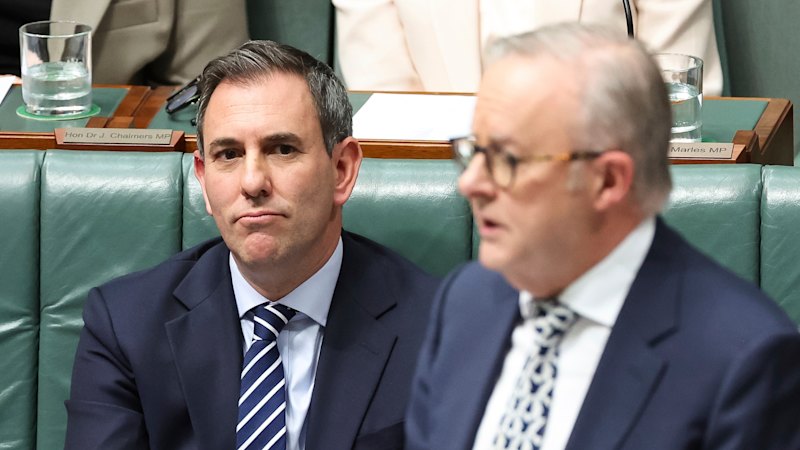


Treasurer Jim Chalmers is being urged by the International Monetary Fund to use his May budget to embrace far-reaching tax reform including an increase in the GST, overhauling the capital gains tax and cutting company tax to lift living standards and get the economy growing faster.
In its annual examination of the economy and interest rates, the fund also warned that state and territory spending on big builds and other expenses is a growing risk, recommending the most significant change to federal-state financial relations in a generation.
Chalmers has signalled the May 12 budget will contain a series of spending cuts, tax reforms and a productivity agenda aimed at lifting the speed at which the economy can grow without adding to inflation pressures.
The government is already expected to reduce the 50 per cent concession for the capital gains tax, which many tax experts have argued has distorted the property market and investor decisions since then prime minister John Howard introduced it 1999.
The IMF said while the Australian economy had achieved a “soft landing” after a sharp rise in interest rates to deal with post-pandemic inflation, the government had to look at ways to lift overall economic growth and productivity.
The fund, a specialised agency of the United Nations, said structural changes, including axing red tape, industrial relations reform and prioritising infrastructure with large economic benefits, had to be on the government’s agenda as well as spending cuts.
It also urged comprehensive changes to the tax system including an increase in the rate of the 10 per cent GST, ending some of the exemptions (which include the financial system, fresh food and education), a cut in the company tax rate, higher taxes on resources and the end of concessions such as those that apply to the capital gains tax.
“A high reliance on direct taxes and a relatively high effective cost of capital hinders investment and productivity growth and suggest there is scope for tax reform,” it said.
“A comprehensive reform package should aim at improving the efficiency, equity, and sustainability of the tax system.
“Tax breaks, including superannuation concessions and capital gains tax discount, could be phased out to generate a more equitable and efficient tax system.”
While there is strong support among tax experts to wind-back the CGT concession, new Liberal deputy leader Jane Hume on Sunday said such a move would be a disaster, especially for first time buyers and renters.
“If you tax residential housing, there will be less of it,” she said.
This masthead revealed last year that pressures on the federation are growing as the states and territories struggle to meet their spending commitments while also building the infrastructure necessary for their economies to grow.
In some of its strongest ever commentary on the Australian federation, the IMF said while the federal budget was recovering there were deep problems at state and territory level.
Recommending a review of the entire Commonwealth’s tax and spending policies, it warned the sharp lift in state and territory debt could ultimately hurt the federal budget bottom line.
“Should state spending continue to accelerate, risks include inefficiency due to rising construction costs and additional credit rating downgrades leading to higher interest expenses,” it warned.
“As the Commonwealth is viewed as a de facto guarantor of state debt by some credit rating agencies, higher sub-national debt could eventually impact Commonwealth borrowing costs.”
It urged changes including an increase in the GST to enable states to axe stamp duty on property sales and coordination between the states on large infrastructure projects to prevent cost blow-outs. Coordination of projects would take federal-state relations back to the mid-1980s when Canberra had much more control over state budgets.
The fund said the government’s expansion of the 5 per cent deposit program for first time home buyers “may contribute to price pressures” as people were able to bring forward their purchase plans.
It said the states should relax what it described as “stringent zoning and building restrictions”, fast-track home approval and land release programs while the federal government should review taxes that affected housing demand and investment.
Savings from winding back property speculation could go back towards infrastructure for new homes.
The IMF’s outlook for the Australian economy is more upbeat than the Reserve Bank’s most recent forecasts.
It is tipping the economy to expand by 2.1 per cent this year, reaching $3 trillion, followed by growth of 2.2 per cent in 2027. The Reserve Bank believes growth will be much more subdued, at 1.8 per cent and 1.6 per cent respectively.
The growth, according to the fund, will be driven by the private sector. Private investment is forecast to grow by 2 per cent this year compared to 0.4 per cent for public investment. Household spending, which accounts for more than half of all economic activity, is expected to grow by 2.5 per cent this year and next after reaching only 2 per cent through 2025.
The fund is also optimistic inflation will ease, falling from 3.4 per cent this year to 2.7 per cent in 2027.
Chalmers said the report, which noted budget policy had “appropriately” sought to balance spending cuts with boosting productivity, was vindication of the government’s economic policies.
He signalled addressing inflation and productivity would be key elements of the May budget.
“Under Labor, economic growth is picking up, business investment is strengthening, unemployment is low, participation is at near record highs, wages are growing, debt is down and the budget is stronger but we know there are big challenges too,” he said.
Cut through the noise of federal politics with news, views and expert analysis. Subscribers can sign up to our weekly Inside Politics newsletter.


