


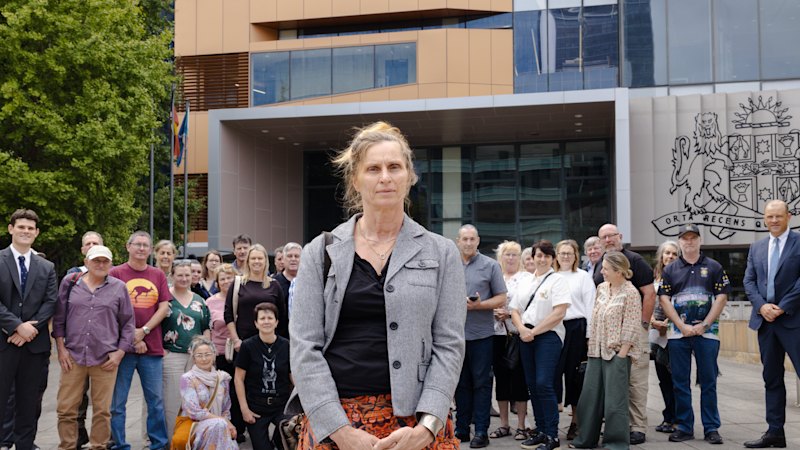

A former wildlife carer has been cleared of all charges of animal cruelty, five years and five days after WIRES and the RSPCA raided her Blue Mountains property and seized three kangaroos in her care.
Tracy Clare Dods, 56, of Kanimbla won her appeal in the Parramatta District Court on Friday, quashing the criminal conviction and sentence that included a ban on owning animals for five years. About 60 supporters from around the state, many of them fellow wildlife carers, travelled to the court for the judgment.
In a lengthy decision, Judge Nanette Williams criticised WIRES and RSPCA officers for behaviour that was “at times aggressive” during the unannounced visit in March 2021, and noted the RSPCA as the prosecuting authority had failed to call crucial witnesses to prove its case beyond reasonable doubt.
The decision overturns the earlier verdict in Katoomba Local Court last March that Dods was guilty of aggravated animal cruelty for not taking Dolores, a female eastern grey kangaroo with injuries from a barbed wire fence, to a veterinarian between February 20 and March 8, 2021.
WIRES veterinarian Dr David Phalen, who attended the raid alongside RSPCA inspector Anthony Croker, testified in the lower court that the animal would have been in constant pain and significant distress.
After he euthanised the kangaroo, he conducted a post-mortem and found a fracture in the right leg. If that injury had been known when the kangaroo first came into care, it would have been euthanised immediately, but an X-ray at the initial examination at Nepean Animal Hospital in October 2020 did not pick it up.
To make out its case, the RSPCA needed to prove that the animal needed to see a veterinarian, that it was cruel not to do so, and that Dods did not have an honestly held and reasonable belief that she was doing the right thing.
The lower court found Dods was not intentionally cruel, but her belief was not reasonably held because she overestimated her own abilities.
Williams overturned that judgment, finding that there were key events in the timeline between the animal entering her care in October 2020 and being seized in March 2021 that upheld the reasonableness of Dods’ belief that her care was adequate.
Since she was told there was no fracture, Dods treated Dolores as an animal with a typical fence-hanging injury, focusing on wound care. The judge found this was reasonable because it was in accordance with her training.
Williams allowed evidence from wildlife carer and trainer Dr Rosemary Austen about the nature of that training, who testified that recovery could take a long time and muscle wastage, even severe muscle wastage, was expected. The lower court had not allowed Austen to appear as an expert witness.
Williams also put considerable weight on the fact that Dods took Dolores to a veterinarian in Hartley at the end of January 2021 when she noticed swelling around the wounds. She found the magistrate had discounted this evidence, setting more store in the opinion of Phalen, whose testimony described Dods as “running the show” by telling the vet what was needed rather than allowing a full examination.
However, Williams said the RSPCA presented no evidence that this was the case, and did not call on this veterinarian as a witness, leaving the written notes as the only evidence. Williams found the vet would have had the chance to examine, diagnose, prescribe antibiotics and advise Dods, and did not raise concerns about the animal’s welfare, again making it reasonable for Dods to believe her care was adequate.
The next key event was a Zoom call on February 21 between WIRES staff including Phalen and Dods. Williams said Dods was not cautioned that it was an evidence-gathering exercise, and it was clear from her demeanour and behaviour that she thought it was a routine case management review. Dods’ participation was “well-meaning”, answering all questions in a “candid, co-operative and polite” manner, offering to send photographs and video and later following through on that offer, the judge said.
The judge accepted the Zoom call also added to the reasonableness of Dods’ belief that she was caring correctly for Dolores, noting Dods had asked Phalen for general advice about macropod care and he declined to answer, and that no one on that call raised concerns about the animal’s wellbeing or Dods’ care of it.
In the 13 days that followed before the authorities “turned up unannounced”, Williams said, “there was effective radio silence”, also adding to the reasonableness of Dods’ belief.
The body-worn camera footage of that visit was evidence in the trial, and Williams found it was effectively a cross-examination that was “at times aggressive”, but Dods remained “calm, co-operative and obliging to authorities”. Williams said she might have disallowed this evidence had the defence had challenged it.
Outside the court, Dods said she was relieved and looking forward to putting it behind her. She said she became a wildlife carer because she loved animals and couldn’t have children, but would be too frightened to ever do it again.
“I am in therapy and I still get panic attacks when a vehicle drives on to my property,” Dods said. “When I see the RSPCA logo, I feel fear and anger.”
An RSPCA spokesperson said the organisation was “naturally disappointed” by the outcome and would assess its options after carefully reviewing the judgment.
A hearing for costs is set down for June 5. Dods said she had spent about $140,000 defending herself, and had raised about $40,000 in crowdfunding from GoFundMe.
Get to the heart of what’s happening with climate change and the environment. Sign up for our fortnightly Environment newsletter.
 Caitlin Fitzsimmons is the environment and climate reporter for The Sydney Morning Herald. She was previously the social affairs reporter and the Money editor.Connect via email.