


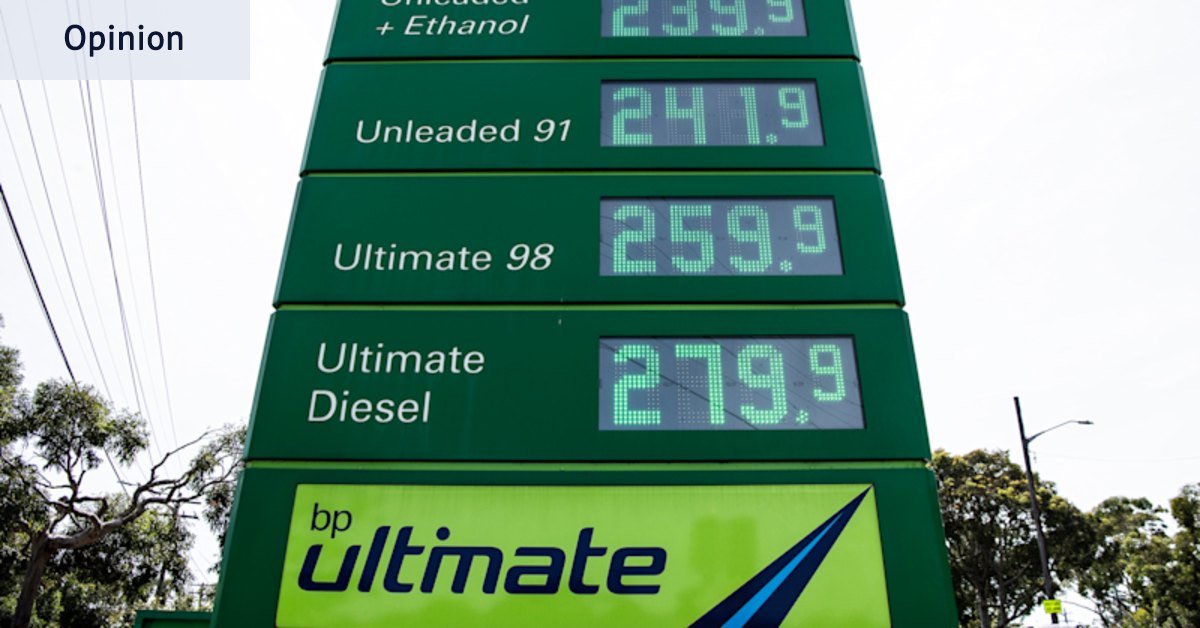
If the community is expecting that the Australian Competition and Consumer Commission (ACCC) will ride in to save Australians from being “price gouged” on petrol, here is a bulletin – it can’t.
There is nothing in consumer law that places any restrictions on what petrol retailers can charge, so despite the bluster and rhetoric about bringing them to task over the massive rise in the costs of fuel, this issue is mostly outside the ACCC’s jurisdiction.
The numbers don’t lie. Sure, the international crude oil price has skyrocketed since Donald Trump’s war on Iran began two and a half weeks ago, but the increase at the bowser has been proportionately larger than the oil price.
Some of this disparity can be explained away by costs associated with the supply chain that lead to higher wholesale prices. But not all, so the evidence suggests that plenty of retailers are “profiteering” or increasing their margins. But that’s because they can legally do so.
Consumer behaviour is also enabling the petrol retailers’ behaviour. Panic buying, particularly in regional areas, is putting some strain on availability – which in turn encourages petrol retailers to lift prices. (A cursory online look at jerrycan availability at Supercheap Auto showed the four stores closest to me were sold out.) Consumers appear to be ignoring pleas from the Energy Minister Chris Bowen, who said it was un-Australian for people to buy more fuel than they needed.
So what consumers brand with the emotive term of “gouging” or “profiteering” is what economists describe as the operation of supply and demand.
Despite headlines heralding the ACCC’s urgent meeting on Tuesday with industry representatives, including big retailers, for a dressing down, the law doesn’t provide much scope for the regulator to introduce a big stick.
There are a couple of exceptions: The ACCC can act if it finds any evidence that any operators are colluding on price – which is against the law.
The second area is petrol retailers misleading consumers, which would include advertised or billboard prices being lower than prices actually charged or even target retailers that mislead customers on why they have increased prices.
The other stick in the ACCC’s arsenal would be a name and shame exercise – which it has used effectively in the past. Additionally, the consumer watchdog provides a service to consumers by publishing petrol prices – as do numerous non-official websites.
And while this ACCC gathering with the industry has been characterised as an emergency meeting, it is actually one of the twice-yearly regular meetings with industry participants which has been brought forward.
I am not suggesting that the ACCC isn’t trying its best to understand the retail industry’s profit margins, just that it can’t dictate prices. There are no legislated caps on petrol prices.
Instead, the ACCC is attempting to use suasion to keep the behaviour of retailers under the public eye.
It will take the more practical step of allowing competitors to collude in order to overcome the uneven supply to particular markets like regional areas.
The reality is that petrol retailers are like any other business that will try to maximise their profits and use every opportunity to do so.
It is noteworthy that the average city petrol price at the bowser did not fall after the government released additional reserves a few days ago.
Meanwhile, it isn’t just the cost of petrol playing into consumer cost-of-living strains.
Every 10¢ per litre increase in petrol prices adds a $1.6 billion annual cost to consumers, according to Citi’s number crunching.
This is almost as much as the $1.8 billion cost of a 25 basis-point increase in the interest rate – which borrowers are set to endure following the Reserve Bank’s decision on Tuesday.
Therefore, given current national average fuel pricing (which has gone up around 60¢ per litre), Citi estimates, “An annualised incremental cost to consumers of ~$6-7 billion relative to average fuel pricing for the six months prior to the conflict.”
This, Citi says, would be a far more meaningful detractor to household spending capacity than the rate hikes, of which there may be one more this year.
Then again, if the Middle Eastern war is concluded in the next month, the petrol pain will be over. But it will take much longer for interest rates to come down.
The Business Briefing newsletter delivers major stories, exclusive coverage and expert opinion. Sign up to get it every weekday morning.
