


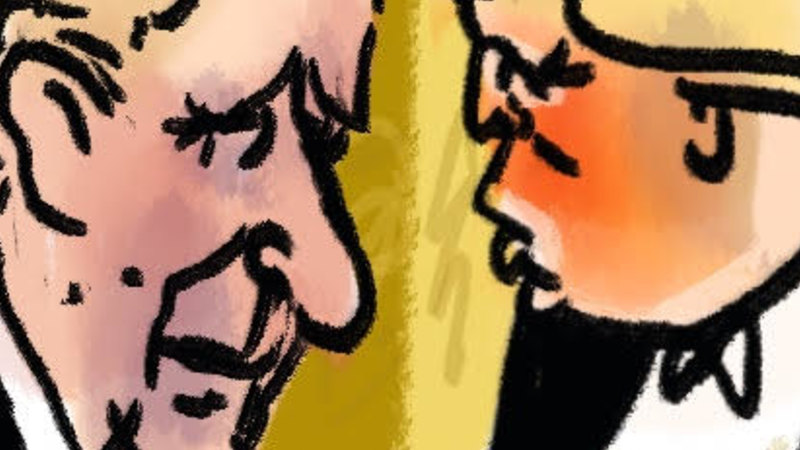








You start one war – and you break everything.
The immediate impact of the war, and the closure of the Strait of Hormuz, is obvious in the Bureau of Statistics’ March monthly inflation report.
Inflation jumped to a three-year high of 4.6 per cent. But if oil prices – which had fallen through January and February – had simply remained flat through March then the annual rate of inflation would have fallen to 3.4 per cent.
In March alone, instead of a 1.1 per cent increase in inflation, overall prices would have been flat.
That’s the price being paid by all of us because of Donald Trump and Benjamin Netanyahu’s foray into Iran.
And this was just in March. The flow-on impact of the sharp increase in fuel prices had yet to hit prices across closely connected areas.
For instance, the cost of domestic and international travel fell by 1.5 per cent and 0.2 per cent, respectively. Anyone who has tried to get a flight within or from Australia recently would know that’s just a fiction.
Closer to home, the cost of milk climbed by 0.6 per cent last month. But that was before supermarkets lifted their prices to cover the transport and production cost increases hitting trucking companies and dairy farmers.
Cheese prices actually dropped in March. That late-night cheese toastie is not going to get cheaper any time soon.
That’s just fuel costs. Farmers in the northern hemisphere are already dealing with sky-high fertiliser prices if, or when, they can get access to the stuff. Spring plantings of rice, wheat and maize are all going to struggle without an influx of fertiliser, meaning a jump in food prices later in the year.
Australian farmers are not far away from confronting the same sort of issues.
Outwardly, a sharp increase in both headline and underlying inflation, which remained steady at 3.3 per cent but has to lift in coming months, would mean the result of next week’s Reserve Bank meeting was all but locked in.
Yet, after the figures, all financial markets downgraded their expectations of a quarter percentage point hike on May 5.
There were a number of reasons for that counterintuitive market reaction.
The first is that inflation was not as bad as feared. Yep, it was a bad result, but markets had expected worse.
The sharp jump in inflation occurred before the Reserve Bank’s second rate rise of 2026 flowed through to the nation’s army of mortgage holders in late March. February’s rate hike has barely started working its way through the economy.
That’s a half percentage point of pain that is just sitting there, ready to wallop mortgage holders being mugged by higher war-induced inflation.
Confidence among consumers and business is around or even lower than that measured during the COVID pandemic. No retailer reckons a shopper scared out of their wits is going to open wide their wallet.
Every analyst is also tipping an increase in unemployment in coming months. Westpac this week said it would reach around 5 per cent by year’s end. That’s an extra 120,000 people out of work.
Anyone who thinks there’s more chance of Donald Trump saying sorry than of the Reserve Bank holding rates steady next week should revisit last month’s interest rate decision.
It was a 5-4 vote to take the cash rate to 4.1 per cent.
The minutes of that meeting noted that all nine attendees agreed that it was impossible to predict future rate movements “with any confidence given the high degree of uncertainty around the breadth and duration of the current conflict in the Middle East”.
“A longer conflict could have a material bearing on both inflation and economic activity.”
The rate hike of that meeting was announced on March 17. Donald Trump later assured the world that the war would be “largely over in two or three days”. While the US wasn’t ready to leave the region just yet, it would occur in the “very near future”.
That was more than a month ago. The Strait of Hormuz is now being blockaded by both Iran and the US. Oil prices are back where they were, around $US110 a barrel, when Trump announced a two-week ceasefire.
No one is talking about an end to the conflict, and a reopening of the strait, any time soon.
The conflict has dragged on. That means chances of a “material bearing on both inflation and economic activity” have increased, not decreased.
There’s a reason other central banks are currently sitting pat on their interest rate settings. The uncertainty caused by Trump’s war is growing, not easing.
And that’s a big problem for the Reserve Bank and the members of its monetary policy setting committee. And anyone who happens to have a mortgage, drives a car, runs a business, wants a holiday or enjoys cheese toasties.
Cut through the noise of federal politics with news, views and expert analysis. Subscribers can sign up to our weekly Inside Politics newsletter.


