











The son of a western suburbs farmer who was awarded almost $28 million for the acquisition of his land for a road reserve says the state government tied up his family in a years-long legal battle to deny them proper compensation.
Jeffrey Barrett of Manor Lakes was last week awarded $27.92 million compensation in the Supreme Court for the acquisition of part of his peri-urban property for the Outer Metropolitan Ring Road, a proposed 100-kilometre, estimated $31 billion orbital freeway through Melbourne’s west and north.
The Victorian Department of Transport and Planning initially made no offer for Barrett’s land, where he farms sheep and some cattle. The government then offered him “$0.00” for his financial loss after he took the government to court, denying that he was entitled to any compensation, before amending its offer to $18.65 million years later.
Barrett rejected the amended offer but scaled back his claim from $31.31 million to $28.27 million.
The court made its decision mostly in favour of Barrett, who is now in his 70s, on March 26, precisely six years after he applied to Wyndham City Council to subdivide part of his rural property for housing, and awarded costs on April 1.
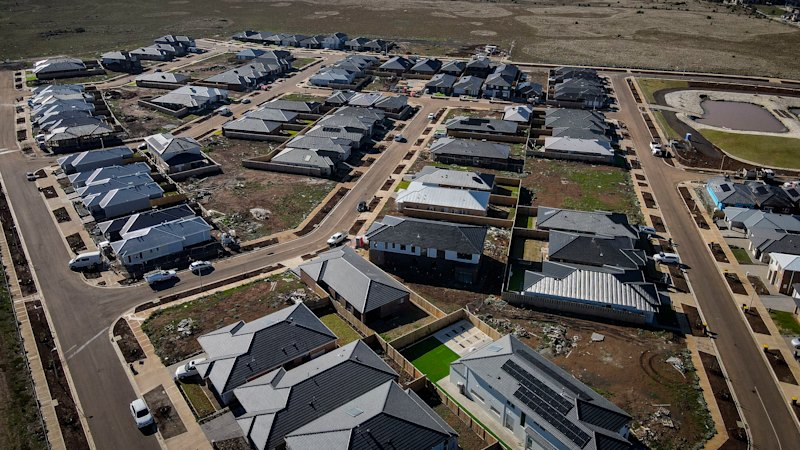
Brett Barrett, Jeffrey’s son, grew up on the Manor Lakes farm that the ring road would one day bisect and now oversees developing part of it into the Winterset Lodge greenfields housing estate.
Brett Barrett said his family stood firm and spent large in its “daunting” pursuit of compensation but said many other families with fewer means would probably have buckled during such a drawn-out legal contest against the state.
“I think it’s disappointing that the process isn’t more streamlined,” Barrett said. “I think it’s very hard on people who are ultimately losing their homes and then they have to spend years in court to move on with life.”
The planned outer ring road passes through more than 600 properties on Melbourne’s fringe. The Victorian government had already spent at least $350 million compensating landowners along the corridor before the latest Supreme Court ruling, and could ultimately pay out $2.7 billion, government planning documents suggest.
Brett Barrett said the government’s approach of rejecting the family’s first claim for compensation in 2021 before making an offer during the court case in 2025, would be excessively costly and time-consuming for most landowners along the corridor.
“Not a lot of people have got that fight,” he said.
“I know a lot of farmers, and they’re not doing that. They’re elderly guys that just feed their cows each day; are they meant to spend millions on legal fees and have it drag out for years?”
The former Brumby Labor government first placed a public acquisition overlay on the outer metropolitan ring corridor in 2010, but no state government has yet committed to the project.
Infrastructure Australia identified it on its 2026 priority list as a potential project to be placed in a five- to 10-year pipeline for investment.
The road and rail project, which arcs across the fastest-growing parts of the city, supports Melbourne’s long-term projected population and freight growth, and would connect transport hubs including Melbourne and Avalon airports, the Port of Geelong and intermodal terminals in Beveridge and Truganina, the assessment states.
The Age revealed last year that Victorian transport planners had urged the government to accelerate the mega-project or risk having congestion in the north and west of Melbourne throttle the state’s economic productivity.
They argued that population growth in the city’s north and west was so rapid that the timeline for starting the first stage of the project should be brought forward at least five years to 2031. The first stage would connect the Hume Freeway in Beveridge with the M80 Ring Road in Thomastown, easing pressure on the increasingly congested Hume. The link would eventually extend to west of Werribee.
The matter was presided over by Supreme Court Justice Claire Harris, who assessed Barrett’s financial loss “as a natural, direct and reasonable consequence of the subject land being reserved by [public acquisition] for the purpose of the OMR as $27,925,000”.
During her ruling on costs, delivered on April 1, Harris said the Land Acquisition and Compensation Act is “intended primarily to be a non-litigious administrative process”.
Harris said in her decision that the department had initially taken an unreasonable position in negotiating the acquisition.
“It was unreasonable of the authority to make no offer in reliance initially on a position that no financial loss was caused and no liability to compensation arose,” Harris said.
“Even on conceding that it no longer relied on a submission that no liability to compensation arose, it didn’t make an offer of compensation until a year later.”
Harris ruled that Barrett also contributed to delays in the matter, by introducing new evidence on hydrology and cultural heritage just before the planned start of a hearing in September 2024, leading to a nine-month adjournment.
A Victorian government spokesperson said the Department of Transport and Planning is reviewing the judgment made on March 26 and will consider its response through the standard process.
The spokesperson said it would be inappropriate to comment on an active legal matter.
The state and federal governments allocated a combined $20 million for a business case for the OMR in 2021. The government said the cost of acquisition of land along the corridor was commercial in confidence.
Start the day with a summary of the day’s most important and interesting stories, analysis and insights. Sign up for our Morning Edition newsletter.


